


Transgenic mice expressing an inhibitory truncated form of p300 exhibit long-term memory deficits
- PMID: 17761541
- PMCID: PMC1994075
- DOI: 10.1101/lm.656907
Transgenic mice expressing an inhibitory truncated form of p300 exhibit long-term memory deficits
Abstract
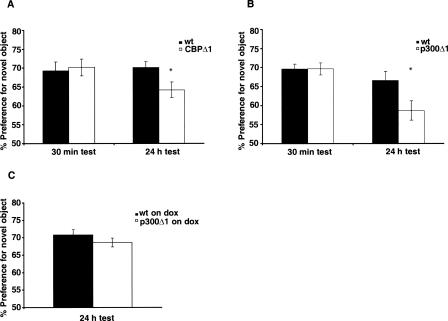
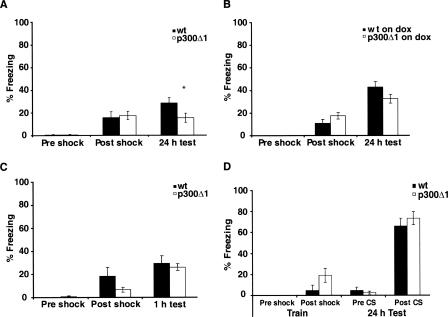
The formation of many forms of long-term memory requires several molecular mechanisms including regulation of gene expression. The mechanisms directing transcription require not only activation of individual transcription factors but also recruitment of transcriptional coactivators. CBP and p300 are transcriptional coactivators that interact with a large number of transcription factors and regulate transcription through multiple mechanisms, including an intrinsic histone acetyltransferase (HAT) activity. HAT activity mediates acetylation of lysine residues on the amino-terminal tails of histone proteins, thereby increasing DNA accessibility for transcription factors to activate gene expression. CBP has been shown to play an important role in long-term memory formation. We have investigated whether p300 is also required for certain forms of memory. p300 shares a high degree of homology with CBP and has been shown to interact with transcription factors known to be critical for long-term memory formation. Here we demonstrate that conditional transgenic mice expressing an inhibitory truncated form of p300 (p300Delta1), which lacks the carboxy-terminal HAT and activation domains, have impaired long-term recognition memory and contextual fear memory. Thus, our study demonstrates that p300 is required for certain forms of memory and that the HAT and carboxy-terminal domains play a critical role.
Figures
References
-
- Abel T., Nguyen P.V., Barad M., Deuel T.A., Kandel E.R., Bourtchouladze R. Genetic demonstration of a role for PKA in the late phase of LTP and in hippocampus-based long-term memory. Cell. 1997;88:615–626. - PubMed
-
- Alarcon J.M., Malleret G., Touzani K., Vronskaya S., Ishii S., Kandel E.R., Barco A. Chromatin acetylation, memory, and LTP are impaired in CBP+/− mice: A model for the cognitive deficit in Rubinstein-Taybi syndrome and its amelioration. Neuron. 2004;42:947–959. - PubMed
-
- Bailey D.J., Kim J.J., Sun W., Thompson R.F., Helmstetter F.J. Acquisition of fear conditioning in rats requires the synthesis of mRNA in the amygdala. Behav. Neurosci. 1999;113:276–282. - PubMed
Publication types
MeSH terms
Substances
LinkOut - more resources
Full Text Sources
Medical
Molecular Biology Databases
Miscellaneous