


The importance of barley genetics and domestication in a global perspective
- PMID: 17761690
- PMCID: PMC2759206
- DOI: 10.1093/aob/mcm139
The importance of barley genetics and domestication in a global perspective
Abstract
Background: Archaeological evidence has revealed that barley (Hordeum vulgare) is one of the oldest crops used by ancient farmers. Studies of the time and place of barley domestication may help in understanding ancient human civilization.
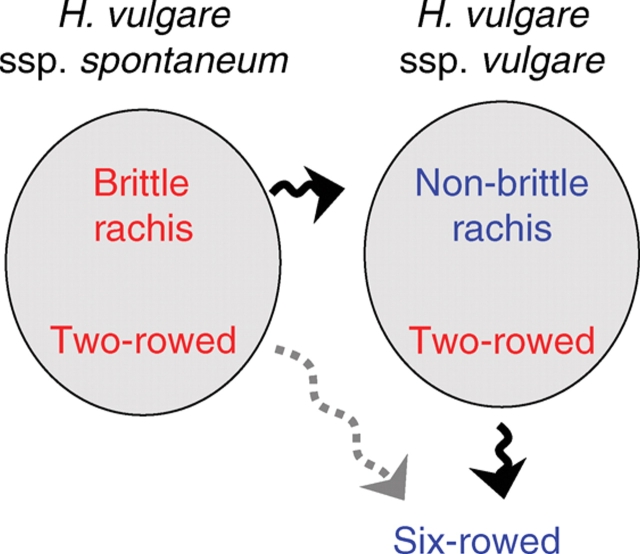
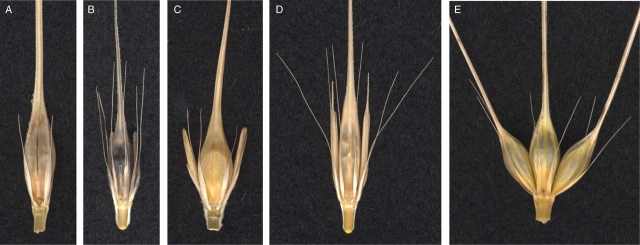
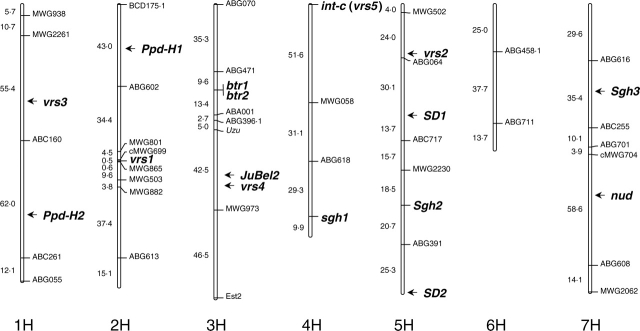
Scope: The studies of domesticated genes in crops have uncovered the mechanisms which converted wild and unpromising wild species to the most important food for humans. In addition to archaeological studies, molecular studies are finding new insights into the process of domestication. Throughout the process of barley domestication human selection on wild species resulted in plants with more harvestable seeds. One of the remarkable changes during barley domestications was the appearance of six-rowed barley. The gene associated with this trait results in three times more seed per spike compared with ancestral wild barley. This increase in number of seed resulted in a major dichotomy in the evolution of barley. The identification of the six-rowed spike gene provided a framework for understanding how this character was evolved. Some important barley domestication genes have been discovered and many are currently being investigated.
Conclusions: Identification of domestication genes in crops revealed that most of the drastic changes during domestication are the result of functional impairments in transcription factor genes, and creation of new functions is rare. Isolation of the six-rowed spike gene revealed that this trait was domesticated more than once in the domestication history of barley. Six-rowed barley is derived from two-rowed ancestral forms. Isolation of photoperiod-response genes in barley and rice revealed that different genes belonging to similar genetic networks partially control this trait.
Figures
References
-
- Åberg E. Hordeum agriocrithon nova sp., a wild six-round barley. The Annals of the Agricultural College of Sweden. 1938;6:159–216.
-
- Amano S, Awayama T, Saisho D, Sato K, Takeda K, Kawasaki S, et al. Construction of a BAC contig spanning the hulled or naked caryopsis locus (Nud/nud) in barley. Breeding Research. 2006;8:66.
-
- Asfaw Z, von Bothmer R. Hybridization between landrace varieties of Ethiopian barley (Hordeum vulgare ssp. vulgare) and the progenitor of barley (H. vulgare ssp. spontaneum) Hereditas. 1990;112:57–64.
-
- Azhaguvel P, Vidya-Saraswathi D, Komatsuda T. High-resolution linkage mapping for the non-brittle rachis locus btr1 in cultivated × wild barley (Hordeum vulgare) Plant Science. 2006;170:1087–1094.
Publication types
MeSH terms
LinkOut - more resources
Full Text Sources
Other Literature Sources
Research Materials
