


Restriction of placental growth in sheep impairs insulin secretion but not sensitivity before birth
- PMID: 17761772
- PMCID: PMC2276990
- DOI: 10.1113/jphysiol.2007.142141
Restriction of placental growth in sheep impairs insulin secretion but not sensitivity before birth
Abstract
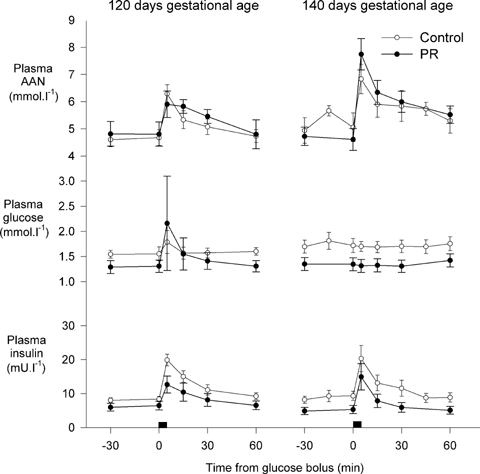
Restricted growth before birth is associated with impaired insulin secretion but with initially enhanced insulin sensitivity in early postnatal life, which then progresses to insulin resistance and impaired glucose homeostasis by adulthood. This suggests that prenatal restraint impairs insulin secretion, but increases insulin sensitivity, before birth. Poor placental growth and function are major causes of restricted fetal growth in humans. We have therefore investigated the effects of restricted placental growth and function on plasma glucose, alpha-amino nitrogen and insulin concentrations and glucose- and arginine-stimulated insulin secretion in the fetal sheep at 120 and 140 days gestational age, and on insulin sensitivity, measured by hyperinsulinaemic euglycaemic clamp, at 130 days gestational age. Placental restriction decreased fetal blood pH and oxygen content, and weight in late gestation by approximately 20%. Reduced fetal and placental weights and indices of poor placental function, in particular fetal hypoxia and hypoglycaemia, were associated with impaired glucose- and arginine-stimulated insulin secretion, but not with changes in insulin sensitivity in the fetal sheep. We conclude that the impaired insulin secretion capacity reported in children and adults after intrauterine growth restriction, and in the neonatal and young adult sheep which is small at birth, is present in utero and persists. Whether this reflects the actions of the adverse intrauterine environment or changes to intrinsic capacity is unclear, but in utero interventions may be necessary to improve postnatal insulin secretion in the infant who is growth-restricted before birth.
Figures
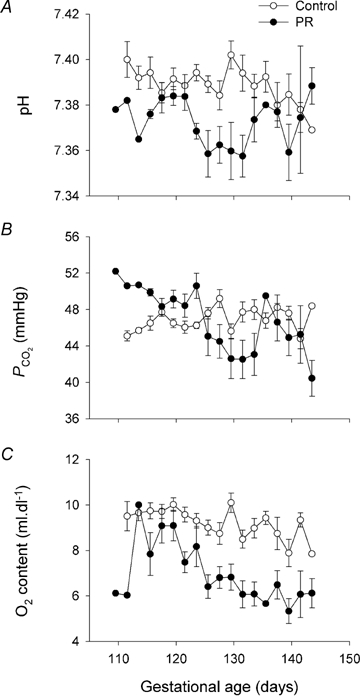
 (B) and oxygen content (C) in control (○) and PR fetuses (•). Data are presented as means ±
Comment in
-
Fetal insulin secretion in late gestation: does size matter?J Physiol. 2007 Dec 15;585(Pt 3):651-2. doi: 10.1113/jphysiol.2007.146811. Epub 2007 Nov 1. J Physiol. 2007. PMID: 17974586 Free PMC article. No abstract available.
References
-
- Aldoretta PW, Carver TD, Hay WW. Maturation of glucose-stimulated insulin secretion in fetal sheep. Biol Neonate. 1998;73:375–386. - PubMed
-
- Bazaes RA, Salazar TE, Pittaluga E, Pena V, Alegria A, Iniguez G, Ong KK, Dunger DB, Mericq MV. Glucose and lipid metabolism in small for gestational age infants at 48 hours of age. Pediatrics. 2003;111:804–809. - PubMed
-
- Béringue F, Blondeau B, Castellotti MC, Bréant B, Czernichow P, Polak M. Endocrine pancreas development in growth-retarded human fetuses. Diabetes. 2002;51:385–391. - PubMed
-
- Bleker OP, Buimer M, van der Post JAM, van der Veen F. Ted (G. J.) Kloosterman: On intrauterine growth. the significance of prenatal care. studies on birth weight, placental weight and placental index. Placenta. 2006;27:1052–1054. - PubMed
-
- Bocking AD, McMillen IC, Harding R, Thorburn GD. Effect of reduced uterine blood flow on fetal and maternal cortisol. J Dev Physiol. 1986;8:237–245. - PubMed
Publication types
MeSH terms
Substances
LinkOut - more resources
Full Text Sources
Medical
