


Differential regulation of action potential firing in adult murine thalamocortical neurons by Kv3.2, Kv1, and SK potassium and N-type calcium channels
- PMID: 17761775
- PMCID: PMC2277158
- DOI: 10.1113/jphysiol.2007.141135
Differential regulation of action potential firing in adult murine thalamocortical neurons by Kv3.2, Kv1, and SK potassium and N-type calcium channels
Abstract
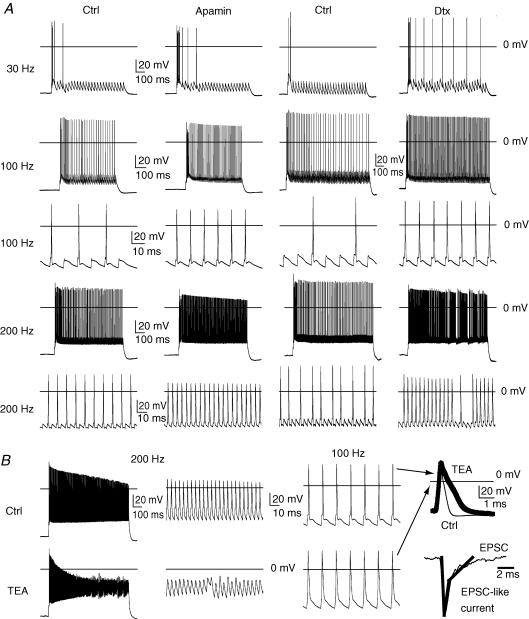
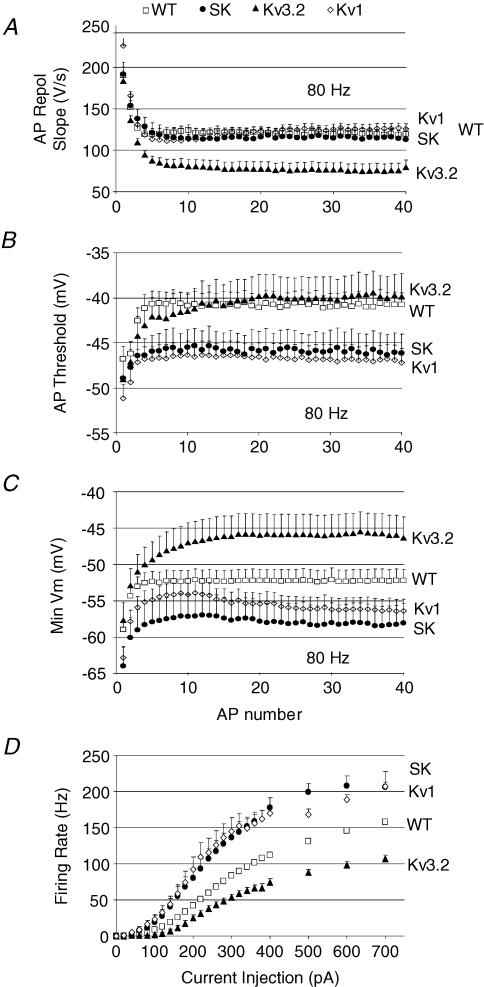
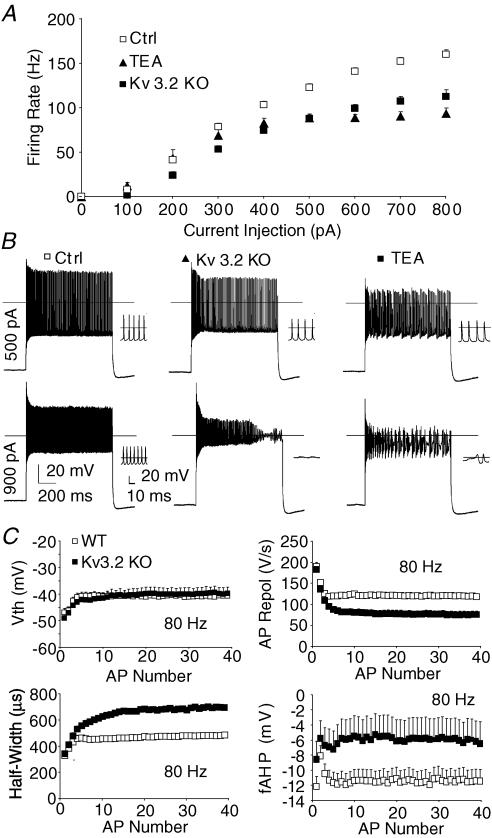
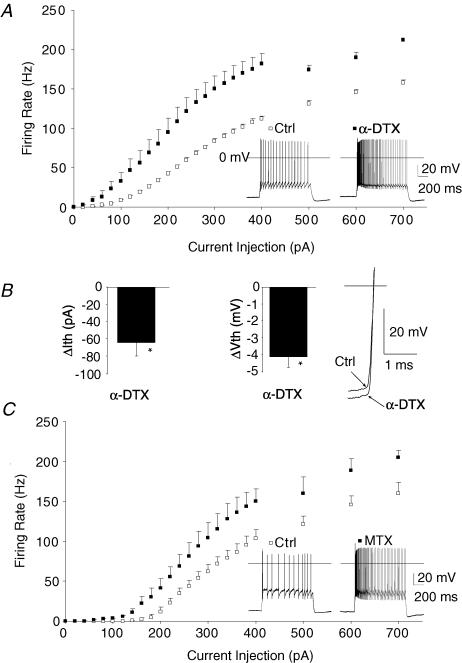
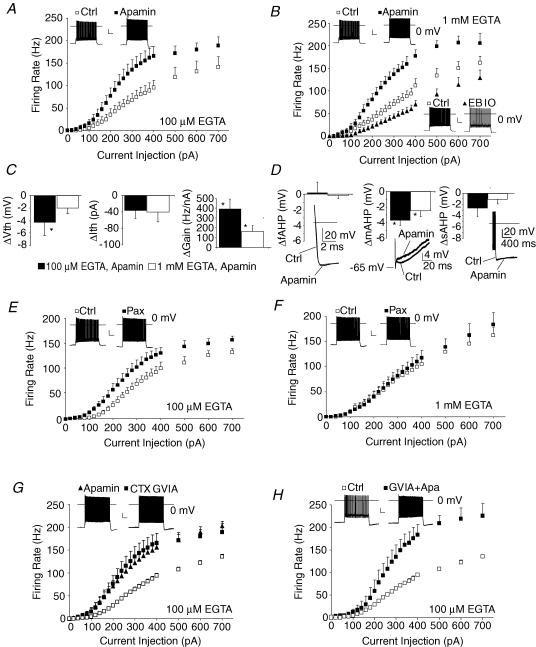
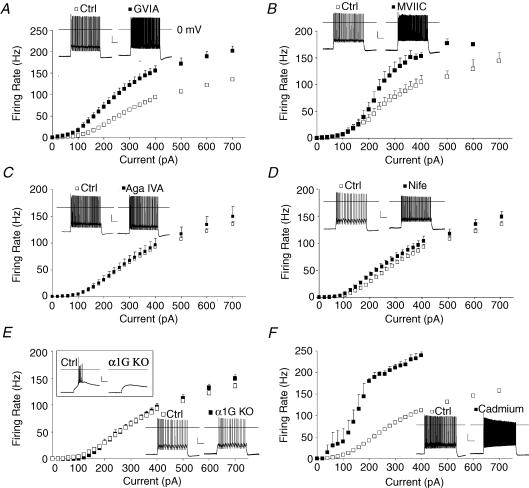
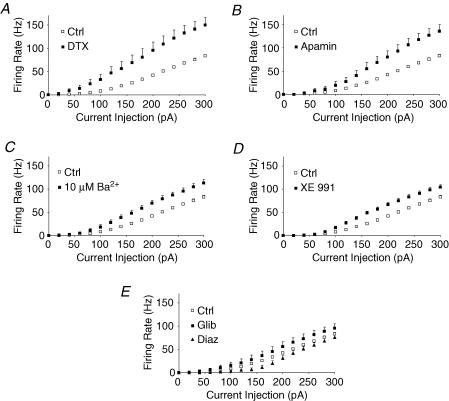
Sensory signals of widely differing dynamic range and intensity are transformed into a common firing rate code by thalamocortical neurons. While a great deal is known about the ionic currents, far less is known about the specific channel subtypes regulating thalamic firing rates. We hypothesized that different K(+) and Ca(2+) channel subtypes control different stimulus-response curve properties. To define the channels, we measured firing rate while pharmacologically or genetically modulating specific channel subtypes. Inhibiting Kv3.2 K(+) channels strongly suppressed maximum firing rate by impairing membrane potential repolarization, while playing no role in the firing response to threshold stimuli. By contrast, inhibiting Kv1 channels with alpha-dendrotoxin or maurotoxin strongly increased firing rates to threshold stimuli by reducing the membrane potential where action potentials fire (V(th)). Inhibiting SK Ca(2+)-activated K(+) channels with apamin robustly increased gain (slope of the stimulus-response curve) and maximum firing rate, with minimum effects on threshold responses. Inhibiting N-type Ca(2+) channels with omega-conotoxin GVIA or omega-conotoxin MVIIC partially mimicked apamin, while inhibiting L-type and P/Q-type Ca(2+) channels had small or no effects. EPSC-like current injections closely mimicked the results from tonic currents. Our results show that Kv3.2, Kv1, SK potassium and N-type calcium channels strongly regulate thalamic relay neuron sensory transmission and that each channel subtype controls a different stimulus-response curve property. Differential regulation of threshold, gain and maximum firing rate may help vary the stimulus-response properties across and within thalamic nuclei, normalize responses to diverse sensory inputs, and underlie sensory perception disorders.
Figures
References
-
- Abel HJ, Lee JCF, Callaway JC, Foehring RC. Relationships between intracellular calcium and afterhyperpolarizations in neocortical pyramial neurons. J Neurophysiol. 2004;91:324–335. - PubMed
-
- Atzori M, Lau D, Tansey EP, Chow A, Ozaita A, Rudy B, McBain CJ. H2 histamine receptor-phosphorylation of Kv3.2 modulates interneuron fast spiking. Nat Neurosci. 2000;3:791–798. - PubMed
-
- Bassett JP, Zugaro MB, Muir GM, Golob EJ, Muller RU, Taube JS. Passive movements of the head do not abolish anticipatory firing properties of head direction cells. J Neurophysiol. 2005;93:1304–1316. - PubMed
Publication types
MeSH terms
Substances
Grants and funding
LinkOut - more resources
Full Text Sources
Other Literature Sources
Molecular Biology Databases
Miscellaneous
