


IP3-dependent nuclear Ca2+ signalling in the mammalian heart
- PMID: 17761776
- PMCID: PMC2277156
- DOI: 10.1113/jphysiol.2007.140731
IP3-dependent nuclear Ca2+ signalling in the mammalian heart
Abstract
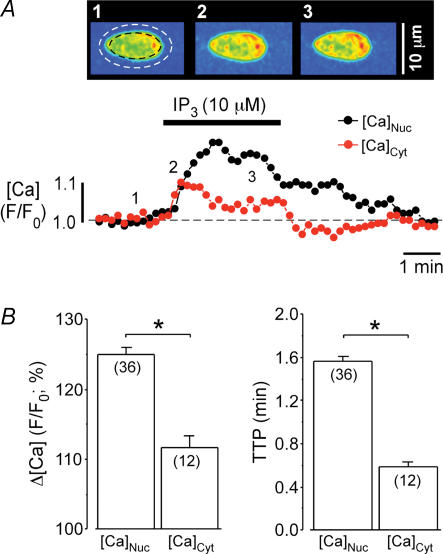
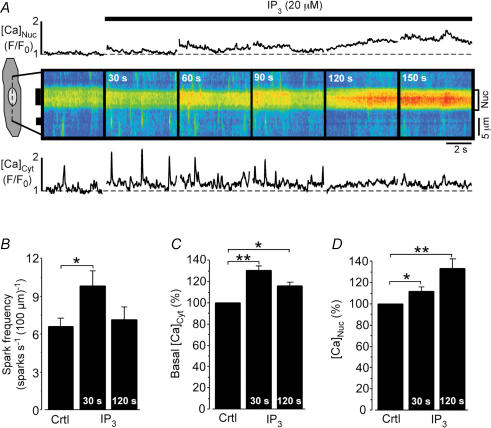
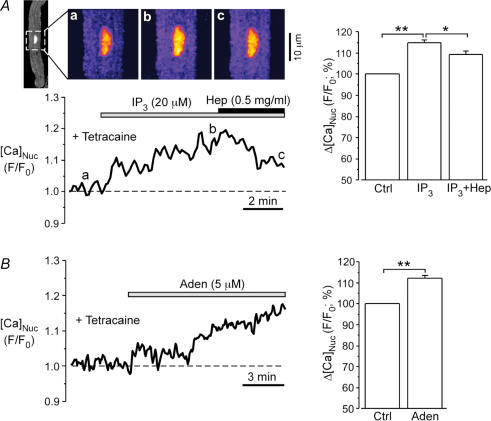
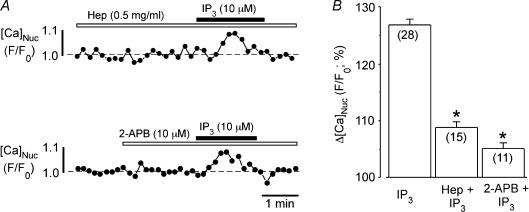
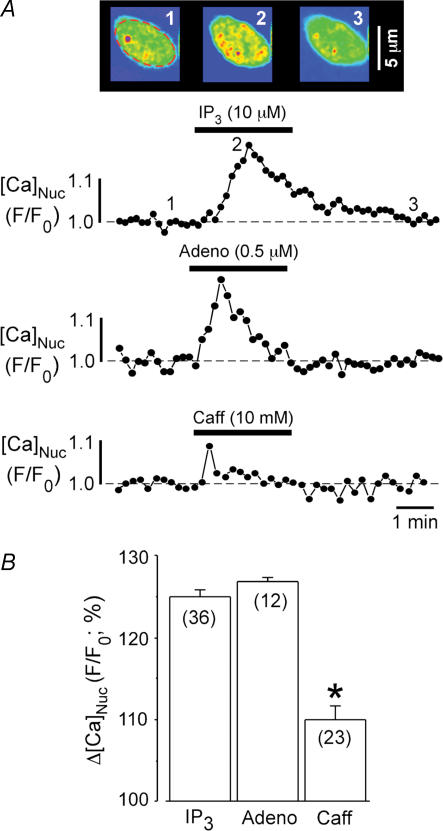
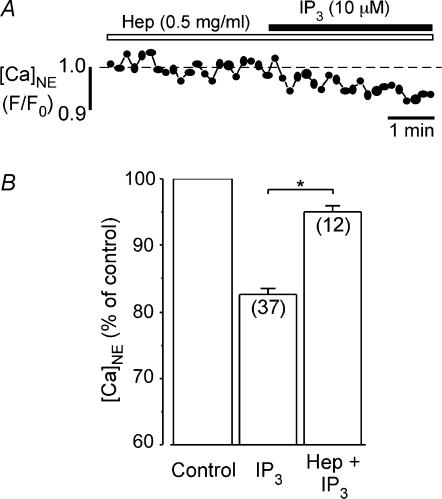
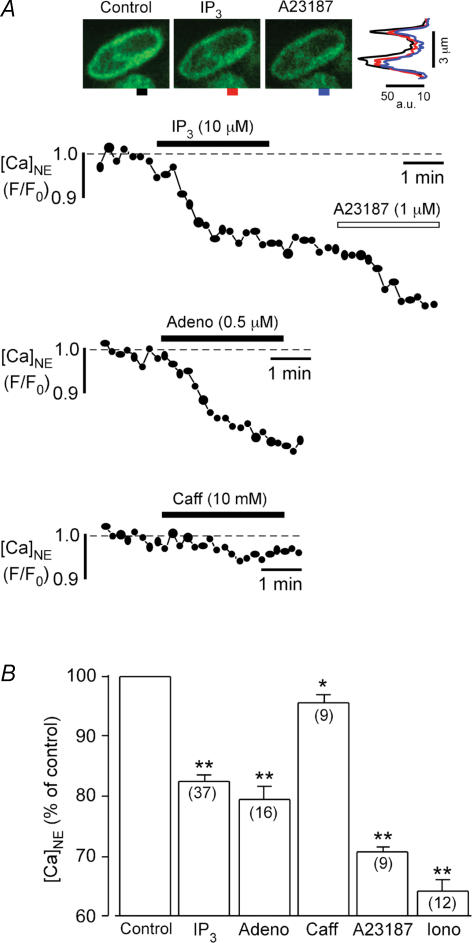
In cardiac myocytes the type-2 inositol 1,4,5-trisphosphate receptor (IP(3)R2) is the predominant isoform expressed. The IP(3)R2 channel is localized to the SR and to the nuclear envelope. We studied IP(3)-dependent nuclear Ca(2+) signals ([Ca(2+)](Nuc)) in permeabilized atrial myocytes and in isolated cardiac nuclei. In permeabilized myocytes IP(3) (20 microm) and the more potent IP(3)R agonist adenophostin (5 microm) caused an elevation of [Ca(2+)](Nuc). An IP(3)-dependent increase of [Ca(2+)](Nuc) was still observed after pretreatment with tetracaine to block Ca(2+) release from ryanodine receptors (RyRs), and the effect of IP(3) was partially reversed or prevented by the IP(3)R blockers heparin and 2-APB. Isolated nuclei were superfused with an internal solution containing the Ca(2+) indicator fluo-4 dextran. Exposure to IP(3) (10 microm) and adenophostin (0.5 microm) increased [Ca(2+)](Nuc) by 25 and 27%, respectively. [Ca(2+)](Nuc) increased to higher levels than [Ca(2+)](Cyt) immediately adjacent to the outer membrane of the nuclear envelope, suggesting that a significant portion of nuclear IP(3) receptors are facing the nucleoplasm. When nuclei were pretreated with heparin or 2-APB, IP(3) failed to increase [Ca(2+)](Nuc). Isolated nuclei were also loaded with the membrane-permeant low-affinity Ca(2+) probe fluo-5N AM which compartmentalized into the nuclear envelope. Exposure to IP(3) and adenophostin resulted in a decrease of the fluo-5N signal that could be prevented by heparin. Stimulation of IP(3)R caused depletion of the nuclear Ca(2+) stores by approximately 60% relative to the maximum depletion produced by the ionophores ionomycin and A23187. The fluo-5N fluorescence decrease was particularly pronounced in the nuclear periphery, suggesting that the nuclear envelope may represent the predominant nuclear Ca(2+) store. The data indicate that IP(3) can elicit Ca(2+) release from cardiac nuclei resulting in localized nuclear Ca(2+) signals.
Figures
References
-
- Bading H, Hardingham GE, Johnson CM, Chawla S. Gene regulation by nuclear and cytoplasmic calcium signals. Biochem Biophys Res Commun. 1997;236:541–543. - PubMed
-
- Bare DJ, Kettlun CS, Liang M, Bers DM, Mignery GA. Cardiac type 2 inositol 1,4,5-trisphosphate receptor: interaction and modulation by calcium/calmodulin-dependent protein kinase II. J Biol Chem. 2005;280:15912–15920. - PubMed
-
- Berridge MJ, Bootman MD, Roderick HL. Calcium signalling: dynamics, homeostasis and remodelling. Nat Rev Mol Cell Biol. 2003;4:517–529. - PubMed
-
- Blatter LA, Wier WG. Agonist-induced [Ca2+]i waves and Ca2+-induced Ca2+ release in mammalian vascular smooth muscle cells. Am J Physiol Heart Circ Physiol. 1992;263:H576–H586. - PubMed
Publication types
MeSH terms
Substances
Grants and funding
LinkOut - more resources
Full Text Sources
Research Materials
Miscellaneous
