. 2007 Dec 15;93(12):4425-32.
doi: 10.1529/biophysj.106.099309. Epub 2007 Aug 31.

Mechanical properties of spider dragline silk: humidity, hysteresis, and relaxation

Affiliations

Mechanical properties of spider dragline silk: humidity, hysteresis, and relaxation

T Vehoff et al. Biophys J. .

Abstract

Spider silk is well-known for its outstanding mechanical properties. However, there is a significant variation of these properties in literature and studies analyzing large numbers of silk samples to explain these variations are still lacking. To fill this gap, the following work examines the mechanical properties of major ampullate silk based on a large ensemble of threads from Nephila clavipes and Nephila senegalensis. In addition, the effect of relative humidity (RH) on the mechanical properties was quantified. The large effect of RH on the mechanical properties makes it plausible that the variation in the literature values can to a large extent be attributed to changes in RH. Spider silk's most remarkable property-its high tenacity-remains unchanged. In addition, this work also includes hysteresis as well as relaxation measurements. It is found that the relaxation process is well described by a stretched exponential decay.


Figures
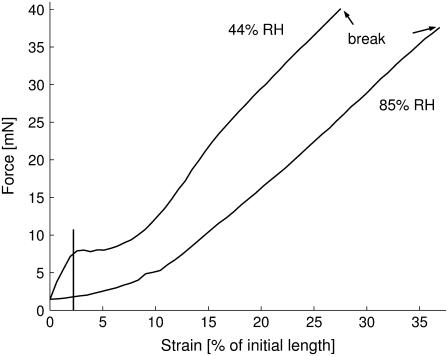
FIGURE 1
FIGURE 1
Typical force-strain curves of two Nephila clavipes fibers at 44% and 85% relative humidity. The vertical line indicates the end of the linear regime. The curves are based on over 1000 data points.
FIGURE 2
FIGURE 2
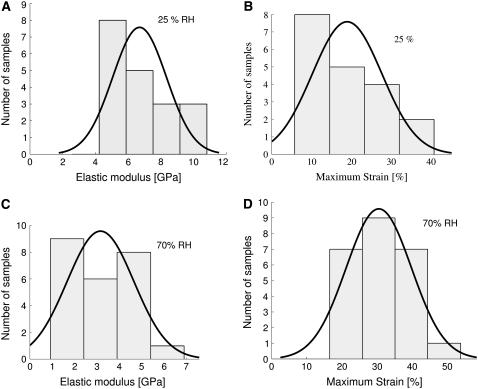
Elastic modulus (above) and strain (below) histograms of two complete Nephila senegalensis ensembles at 25% (left) and 70% (right) relative humidity. For comparison, a Gaussian distribution with the same expectation value μ normalized to the area underneath the bars is shown.
FIGURE 3
FIGURE 3
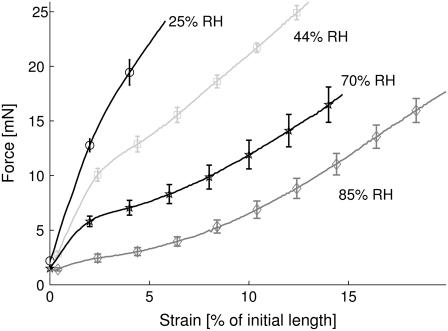
Averaged force-strain curves for Nephila senegalensis ensembles measured at 25%, 44%, 70%, and 85% relative humidity. For clarity, error bars and symbols are shown only at every 20th data point.
FIGURE 4
FIGURE 4
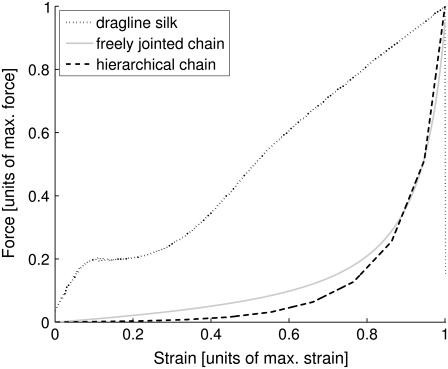
Comparison of a typical measured dragline silk force-strain curve with theoretical curves obtained from freely jointed (N = 109; b = 10−7 m; T = 300 K) and with the predicted curves according to the hierarchical chain model (α = 0.5, β = 2).
FIGURE 5
FIGURE 5
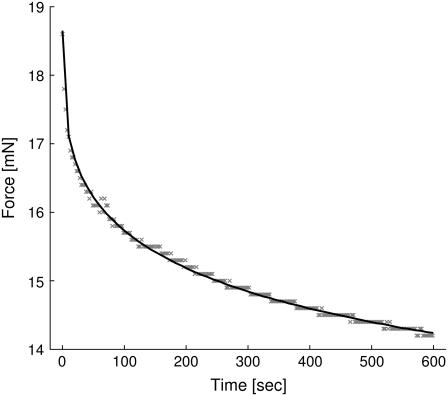
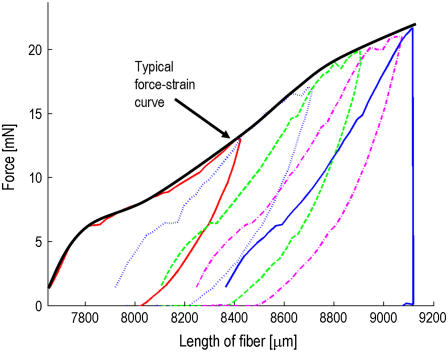
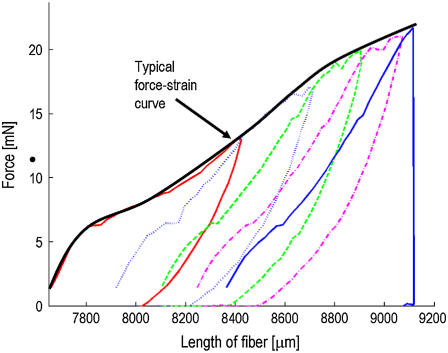
Relaxation curve of a Nephila clavipes fiber extended to 20% of its initial length at 44% relative humidity. The dots are the measured data points, the solid line is the least-square fit obtained by simplex iteration with a deviation of χ2 = 1.10.
FIGURE 6
FIGURE 6
A typical hysteresis measurement cycle for Nephila clavipes at 42% RH without gauge force, including a zoom on the repeated hysteresis curves. The crosses and circles represent the first and the last of the repeated hysteresis cycles, respectively.
FIGURE 7
FIGURE 7
Five repeated hysteresis cycles of a Nephila senegalensis fiber at 56% RH with gauge force.
FIGURE 8
FIGURE 8
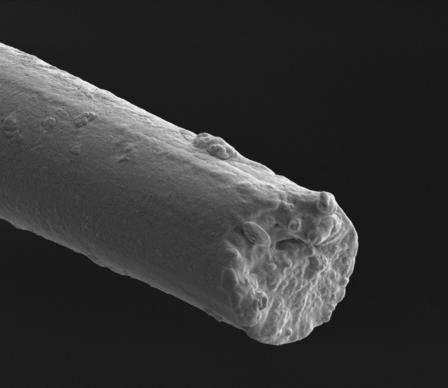
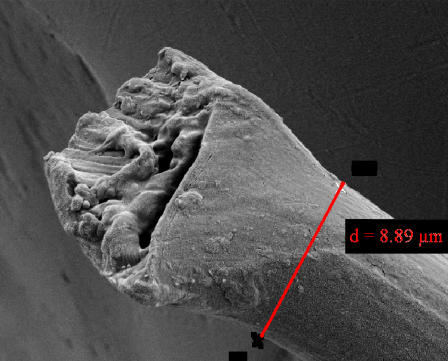
SEM images of a torn (left) Nephila senegalensis fiber and of one cut by hand with a scalpel (right) at a magnification of 10,000.
FIGURE 8
FIGURE 8
SEM images of a torn (left) Nephila senegalensis fiber and of one cut by hand with a scalpel (right) at a magnification of 10,000.
FIGURE 9
FIGURE 9
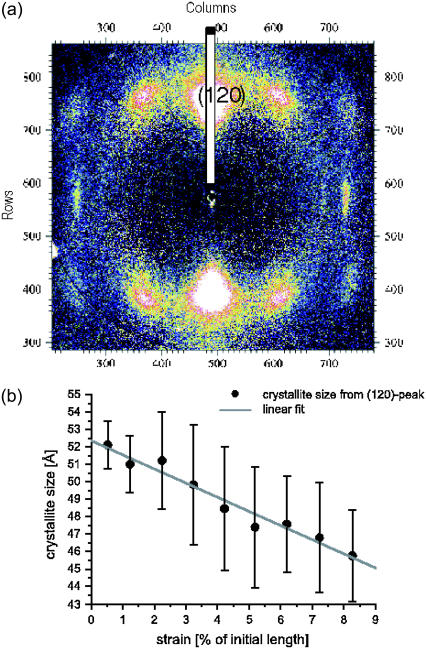
(a) Wide angle x-ray diffraction pattern recorded from a single N. madagascariensis fiber at ID13/ESRF. The fiber axis is along the horizontal direction. The pattern can be indexed to an orthorhombic lattice, with the (120) reflection occurring as the strongest peak. A longitudinal cut through the (120) reflection can be analyzed to compute the lateral crystallite width from the Debye-Scherrer formula; see the wide stripe. (b) The resulting values for the crystallite width as a function of strain show a pronounced decrease.

References

    1. Vollrath, F., and D. Knight. 2001. Liquid crystalline spinning of spider silk. Nature. 410:541–548. - PubMed
    1. Gosline, J., P. Guerette, C. Ortlepp, and K. Savage. 1999. The mechanical design of spider silks: from fibroin sequence to mechanical function. J. Exp. Biol. 202:3295–3303. - PubMed
    1. Fossey, S., D. Kaplan, and E. J. E. Mark. 1999. Silk protein. In Polymer Data Handbook. Oxford University Press, New York.
    1. Riekel, C., and F. Vollrath. 2001. Spider silk fiber extrusion: combined wide- and small-angle x-ray microdiffraction experiments. Int. J. Biol. Macromol. 29:203–210. - PubMed
    1. Eles, P., and C. Michal. 2004. Strain dependent local phase transitions observed during controlled supercontraction reveal mechanisms in spider silk. Macromolecules. 37:1342–1345.

Publication types