


A water-explicit lattice model of heat-, cold-, and pressure-induced protein unfolding
- PMID: 17766342
- PMCID: PMC2098741
- DOI: 10.1529/biophysj.107.108530
A water-explicit lattice model of heat-, cold-, and pressure-induced protein unfolding
Abstract
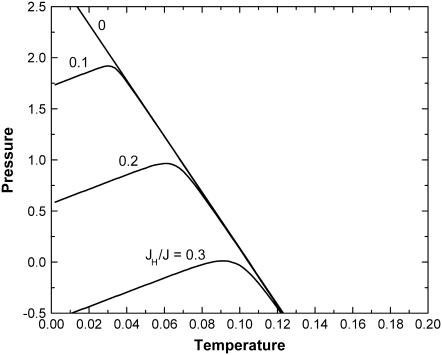
We investigate the effect of temperature and pressure on polypeptide conformational stability using a two-dimensional square lattice model in which water is represented explicitly. The model captures many aspects of water thermodynamics, including the existence of density anomalies, and we consider here the simplest representation of a protein: a hydrophobic homopolymer. We show that an explicit treatment of hydrophobic hydration is sufficient to produce cold, pressure, and thermal denaturation. We investigate the effects of the enthalpic and entropic components of the water-protein interactions on the overall folding phase diagram, and show that even a schematic model such as the one we consider yields reasonable values for the temperature and pressure ranges within which highly compact homopolymer configurations are thermodynamically stable.
Figures




References
-
- Hawley, S. A. 1971. Reversible pressure-temperature denaturation of chymotrypsinogen. Biochemistry. 10:2436–2442. - PubMed
-
- Heremans, K., and L. Smeller. 1998. Protein structure and dynamics at high pressure. Biochim. Biophys. Acta. 1386:353–370. - PubMed
-
- Ravindra, R., and R. Winter. 2003. On the temperature-pressure free-energy landscape of proteins. ChemPhysChem. 4:359–365. - PubMed
-
- Dill, K. A. 1990. Dominant forces in protein folding. Biochemistry. 29:7133–7155. - PubMed
-
- Kauzmann, W. 1959. Some factors in the interpretation of protein denaturation. Adv. Protein Chem. 14:1–63. - PubMed
Publication types
MeSH terms
Substances
LinkOut - more resources
Full Text Sources
