


Transcriptomics-based identification of novel factors enhancing heterologous protein secretion in yeasts
- PMID: 17766460
- PMCID: PMC2075068
- DOI: 10.1128/AEM.01196-07
Transcriptomics-based identification of novel factors enhancing heterologous protein secretion in yeasts
Abstract
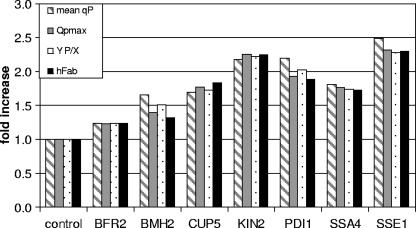
Efficient production of heterologous proteins with yeasts and other eukaryotic hosts is often hampered by inefficient secretion of the product. Limitation of protein secretion has been attributed to a low folding rate, and a rational solution is the overexpression of proteins supporting folding, like protein disulfide isomerase (Pdi), or the unfolded protein response transcription factor Hac1. Assuming that other protein factors which are not directly involved in protein folding may also support secretion of heterologous proteins, we set out to analyze the differential transcriptome of a Pichia pastoris strain overexpressing human trypsinogen versus that of a nonexpressing strain. Five hundred twenty-four genes were identified to be significantly regulated. Excluding those genes with totally divergent functions (like, e.g., core metabolism), we reduced this number to 13 genes which were upregulated in the expression strain having potential function in the secretion machinery and in stress regulation. The respective Saccharomyces cerevisiae homologs of these genes, including the previously characterized secretion helpers PDI1, ERO1, SSO2, KAR2/BiP, and HAC1 as positive controls, were cloned and overexpressed in a P. pastoris strain expressing a human antibody Fab fragment. All genes except one showed a positive effect on Fab fragment secretion, as did the controls. Six out of these novel secretion helper factors, more precisely Bfr2 and Bmh2 (involved in protein transport), the chaperones Ssa4 and Sse1, the vacuolar ATPase subunit Cup5, and Kin2 (a protein kinase connected to exocytosis), proved their benefits for practical application in laboratory-scale production processes by increasing both specific production rates and the volumetric productivity of an antibody fragment up to 2.5-fold in fed-batch fermentations of P. pastoris.
Figures
References
-
- Archer, D., D. Jeenes, and D. Mackenzie. 1994. Strategies for improving heterologous protein production from filamentous fungi. Antonie Leeuwenhoek 65:245-250. - PubMed
-
- Bao, W., and H. Fukuhara. 2001. Secretion of human proteins from yeast: stimulation by duplication of polyubiquitin and protein disulfide isomerase genes in Kluyveromyces lactis. Gene 272:103-110. - PubMed
-
- Bickford, L., E. Mossessova, and J. Goldberg. 2004. A structural view of the COPII vesicle coat. Curr. Opin. Struct. Biol. 14:147-153. - PubMed
-
- Chabane, S., E. Gachet, and F. Képès. 1998. Over-expression of the yeast BFR2 gene partially suppresses the growth defects induced by Brefeldin A and by four ER-to-Golgi mutations. Curr. Genet. 33:21-28. - PubMed
-
- Conesa, A., P. J. Punt, N. van Luijk, and C. A. van den Hondel. 2001. The secretion pathway in filamentous fungi: a biotechnological view. Fungal Genet. Biol. 33:155-171. - PubMed
Publication types
MeSH terms
Substances
LinkOut - more resources
Full Text Sources
Other Literature Sources
Molecular Biology Databases
