


Limited performance of DNA barcoding in a diverse community of tropical butterflies
- PMID: 17785265
- PMCID: PMC3227132
- DOI: 10.1098/rspb.2007.1035
Limited performance of DNA barcoding in a diverse community of tropical butterflies
Abstract
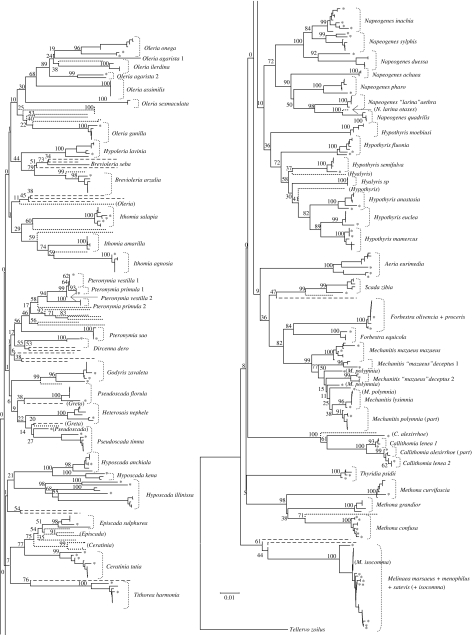
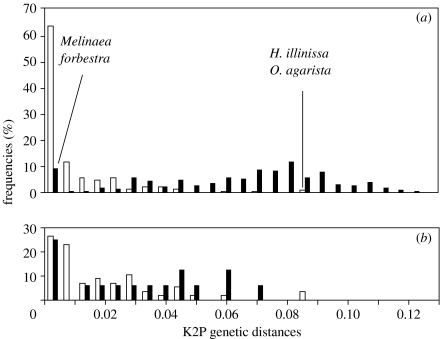
DNA 'barcoding' relies on a short fragment of mitochondrial DNA to infer identification of specimens. The method depends on genetic diversity being markedly lower within than between species. Closely related species are most likely to share genetic variation in communities where speciation rates are rapid and effective population sizes are large, such that coalescence times are long. We assessed the applicability of DNA barcoding (here the 5' half of the cytochrome c oxidase I) to a diverse community of butterflies from the upper Amazon, using a group with a well-established morphological taxonomy to serve as a reference. Only 77% of species could be accurately identified using the barcode data, a figure that dropped to 68% in species represented in the analyses by more than one geographical race and at least one congener. The use of additional mitochondrial sequence data hardly improved species identification, while a fragment of a nuclear gene resolved issues in some of the problematic species. We acknowledge the utility of barcodes when morphological characters are ambiguous or unknown, but we also recommend the addition of nuclear sequence data, and caution that species-level identification rates might be lower in the most diverse habitats of our planet.
Figures
References
-
- Altschul S.F, Madden T.L, Schaffer A.A, Zhang J.H, Zhang Z, Miller W, Lipman D.J. Gapped BLAST and PSI-BLAST: a new generation of protein database search programs. Nucleic Acids Res. 1997;25:3389–3402. doi:10.1093/nar/25.17.3389 - DOI - PMC - PubMed
-
- Beltrán M.S, Jiggins C.D, Bull V, Linares M, Mallet J, McMillan W.O, Bermingham E. Phylogenetic discordance at the species boundary: comparative gene genealogies among rapidly radiating Heliconius butterflies. Mol. Biol. Evol. 2002;19:2176–2190. - PubMed
-
- Blaxter M. Molecular systematics—counting angels with DNA. Nature. 2003;421:122–124. doi:10.1038/421122a - DOI - PubMed
-
- Brower A.V.Z. Phylogeny of Heliconius butterflies inferred from mitochondrial DNA sequences (Lepidoptera: Nymphalidae) Mol. Phylogenet. Evol. 1994;3:159–174. doi:10.1006/mpev.1994.1018 - DOI - PubMed
-
- Brower A.V.Z. A new mimetic species of Heliconius (Lepidoptera: Nymphalidae), from southeastern Colombia, as revealed by cladistic analysis of mitochondrial DNA sequences. Zool. J. Linn. Soc. 1996;116:317–332. doi:10.1006/zjls.1996.0022 - DOI
Publication types
MeSH terms
Substances
LinkOut - more resources
Full Text Sources
Other Literature Sources