Review
. 2008 May;83(5):673-91.
doi: 10.1038/sj.clpt.6100296. Epub 2007 Sep 5.

Recent advances on the molecular mechanisms involved in the drug resistance of cancer cells and novel targeting therapies

Affiliations
Review

Recent advances on the molecular mechanisms involved in the drug resistance of cancer cells and novel targeting therapies

M Mimeault et al. Clin Pharmacol Ther. 2008 May.

Abstract

This review summarizes the recent knowledge obtained on the molecular mechanisms involved in the intrinsic and acquired resistance of cancer cells to current cancer therapies. We describe the cascades that are often altered in cancer cells during cancer progression that may contribute in a crucial manner to drug resistance and disease relapse. The emphasis is on the implication of ATP-binding cassette (ABC) multidrug efflux transporters in drug disposition and antiapoptotic factors, including epidermal growth factor receptor cascades and deregulated enzymes in ceramide metabolic pathways. The altered expression and activity of these signaling elements may have a critical role in the resistance of cancer cells to cytotoxic effects induced by diverse chemotherapeutic drugs and cancer recurrence. Of therapeutic interest, new strategies for reversing the multidrug resistance and developing more effective clinical treatments against the highly aggressive, metastatic, and recurrent cancers, based on the molecular targeting of the cancer progenitor cells and their further differentiated progeny, are also described.


Conflict of interest statement

CONFLICT OF INTEREST The authors declared no conflict of interest.

Figures

Figure 1
Figure 1
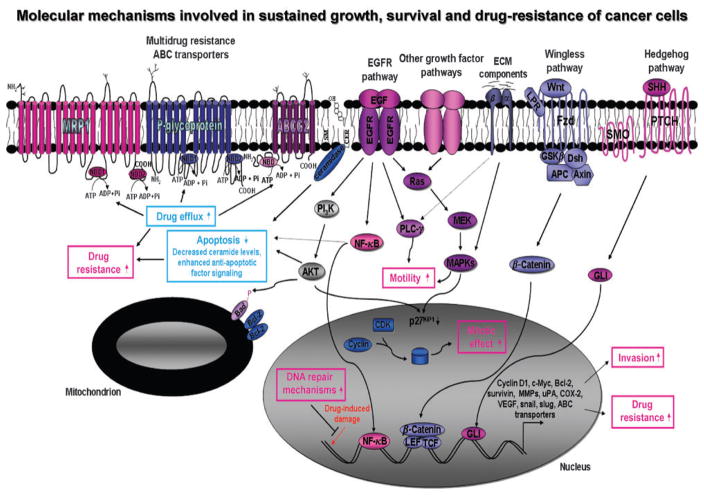
Schematic showing the possible molecular mechanisms involved in the sustained growth, survival, invasion, and drug resistance of cancer cells. The oncogenic intracellular cascades induced through the activation of distinct growth factor signaling pathways, including EGF–EGFR system, sonic hedgehog SHH/PTCH/GLI, Wnt/β-catenin, and extracellular matrix (ECM) component/integrins, which may provide a critical role for the sustained growth, survival, and invasion of cancer cells, are shown. The upregulated expression levels of certain target gene products, including upregulated antiapoptotic factors Bcl-2 and survivin, matrix metalloproteinases (MMPs), urokinase plasminogen activator (uPA), cyclooxygenase (COX-2), vascular epidermal growth factor (VEGF), transcriptional repressor of E-cadherin (snail and slug), and MDR ABC transporters that can contribute to the malignant transformation of cancer cells and drug resistance are indicated. In addition, the possible drug efflux via the MDR ABC transporters, including MRP1, P-glycoprotein, and brain cancer resistance protein (BCRP/ABCG2), is also shown. APC, adenomatous polyposis coli; CDK, cyclin-dependent kinase; CER, ceramide; EGF, epidermal growth factor; EGFR, epidermal growth factor receptor; FZD, Frizzled receptor; IGF, insulin-like growth factor; IGF-1R, insulin-like growth factor-1 receptor; LEF, lymphoid enhancer factor; LPR, low-density lipoprotein receptor-related protein; MAPKs, mitogen-activated protein kinase; MEK, extracellular signal-related kinase kinase; NBD, nucleotide binding domain; NF-κB, nuclear factor-κB; PI3K, phosphatidyl inositol 3′-kinase; PLC-γ, phospholipase C-γ; SHH, sonic hedgehog; SM, sphingomyelin; SMO, smoothened; TCF, T-cell factor; uPA, urokinase plasminogen activator; Wnt, wingless.
Figure 2
Figure 2
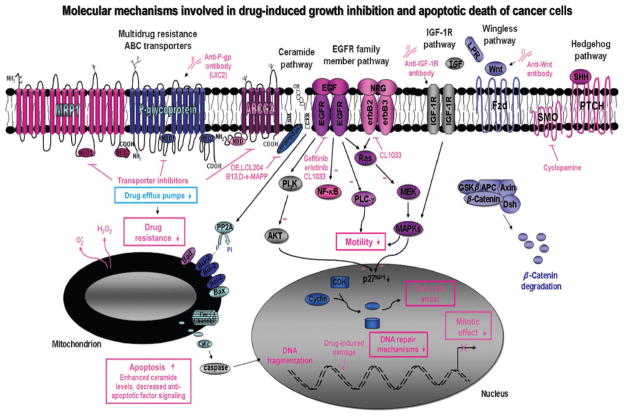
Proposed molecular targets in cancer cells for the development of novel therapeutic strategies against aggressive and recurrent cancers. The schematic shows the possible antiproliferative and apoptotic effects induced by the tyrosine kinase activity inhibitors, including EGFR (gefitinib and erlotinib) and EGFR/erbB2/erbB3 (CI-1033), as well as by a selective inhibitor of SMO hedgehog signaling element (cyclopamine) and monoclonal antibody directed against Wnt and IGF-1R. Moreover, the reversal of the MDR mediated through ABC transporters by using specific transporter inhibitors and antibody directed against P-glycoprotein drug efflux pump is also shown. Cyt c, cytochrome c; PP2A, protein phosphatase 2A.
Figure 3
Figure 3
Schematic representation of metabolic pathways involved in the biosynthesis and degradation of the endogenous sphingolipid ceramide. The cellular ceramide (Cer) accumulation induced through the activation of de novo synthesis and sphingomyelin pathways as well as the catabolic pathway involved in ceramide degradation are shown. Moreover, the blockade of the ceramide degradation by using the specific inhibitors of the enzymes that catalyze the transformation of proapoptotic ceramide into its diverse metabolites, including ceramidase, sphingosine kinase, and GCS inhibitors, and whose inhibitory agents can induce the ceramide accumulation-induced apoptotic death in cancer cells are also indicated. D-e-MAPP, D-erythro-2-(N-myristoylamino)-1-phenyl-1-propanol; DMS, N,N-dimethylsphingosine; GCS, glucosylceramide synthase; OE, N-oleoylethanolamine; PDMP, D,L-threo-1-phenyl-2-decanoylamino-3-morpholino-1-propanol; PPMP, 1-phenyl-2-palmitoylamino-3-morpholino-1-propanol.

References

    1. Brawley OW, Kramer BS. Cancer screening in theory and in practice. J Clin Oncol. 2005;23:293–300. - PubMed
    1. Mimeault M, Brand RE, Sasson AA, Batra SK. Recent advances on the molecular mechanisms involved in pancreatic cancer progression and therapies. Pancreas. 2005;31:301–316. - PubMed
    1. Mimeault M, Batra SK. Recent advances on multiple tumorigenic cascades involved in prostatic cancer progression and targeting therapies. Carcinogenesis. 2006;27:1–22. - PubMed
    1. Lock-Andersen J, Horn J, Sjostrand H. Prognosis after sentinel node biopsy in malignant melanoma. Ugeskr Laeger. 2006;168:2457–2462. - PubMed
    1. Shiraishi J, et al. Computer-aided diagnosis for the detection and classification of lung cancers on chest radiographs ROC analysis of radiologists’ performance. Acad Radiol. 2006;13:995–1003. - PubMed

Publication types

MeSH terms

Substances