


Alternative signaling: cardiomyocyte beta1-adrenergic receptors signal through EGFRs
- PMID: 17786237
- PMCID: PMC1952644
- DOI: 10.1172/JCI33135
Alternative signaling: cardiomyocyte beta1-adrenergic receptors signal through EGFRs
Abstract
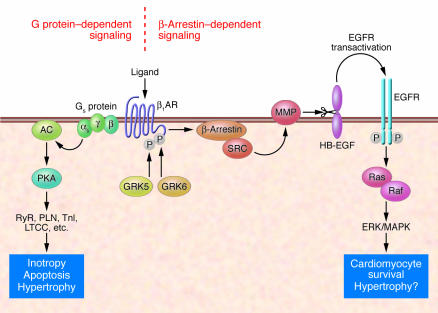
Acute stimulation of cardiac beta1-adrenergic receptors (beta1ARs) by norepinephrine represents the strongest endogenous mechanism for increasing cardiac function, but long-term stimulation induces cardiomyocyte apoptosis and contributes to cardiac disease. These effects have been attributed to coupling of the beta1AR to the stimulatory G protein (Gs) and classical cAMP-mediated signaling. In this issue of the JCI, Noma and colleagues report that cardiomyocyte beta1ARs may in addition deliver an antiapoptotic signal through transactivation of EGFRs (see the related article beginning on page 2445). Their findings provide a perspective for a novel class of receptor ligands that may direct beta1AR signaling toward alternative signaling pathways.
Figures
Comment on
-
Beta-arrestin-mediated beta1-adrenergic receptor transactivation of the EGFR confers cardioprotection.J Clin Invest. 2007 Sep;117(9):2445-58. doi: 10.1172/JCI31901. J Clin Invest. 2007. PMID: 17786238 Free PMC article.
References
-
- Cohn J.N., et al. Plasma norepinephrine as a guide to prognosis in patients with chronic congestive heart failure. N. Engl. J. Med. 1984;311:819–823. - PubMed
-
- Bristow M.R. β-adrenergic receptor blockade in chronic heart failure. Circulation. 2000;101:558–569. - PubMed
-
- Engelhardt S. β-adrenergic receptors in heart failure. Heart Fail. Clin. 2005;1:183–191. - PubMed
-
- Lohse M.J., Engelhardt S., Eschenhagen T. What is the role of β-adrenergic signaling in heart failure? Circ. Res. 2003;93:896–906. - PubMed
-
- Bristow M.R., et al. Decreased catecholamine sensitivity and β-adrenergic-receptor density in failing human hearts. N. Engl. J. Med. 1982;307:205–211. - PubMed
