


Teaching patient assessment skills to doctor of pharmacy students: the TOPAS study
- PMID: 17786252
- PMCID: PMC1959204
- DOI: 10.5688/aj710464
Teaching patient assessment skills to doctor of pharmacy students: the TOPAS study
Abstract
Objectives: To determine the content and extent, design, and relative importance of patient assessment courses in the professional pharmacy curriculum.
Methods: A 20-item questionnaire was developed to gather information pertaining to patient assessment. Pharmacy practice department chairs were mailed a letter with an Internet link to an online survey instrument.
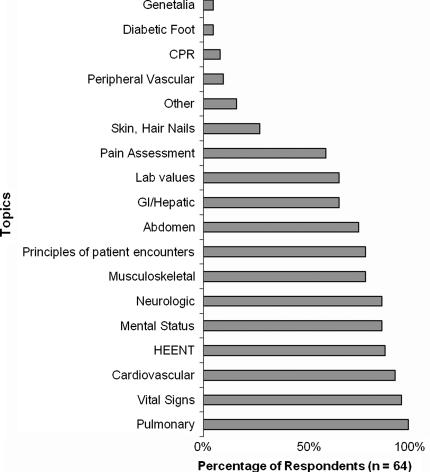
Results: Ninety-six percent of the programs indicated that patient assessment skills were taught. Forty-five percent of respondents indicated their course was a standalone course. The most common topics covered in assessment courses were pulmonary examination, vital signs, and cardiovascular assessment.
Conclusion: There is significant variability in the topics covered, depth of content, types of instruction, and evaluation methods used in patient assessment courses in US colleges of pharmacy. This survey was an initial assessment of what is being done regarding education of student pharmacists on patient assessment.
Keywords: curriculum design; laboratory instruction; patient assessment; physical assessment.
Figures
References
-
- Jones RA. Patient Assessment and the Pharmaceutical Care Process. In: Jones RM, Rospond RM, editors. Patient Assessment for Pharmacy Practice. Baltimore, Md: Lippincott Williams & Wilkins; 2003. pp. 2–8.
-
- American Association of Colleges of Pharmacy. Center for the Advancement of Pharmaceutical Education (CAPE), Advisory Panel on Educational Outcomes. Educational outcomes. Revised version 1998. Available from http://www.aacp.org/Docs/MainNavigation/ForDeans/5763_CAPEoutcomes.pdf. Accessed July 20, 2006.
-
- Joint Commission of Pharmacy Practitioners. JCPP Future Vision of Pharmacy Practice. November 10, 2004. Available at: http://www.aacp.org/Docs/MainNavigation/Resources/6725_JCPPFutureVisiono.... Accessed September 6, 2006.
-
- Closson RG. Physical assessment instruction, 1981-1982: A survey of american colleges of pharmacy. Am J Pharm Educ. 1984;48:25.
-
- United States Centers for Medicare and Medicaid Services. Medicare Prescription Drug Benefit Final Rule; 42 CFR Parts 400, 403, 411, 417, and 423 Medicare Program. January 28, 2005. Available at http://www.cms.hhs.gov/PhysicianSelfReferral/Downloads/CMS4068F.pdf. Accessed October 12, 2006.
Publication types
MeSH terms
LinkOut - more resources
Full Text Sources