


Decreased pain response in mice following cortex-specific knockout of the N-methyl-D-aspartate NR1 subunit
- PMID: 17822844
- PMCID: PMC3670823
- DOI: 10.1016/j.neulet.2007.08.030
Decreased pain response in mice following cortex-specific knockout of the N-methyl-D-aspartate NR1 subunit
Abstract
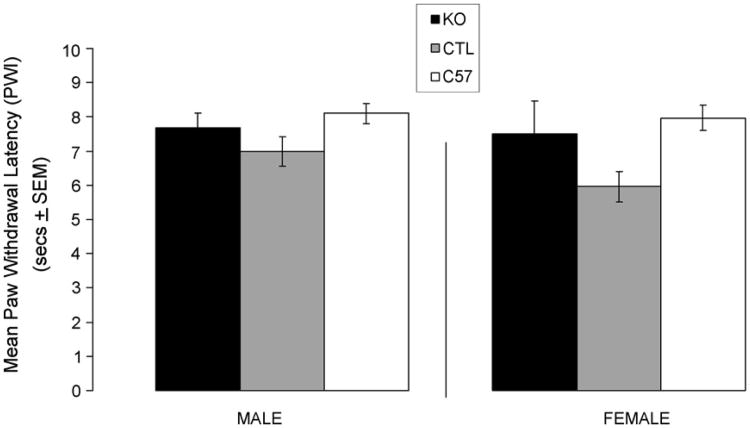
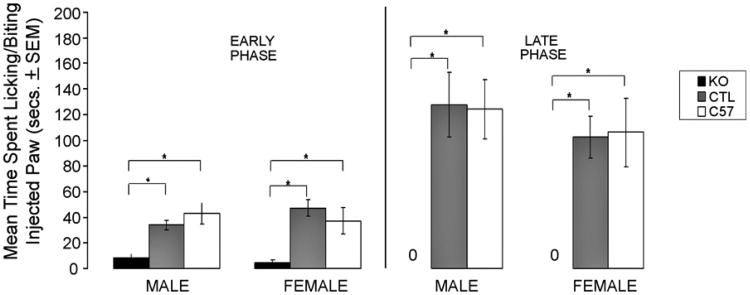
Studies have shown that N-methyl-D-aspartate (NMDA) receptors play a critical role in pain processing at different levels of the central nervous system. In this study, we used cortex-specific NR1 knockout mice (C57BL/6 strain) to elucidate the role of cortical NMDA receptors in pain processes. On post-natal day 20, paw withdrawal latency (PWL) to a noxious thermal stimulus was measured in male and female knockout (KO), control (Ctrl), and C57BL/6 (C57) mice. Twenty-four hours later, the same mice were tested in the formalin-pain assay (20 microl of 5% formalin injected into one hind-paw). The results show that KO mice (both male and female) have significantly reduced pain responses during both early and late phases of formalin test, as compared with Ctrl and C57 mice (p<0.01). By contrast, no differences among groups were found in PWL to a noxious thermal stimulus. Taken together, these results demonstrate dissociation in the role of cortical NMDA receptors in mediating different types of pain.
Figures
References
-
- Abbott FV, Melzack R. Brainstem lesions dissociate neural mechanisms of morphine analgesia in different kinds of pain. Brain Res. 1982;251:149–151. - PubMed
-
- Abbott FV, Melzack R, Samuel C. Morphine analgesia in the tail-flick and formalin pain tests is mediated by different neural systems. Exp Neurol. 1982;75:644–651. - PubMed
-
- Barr GA. Maturation of the biphasic behavioral and heart rate response in the formalin test. Pharmacol Biochem Behav. 1998;60:329–335. - PubMed
-
- Chang C, Shyu BC. A fMRI study of brain activation during non-noxious and noxious electrical stimulation of the sciatic nerve of rats. Brain Res. 2001;897:71–81. - PubMed
Publication types
MeSH terms
Substances
Grants and funding
LinkOut - more resources
Full Text Sources
Medical
Molecular Biology Databases
Research Materials
