


Heparin induced thrombocytopenia: diagnosis and management update
- PMID: 17823223
- PMCID: PMC2600013
- DOI: 10.1136/pgmj.2007.059188
Heparin induced thrombocytopenia: diagnosis and management update
Abstract
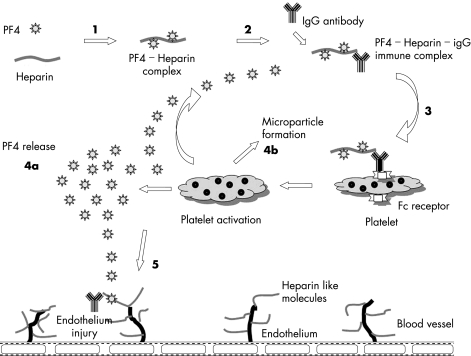
Heparin-induced thrombocytopenia (HIT) is a potentially devastating immune mediated adverse drug reaction caused by the emergence of antibodies that activate platelets in the presence of heparin. Despite thrombocytopenia, bleeding is rare; rather, HIT is strongly associated with thromboembolic complications involving both the arterial and venous systems. A number of laboratory tests are available to confirm the diagnosis; however, when HIT is clinically suspected, treatment should not be withheld pending the result. Fortunately, therapeutic strategies have been refined, and new and effective therapeutic agents are available. Treatment options are focused on inhibiting thrombin formation or direct thrombin inhibition. Warfarin should not be used until the platelet count has recovered.
Conflict of interest statement
Competing interests: None declared.
References
-
- Chong B H. Heparin‐induced thrombocytopenia. J Thromb Haemost 200311471–1478. - PubMed
-
- Campbell K R, Mahaffey K W, Lewis B E.et al Bivalirudin in patients with heparin‐induced thrombocytopenia undergoing percutaneous coronary intervention. J Invasive Cardiol 200012(suppl F)14F–19F. - PubMed
-
- Strauss R, Wehler M, Mehler K.et al Thrombocytopenia in patients in the medical intensive care unit: bleeding prevalence, transfusion requirements, and outcome. Crit Care Med 2002301765–1771. - PubMed
-
- Rice L. Heparin‐induced thrombocytopenia: myths and misconceptions. Arch Intern Med 20041641961–1964. - PubMed
Publication types
MeSH terms
Substances
LinkOut - more resources
Full Text Sources
Other Literature Sources
Medical
