Review
. 2007 Nov 10;59(13):1293-8.
doi: 10.1016/j.addr.2007.08.005. Epub 2007 Aug 14.

Three-dimensional microenvironments modulate fibroblast signaling responses

Affiliations
Review

Three-dimensional microenvironments modulate fibroblast signaling responses

J Angelo Green et al. Adv Drug Deliv Rev. .

Abstract

Modes of signaling in fibroblasts can differ substantially depending on whether these cells are in their natural three-dimensional environment compared to artificial two-dimensional culture conditions. Although studying cell behavior in two-dimensional environments has been valuable for understanding biological processes, questions can be raised about their in vivo physiological relevance. This review focuses on some of our research involving fibroblast behavior in cell-derived three-dimensional matrices. Specifically, we examine how these matrices affect cell morphology, adhesion, proliferation, and signaling compared to two-dimensional substrates. We stress the importance of controls for three-dimensional matrix studies and discuss cancer as an example in which altered three-dimensional matrices can influence fibroblast signaling. Studying cells in three-dimensional microenvironments can lead to the design of more physiologically relevant conditions for assaying drug responses and deciphering biological mechanisms.


Figures
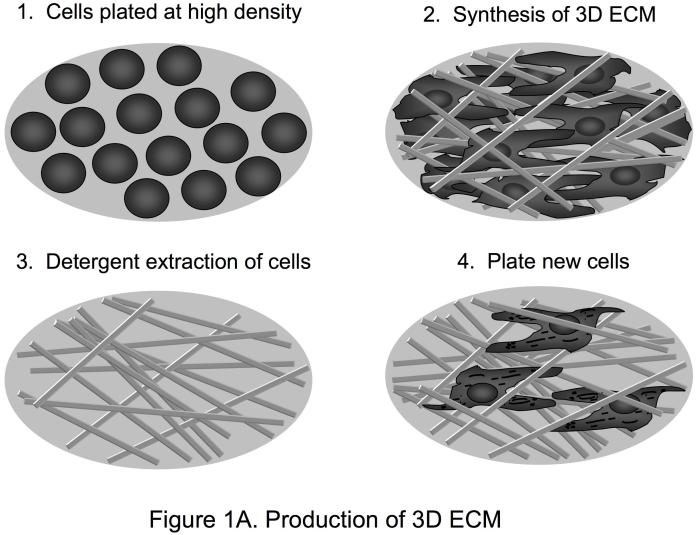
Figure 1
Figure 1
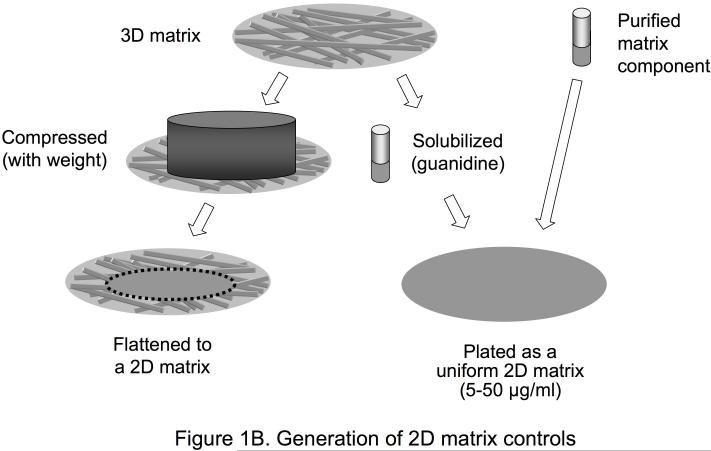
Production of 3D ECM and 2D matrix controls. A. This illustration describes the method for generating tissue culture surfaces coated with cell-derived three-dimensional matrices. This method can be adapted to many cell types. Using NIH 3T3 fibroblasts, matrices 7-15 μm thick composed mainly of fibronectin fibrillar lattices can be obtained. First, fibroblasts are plated and maintained in culture in a confluent state. Five to nine days later, the matrices are denuded of cells using detergent, and cellular debris is removed. The 3D matrices can be washed and stored for periods of up to two to three weeks at 4°C before plating cells on them to examine cellular responses. B. Various methods can be used to obtain appropriate controls for use in 3D ECM studies. To obtain 2D controls with the same molecular composition as the 3D matrix, the 3D matrix can be solubilized in guanidine and plated as a 2D matrix, or the 3D matrix can be mechanically compressed using a known weight applied to a given area. Alternatively, a purified matrix component such as fibronectin can be solubilized and plated as a 2D matrix.
Figure 1
Figure 1
Production of 3D ECM and 2D matrix controls. A. This illustration describes the method for generating tissue culture surfaces coated with cell-derived three-dimensional matrices. This method can be adapted to many cell types. Using NIH 3T3 fibroblasts, matrices 7-15 μm thick composed mainly of fibronectin fibrillar lattices can be obtained. First, fibroblasts are plated and maintained in culture in a confluent state. Five to nine days later, the matrices are denuded of cells using detergent, and cellular debris is removed. The 3D matrices can be washed and stored for periods of up to two to three weeks at 4°C before plating cells on them to examine cellular responses. B. Various methods can be used to obtain appropriate controls for use in 3D ECM studies. To obtain 2D controls with the same molecular composition as the 3D matrix, the 3D matrix can be solubilized in guanidine and plated as a 2D matrix, or the 3D matrix can be mechanically compressed using a known weight applied to a given area. Alternatively, a purified matrix component such as fibronectin can be solubilized and plated as a 2D matrix.
Figure 2
Figure 2
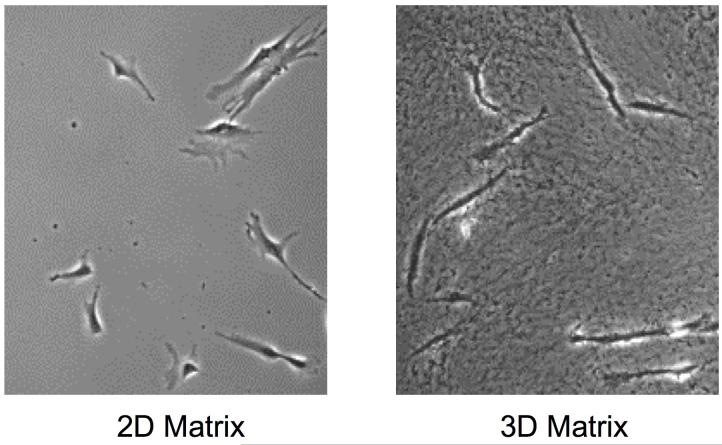
Differences in cell morphology between cells on a 2D matrix and in a fibrillar 3D matrix. Fibroblasts cultured in a cell-derived 3D matrix appear elongated and spindle-shaped compared to cells plated on a 2D matrix, which possess characteristic fan-shaped lamellae. On a 2D matrix, an artificial cell polarity is created between the upper and lower surfaces of the cell. No such polarity exists within the 3D matrix since the cells are completely surrounded by extracellular matrix proteins. Note the fibrillar appearance of the 3D matrix.
Figure 3
Figure 3
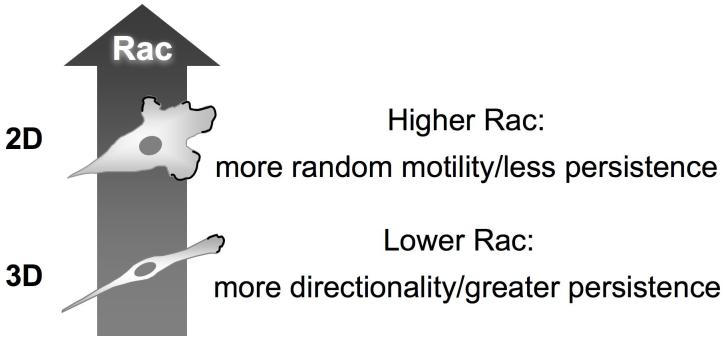
The Rac switch. Fibroblasts migrating in a 3D microenvironment have moderately lower total levels of Rac activation, which results in fewer peripheral lamellae and greater directionality and persistence of migration. The reduction in overall Rac levels does not affect the localization of Rac to the leading edge, which represents a general mechanism for stimulating migration using leading lamellae.
Figure 4
Figure 4
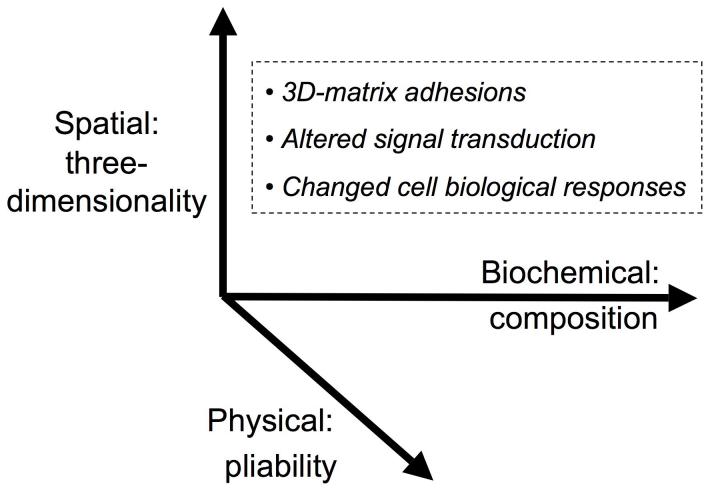
Factors in the microenvironment that regulate cell responses. At least three major classes of microenvironmental factors affect cellular behavior. The biochemical composition of the ECM, e.g. its content of collagen versus other molecules, plays a well-known role. In addition, however, physical parameters of the matrix, particularly its pliability, can have major effects on cellular responses. A third parameter involves spatial cues, particularly whether a matrix is two-dimensional (providing a unidirectional source of polarity) or three-dimensional. Each of these classes of microenvironmental factors can affect the type of cell adhesion, e.g. 3D-matrix adhesions compared to focal adhesions, can have different effects on various signal transduction pathways, and can change cell morphology, proliferation, migration, and differentiation.

References

    1. Griffith LG, Swartz MA. Capturing complex 3D tissue physiology in vitro. Nat Rev Mol Cell Biol. 2006;7:211–224. - PubMed
    1. Schindler M, Nur EKA, Ahmed I, Kamal J, Liu HY, Amor N, Ponery AS, Crockett DP, Grafe TH, Chung HY, Weik T, Jones E, Meiners S. Living in three dimensions: 3D nanostructured environments for cell culture and regenerative medicine. Cell Biochem Biophys. 2006;45:215–227. - PubMed
    1. Hynes RO. Integrins: bidirectional, allosteric signaling machines. Cell. 2002;110:673–687. - PubMed
    1. DeMali KA, Wennerberg K, Burridge K. Integrin signaling to the actin cytoskeleton. Curr Opin Cell Biol. 2003;15:572–582. - PubMed
    1. Aota S, Nagai T, Yamada KM. Characterization of regions of fibronectin besides the arginine-glycine-aspartic acid sequence required for adhesive function of the cell-binding domain using site-directed mutagenesis. J Biol Chem. 1991;266:15938–15943. - PubMed

Publication types

MeSH terms