


Review
doi: 10.1016/j.bbrc.2007.08.054.
Epub 2007 Aug 20.
Hsp90--from signal transduction to cell transformation
Affiliations
- PMID: 17826744
- PMCID: PMC2528838
- DOI: 10.1016/j.bbrc.2007.08.054
Item in Clipboard
Review
Hsp90--from signal transduction to cell transformation
Biochem Biophys Res Commun.
.
Abstract
The molecular chaperone, Hsp90, facilitates the maturation and/or activation of over 100 'client proteins' involved in signal transduction and transcriptional regulation. Largely an enigma among the families of heat shock proteins, Hsp90 is central to processes broadly ranging from cell cycle regulation to cellular transformation. Here, we review the contemporary body of knowledge regarding the biochemical mechanisms of Hsp90 and update the most current paradigms defining its involvement in both normal and pathological cell physiology.
Figures
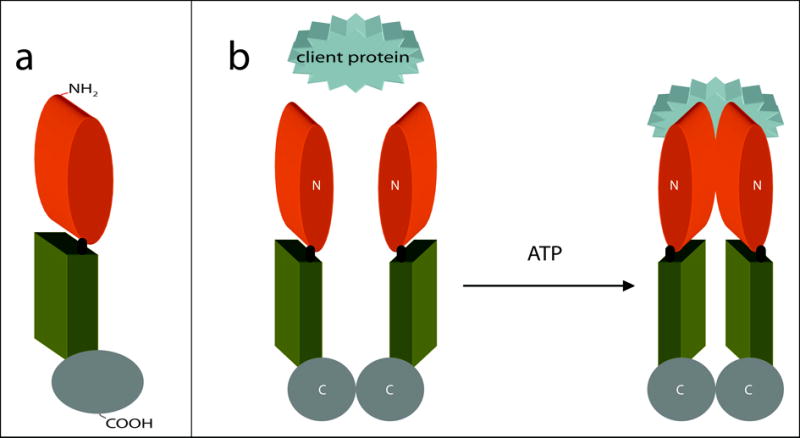
(a) Schematic representation of Hsp90. The Hsp90 monomer is comprised of three domains: the N-terminal domain responsible for ATP-binding (orange), a core domain (green), and a C-terminal domain that facilitates homodimerization (gray). In eukaryotes, a short charged region links the N-terminal and core domains (black). (b) ATP-driven molecular clamp cycle of Hsp90. In the absence of bound nucleotide, the C-termini (C) of two Hsp90 monomers interact to maintain an antiparallel dimer (left). Concurrently, the N-termini (N) of the Hsp90 homodimer preserve an open-state, facilitating the capture of client proteins (left). On the right, association with ATP induces modest changes in the conformation of Hsp90 that permit a transitory interaction between the opposing N-terminal domains. This produces the closed-form of Hsp90 where clamping of the substrate protein occurs.
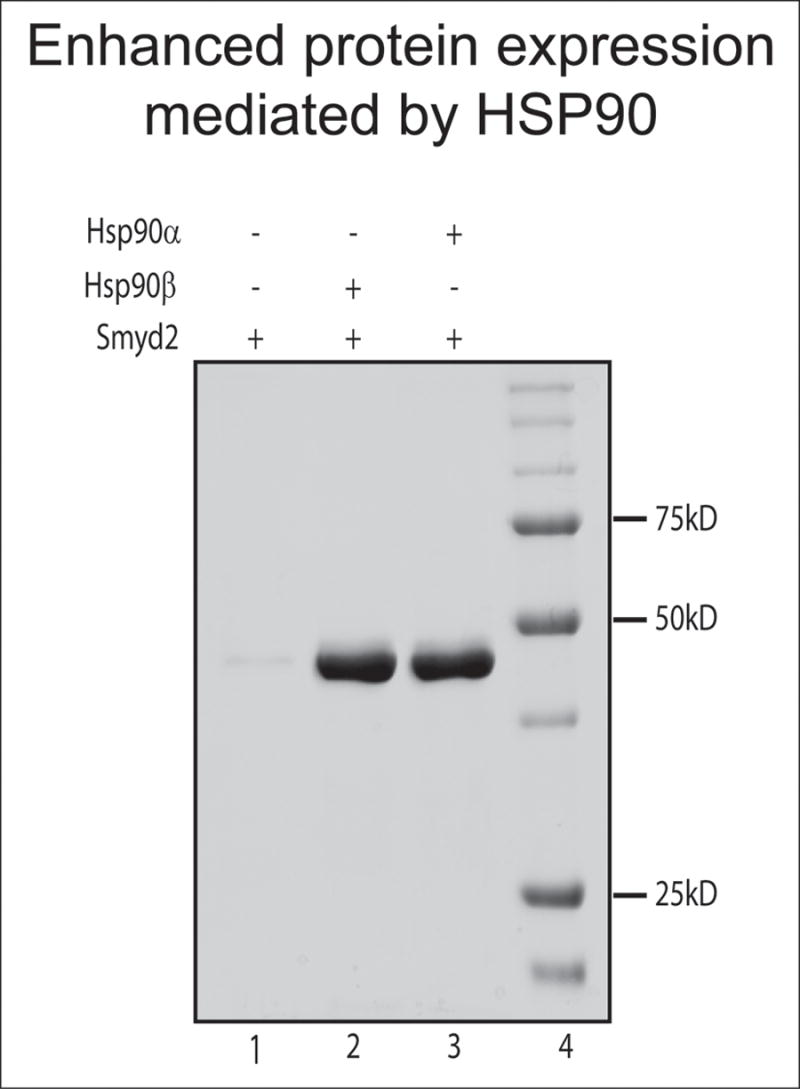
There are two isoforms of Hsp90 (Hsp90α and Hsp90β) which share 85% identity and maintain virtually indistinguishable functional properties [59]. Here, Hsp90 isoform-expressing Escherichia coli strains produce higher yields of soluble Smyd2. Wild type (lane1) and Hsp90 isoform-expressing (lanes 2 and 3) E. coli strains were transformed with a Smyd2 expression construct [45]. Equal amounts (2.5 g wet cell paste) of cultured E. coli cells were used for isolation and purification of Smyd2. The migration of molecular weight markers (in kiloDaltons) is indicated. The depicted results are representative of the enhanced solubility achieved with numerous proteins (Table 1) in Hsp90+ strains.
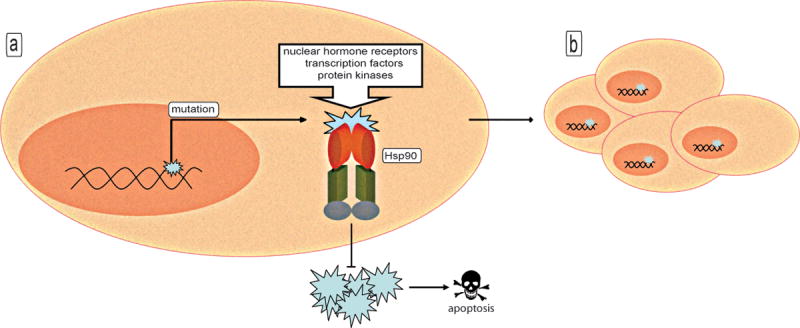
(a) Hsp90 stabilizes many mutated proteins that mediate cell transformation and prevents the aggregation of aberrantly expressed proteins (blue), which would otherwise result in toxic stress signals leading to the progression of apoptosis. (b) The chaperoning capacity of Hsp90 facilitates the evolution of neoplastic clones.
References
-
- Finkelstein DB, Strausberg S. Identification and expression of a cloned yeast heat shock gene. J Biol Chem. 1983;258:1908–1913. - PubMed
-
- Meng X, Jerome V, Devin J, Baulieu EE, Catelli MG. Cloning of chicken hsp90 beta: the only vertebrate hsp90 insensitive to heat shock. Biochem Biophys Res Commun. 1993;190:630–636. - PubMed
-
- Pearl LH, Prodromou C. Structure and in vivo function of Hsp90. Curr Opin Struct Biol. 2000;10:46–51. - PubMed
-
- Pearl LH, Prodromou C. Structure and mechanism of the Hsp90 molecular chaperone machinery. Annu Rev Biochem. 2006;75:271–294. - PubMed
Publication types
MeSH terms
Substances
Grants and funding
LinkOut - more resources
Full Text Sources
Miscellaneous
