


Impact of substrate glycoside linkage and elemental sulfur on bioenergetics of and hydrogen production by the hyperthermophilic archaeon Pyrococcus furiosus
- PMID: 17827328
- PMCID: PMC2074980
- DOI: 10.1128/AEM.00597-07
Impact of substrate glycoside linkage and elemental sulfur on bioenergetics of and hydrogen production by the hyperthermophilic archaeon Pyrococcus furiosus
Abstract
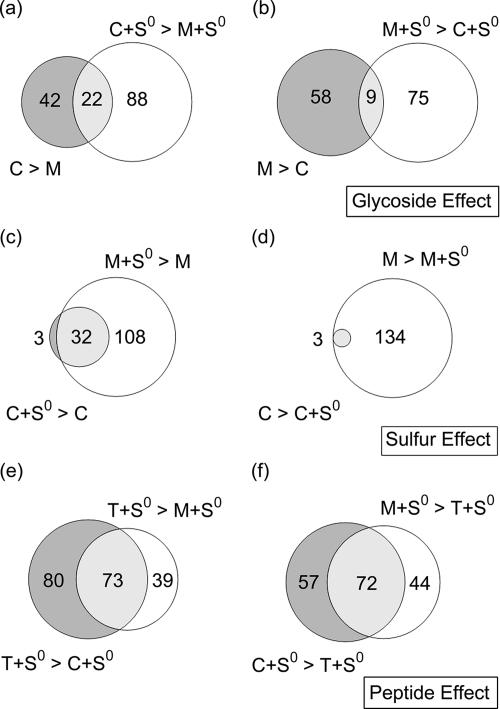
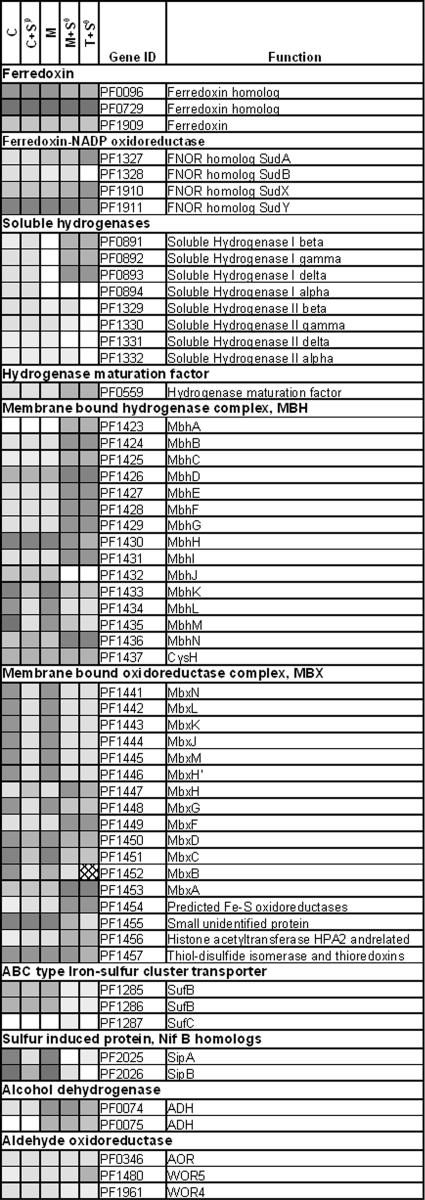
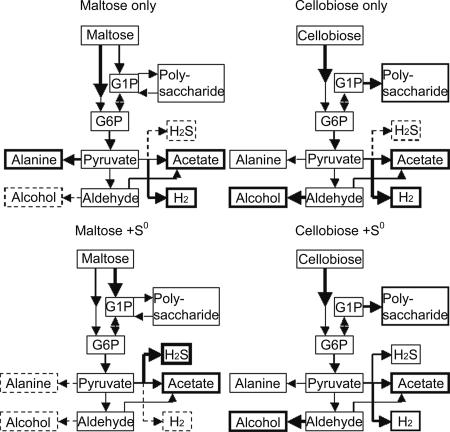
Glycoside linkage (cellobiose versus maltose) dramatically influenced bioenergetics to different extents and by different mechanisms in the hyperthermophilic archaeon Pyrococcus furiosus when it was grown in continuous culture at a dilution rate of 0.45 h(-1) at 90 degrees C. In the absence of S(0), cellobiose-grown cells generated twice as much protein and had 50%-higher specific H(2) generation rates than maltose-grown cultures. Addition of S(0) to maltose-grown cultures boosted cell protein production fourfold and shifted gas production completely from H(2) to H(2)S. In contrast, the presence of S(0) in cellobiose-grown cells caused only a 1.3-fold increase in protein production and an incomplete shift from H(2) to H(2)S production, with 2.5 times more H(2) than H(2)S formed. Transcriptional response analysis revealed that many genes and operons known to be involved in alpha- or beta-glucan uptake and processing were up-regulated in an S(0)-independent manner. Most differentially transcribed open reading frames (ORFs) responding to S(0) in cellobiose-grown cells also responded to S(0) in maltose-grown cells; these ORFs included ORFs encoding a membrane-bound oxidoreductase complex (MBX) and two hypothetical proteins (PF2025 and PF2026). However, additional genes (242 genes; 108 genes were up-regulated and 134 genes were down-regulated) were differentially transcribed when S(0) was present in the medium of maltose-grown cells, indicating that there were different cellular responses to the two sugars. These results indicate that carbohydrate characteristics (e.g., glycoside linkage) have a major impact on S(0) metabolism and hydrogen production in P. furiosus. Furthermore, such issues need to be considered in designing and implementing metabolic strategies for production of biofuel by fermentative anaerobes.
Figures
References
-
- Adams, M. W. 1993. Enzymes and proteins from organisms that grow near and above 100°C. Annu. Rev. Microbiol. 47:627-658. - PubMed
-
- Adams, M. W., J. F. Holden, A. L. Menon, G. J. Schut, A. M. Grunden, C. Hou, A. M. Hutchins, F. E. Jenney, Jr., C. Kim, K. Ma, G. Pan, R. Roy, R. Sapra, S. V. Story, and M. F. Verhagen. 2001. Key role for sulfur in peptide metabolism and in regulation of three hydrogenases in the hyperthermophilic archaeon Pyrococcus furiosus. J. Bacteriol. 183:716-724. - PMC - PubMed
-
- Akutsu, J., Z. Zhang, M. Tsujimura, M. Sasaki, M. Yohda, and Y. Kawarabayasi. 2005. Characterization of a thermostable enzyme with phosphomannomutase/phosphoglucomutase activities from the hyperthermophilic archaeon Pyrococcus horikoshii OT3. J. Biochem. 138:159-166. - PubMed
-
- Bauer, M. W., E. J. Bylina, R. V. Swanson, and R. M. Kelly. 1996. Comparison of a beta-glucosidase and a beta-mannosidase from the hyperthermophilic archaeon Pyrococcus furiosus. Purification, characterization, gene cloning, and sequence analysis. J. Biol. Chem. 271:23749-23755. - PubMed
Publication types
MeSH terms
Substances
LinkOut - more resources
Full Text Sources
Other Literature Sources
