. 2007 Sep;19(9):2866-85.
doi: 10.1105/tpc.107.052944. Epub 2007 Sep 7.

AP2-ERF transcription factors mediate Nod factor dependent Mt ENOD11 activation in root hairs via a novel cis-regulatory motif

Affiliations

AP2-ERF transcription factors mediate Nod factor dependent Mt ENOD11 activation in root hairs via a novel cis-regulatory motif

Andry Andriankaja et al. Plant Cell. 2007 Sep.

Abstract

Rhizobium Nod factors (NFs) are specific lipochitooligosaccharides that activate host legume signaling pathways essential for initiating the nitrogen-fixing symbiotic association. This study describes the characterization of cis-regulatory elements and trans-interacting factors that regulate NF-dependent and epidermis-specific gene transcription in Medicago truncatula. Detailed analysis of the Mt ENOD11 promoter using deletion, mutation, and gain-of-function constructs has led to the identification of an NF-responsive regulatory unit (the NF box) sufficient to direct NF-elicited expression in root hairs. NF box-mediated expression requires a major GCC-like motif, which is also essential for the binding of root hair-specific nuclear factors. Yeast one-hybrid screening has identified three closely related AP2/ERF transcription factors (ERN1 to ERN3) that are able to bind specifically to the NF box. ERN1 is identical to an ERF-like factor identified recently. Expression analysis has revealed that ERN1 and ERN2 genes are upregulated in root hairs following NF treatment and that this activation requires a functional NFP gene. Transient expression assays in Nicotiana benthamiana have further shown that nucleus-targeted ERN1 and ERN2 factors activate NF box-containing reporters, whereas ERN3 represses ERN1/ERN2-dependent transcription activation. A model is proposed for the fine-tuning of NF-elicited gene transcription in root hairs involving the interplay between repressor and activator ERN factors.


Figures
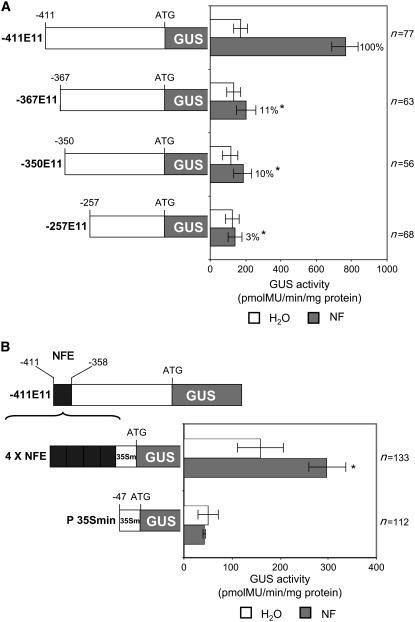
Figure 1.
Figure 1.
Identification of a 54-bp Nod Factor–Responsive Element (NFE) within the Mt ENOD11 Promoter Sufficient to Drive Root Hair–Specific Expression. GUS activity driven by Mt ENOD11 5′ promoter deletions and gain-of-function constructs fused to the GUS reporter gene were analyzed in transgenic M. truncatula roots. (A) Schematic representation of Mt ENOD11 5′ promoter deletion fusions. Numbers above the promoters indicate the positions of 5′ deletions relative to the translation initiation codon ATG. Fluorimetric GUS activities were quantified in root extracts following either water (white bars) or NF (10−9 M) (gray bars) treatment. The percentage values refer to the proportion of NF-induced GUS activity (i.e., after subtraction of the water control value) of a given construct in relation to the −411E11 reference construct. Asterisks indicate statistically significant differences (P < 0.05, Student's t test) compared with the reference −411E11 construct (see Supplemental Table 1 online). (B) Fluorimetric analyses of reporter GUS activities driven by the gain-of-function 4xNFE construct and the control P35S min construct following NF treatments (10−9 M). The asterisk indicates a statistically significant difference (P < 0.05, Student's t test) compared with the reference P35S min construct. Error bars represent ±sd of mean activity values derived from three independent experiments performed with n number of individual roots.
Figure 2.
Figure 2.
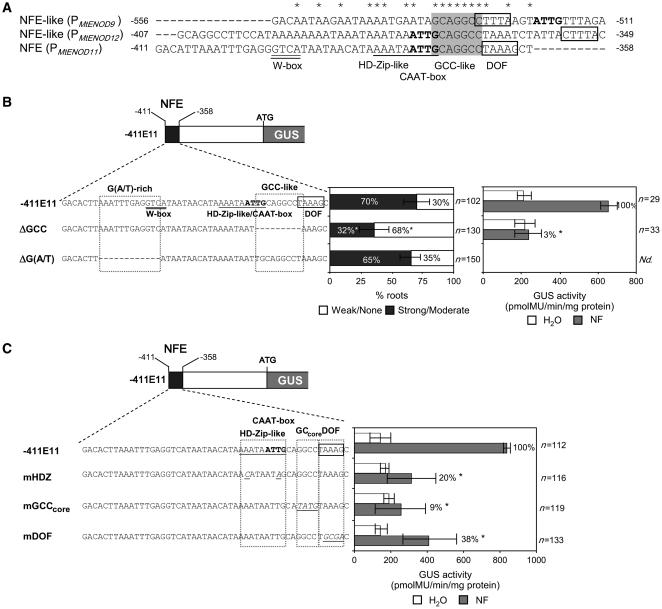
Functional Analyses of Conserved cis Motifs Involved in NF-Elicited Expression. (A) Partial sequence alignment of NFE and NFE-like sequences within the Mt ENOD11, -9, and -12 promoters. Asterisks indicate conserved nucleotides at the given positions. The fully conserved 8-bp GCC-like motif is shaded. Putative W box (GTCA), HD-ZIP–like (AAATAATTG), CAAT box (CAAT or ATTG), and DOF (TAAAG or CTTTA) sequences are indicated by double underlining, underlining, boldface lettering, and boxing, respectively. (B) GUS activity of the −411E11 reference and derived constructs block-deleted within the conserved GCC-like and/or G(A/T)-rich motifs of NFE. The relative strength of root hair–specific GUS activity was visually screened in individual NF-treated roots (see Methods) and is represented as the percentage of roots exhibiting clear-cut GUS activity in the root hairs. GUS activity levels were also measured by fluorimetric assays in protein extracts from either water-treated (white bars) or NF-treated (gray bars) roots. The percentage values refer to NF-elicited GUS activities (i.e., after subtraction of the water control value) relative to that obtained with the −411E11 reference construct. (C) Quantitative analysis of GUS activity driven by the −411E11 construct and its mutated derivatives. Substituted nucleotides are shown in italics and underlined. The percentage values refer to NF-induced GUS activities relative to the reference construct. In (B) and (C), error bars represent ±sd and asterisks indicate significant differences compared with the reference construct (P < 0.05, Student's t test) (see Supplemental Table 1 online). n represents the number of individual transgenic roots analyzed.
Figure 3.
Figure 3.
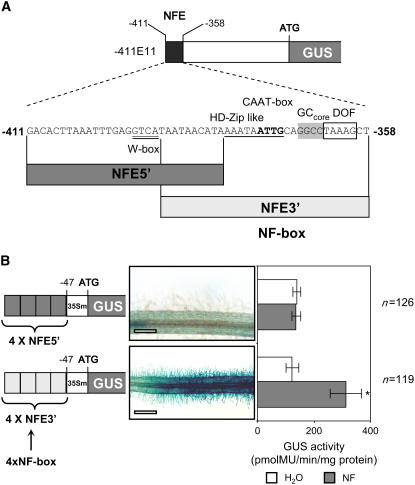
The NF Box Confers an NF-Specific Response in the Root Epidermis. (A) Schematic representation of the NFE sequence and associated cis motifs. The sequences NFE5′ and NFE3′ (NF box) were used to generate the new gain-of-function constructs tested in (B). (B) Histochemical and quantitative analyses of GUS activity directed by gain-of-function 4xNFE5′ and 4xNFE3′ (4xNF box) constructs. Data are represented as mean values obtained by the analysis of n individual roots from three independent experiments. Error bars represent ±sd. The asterisk indicates a significant difference compared with the reference construct (P < 0.05, Student's t test) (see Supplemental Table 1 online). Bars = 200 μm.
Figure 4.
Figure 4.
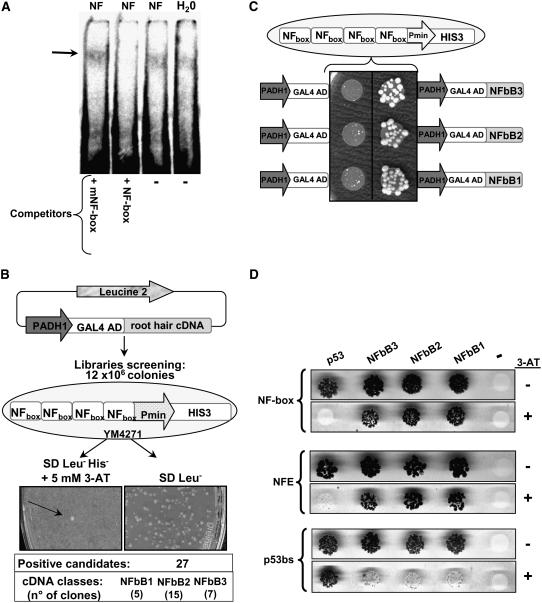
Isolation of NF Box Binding Proteins. (A) Band shift experiments using an NF box–containing DNA probe with root hair protein extracts from 6-h water- or NF-treated roots. In competitor lane reactions, 50 to 100 molar excesses of cold NF box or mNF box probes were included. (B) Schematic representation of the one-hybrid strategy used to screen cDNA libraries from NF-treated root hairs using a HIS3 reporter gene under the control of a minimal HIS3 promoter fused to a tetramer of the NF box and expressed in the yeast YM4271 reporter strain. The number of positive clones corresponding to each of the three cDNA classes (NFbB1, NFbB2, and NFbB3) isolated after two rounds of screening and able to grow on 5 mM 3-AT is indicated. (C) Confirmation of the interaction of NFbB1, NfbB2, and NFbB3 with the NF box by retransformation of yeast YM4271 containing the tetramer NF box-HIS3 reporter with the isolated plasmids expressing GAL4-NFbB fusions and control GAL4 plasmids. Yeast cells were grown on synthetic dropout (SD) LeuHis + 5 mM 3-AT medium. (D) Binding specificity of NFbB proteins. YM4721 reporter strains carrying tetramer NF box, tetramer NFE, and trimer p53 cis (p53bs) sequences were transformed with plasmids expressing the mouse GAL4-p53 factor that interacts with the p53 binding site, the NFbBs GAL4-NFbBs proteins, and the water control (−). Yeast growth was examined under either nonselective SD Leu conditions (−3-AT) or selective SD LeuHis conditions on medium supplemented with 5 mM 3-AT (+3-AT).
Figure 5.
Figure 5.
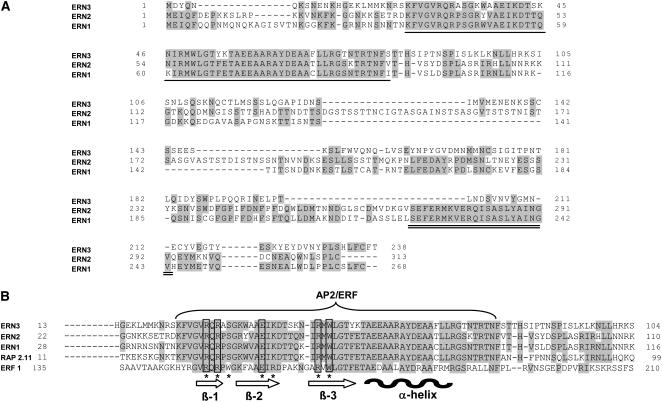
NF Box Binding Proteins Named ERN1, ERN2, and ERN3 Belong to the ERF Transcription Factor Family. Comparison of the deduced amino acid sequences of the three entire ERN1, ERN2, and ERN3 proteins (A) and the corresponding AP2/ERF DNA binding domains aligned by ClustalW (Thompson et al., 1997) with those of the related Arabidopsis RAP2.11 proteins (B). Identical amino acid residues are shaded gray. The conserved AP2/ERF DNA binding domain in (A) is underlined, and the 20–amino acid stretch conserved in ERN1 and ERN2 is double underlined. In (B), the conserved AP2/ERF DNA binding domain is indicated. The black wavy bar and arrows represent predicted α-helix and β-sheet regions, respectively, within the AP2/ERF domain of At ERF1 (Allen et al., 1998). Asterisks correspond to conserved amino acid residues required for DNA binding to GCC box motifs.
Figure 6.
Figure 6.
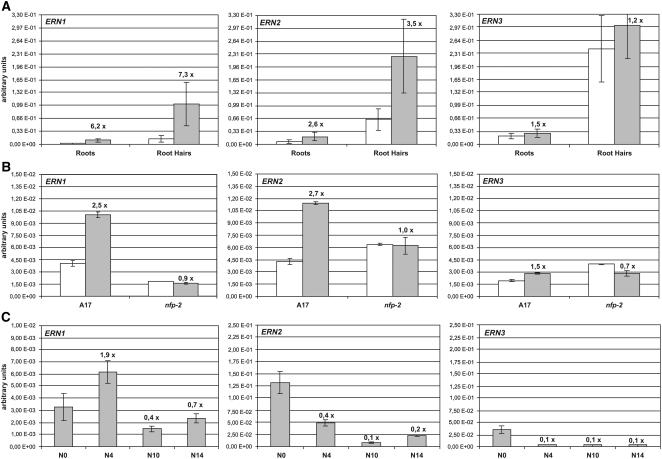
The ERN1, ERN2, and ERN3 Genes Are Upregulated in NF-Treated M. truncatula Root Tissues. (A) Quantitative RT-PCR for ERN1, ERN2, and ERN3 transcripts in total RNA samples extracted from 3-d in vitro grown wild-type intact roots or isolated root hairs treated with either water (white bars) or 10−8 M NFs (gray bars) for 6 h. (B) Quantitative RT-PCR for ERN transcripts in total RNA samples extracted from 3-d aeroponically grown wild-type (A17) or nfp-2 mutant roots treated with either water (white bars) or 10−9 M NFs (gray bars) for 6 h. (C) Quantitative RT-PCR for ERN transcripts in total RNA samples extracted from nitrogen-starved 10-d aeroponically grown wild-type roots (N0) or isolated nodules harvested at 4 d (N4), 10 d (N10), or 14 d (N14) after inoculation. Values represent averages of either two or three independent biological experiments after normalization against EF1α transcript levels (see Methods). Multiplication factors above the shaded bars refer to NF:water expression ratios. Error bars represent ±sd.
Figure 7.
Figure 7.
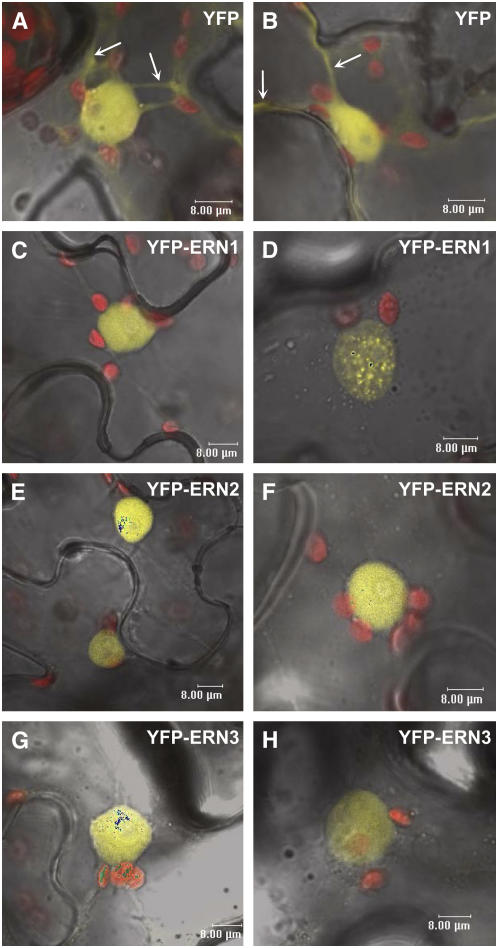
Nuclear Localization of ERN1-, ERN2-, and ERN3-YFP Fusion Proteins. Confocal images of epidermal N. benthamiana cells expressing control YFP ([A] and [B]), YFP-ERN1 ([C] and [D], YFP-ERN2 ([E] and [F]), and YFP-ERN3 ([G] and [H]) fusion proteins under the control of the 35S promoter. Note the exclusive nuclear localization for the ERN proteins in the nucleoplasm ([C] and [E] to [H]) or in discrete nuclear bodies (D) compared with the cytoplasm (arrows) and the nucleus-localized YFP control ([A] and [B]). In all panels, chloroplast fluorescence appears red. Similar results were obtained with green fluorescent protein (GFP) fusion proteins (data not shown).
Figure 8.
Figure 8.
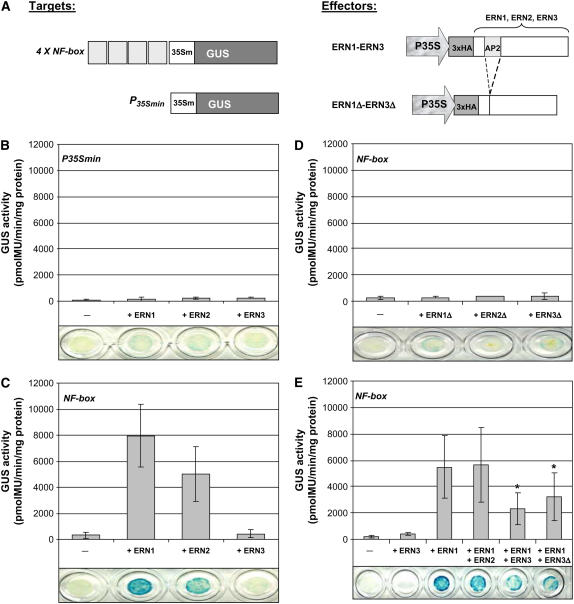
Transactivation and Repressor Properties of ERN Factors in N. benthamiana Cells. (A) Schematic representation of the 3xHA-tagged ERN effector proteins and the target GUS reporters used for trans-activation studies in A. tumefaciens–infiltrated N. benthamiana cells. The P35Smin-GUS reporter construct alone or fused to the tetramer of the NF box (4xNF box) was used as target GUS reporter. The effector constructs were under the control of the 35S promoter (P35S), and all contained a 3xHA 5′ tag upstream of the ERN sequences, deleted (ERN1Δ, ERN2Δ, and ERN3Δ) or not (ERN1, ERN2, and ERN3), for their respective AP2/ERF (AP2) DNA binding domains. (B) to (E) Histochemical and fluorimetric GUS activities of N. benthamiana leaf discs at 24 h following infiltration with the reporters alone (−) or in combination with the different effectors. ERN1 to -3 or ERN1Δ to -3Δ effectors were coinfiltrated with P35Smin (B) or 4xNF box ([C] and [D]) target GUS reporters. Transcriptional activation of the 4xNF box reporter in (E) was measured following expression of individual ERN1 or ERN3 effectors or combined expression of ERN1/ERN2, ERN1/ERN3, or ERN1/ERN3Δ effectors. GUS activity levels were measured using 1 μg of total protein extracts. Error bars represent ±sd of mean GUS activity values derived from either three or four ([B] to [D]) or seven to nine (E) independent experiments. In (E), data are compiled from measurements of 15 to 18 individual samples that were used for Student's t test statistical analysis. Asterisks indicate statistically significant differences (P < 0.05, Student's t test) compared with the reference ERN1 effector construct (see Supplemental Table 2 online).
Figure 9.
Figure 9.
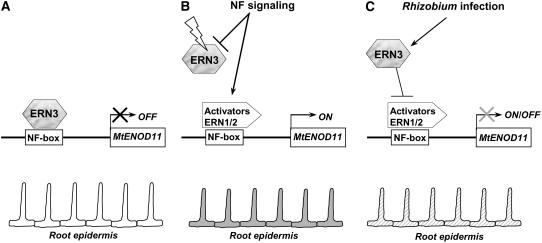
Model for ERN Factor–Mediated Regulation of Early Nodulin Gene Expression in M. truncatula Root Hairs. In the absence of the rhizobial partner, we propose that constitutive binding of ERN3 to the NF box sequence represses Mt ENOD11 gene expression in the root epidermis (A). During the early preinfection stages of the symbiotic association (B), NFs secreted by S. meliloti are perceived and transduced by the NFP-dependent NF signaling pathway. Transcription activation and accumulation of the ERN1/2 activators, probably accompanied by modifications of ERN3 protein levels/activities, lead to transactivation of the Mt ENOD11 gene in root hairs via the NF box regulatory unit (B). Upon bacterial root infection, de novo accumulation of active ERN3 presumably leads to the progressive repression of ERN1/ERN2 transcription activities.

References

    1. Aharoni, A., Dixit, S., Jetter, R., Thoenes, E., van Arkel, G., and Pereira, A. (2004). The SHINE clade of AP2 domain transcription factors activates wax biosynthesis, alters cuticle properties, and confers drought tolerance when overexpressed in Arabidopsis. Plant Cell 16 2463–2480. - PMC - PubMed
    1. Allen, M.D., Yamasaki, K., Ohme-Takagi, M., Tateno, M., and Suzuki, M. (1998). A novel mode of DNA recognition by a beta-sheet revealed by the solution structure of the GCC-box binding domain in complex with DNA. EMBO J. 17 5484–5496. - PMC - PubMed
    1. Al-Sady, B., Ni, W., Kircher, S., Schafer, E., and Quail, P.H. (2006). Photoactivated phytochrome induces rapid PIF3 phosphorylation prior to proteasome-mediated degradation. Mol. Cell 23 439–446. - PubMed
    1. Ané, J.M., et al. (2004). Medicago truncatula DMI1 required for bacterial and fungal symbioses in legumes. Science 303 1364–1367. - PubMed
    1. Ardourel, M., Demont, N., Debellé, F., Maillet, F., de Billy, F., Promé, J.C., Dénarié, J., and Truchet, G. (1994). Rhizobium meliloti lipooligosaccharide nodulation factors: Different structural requirements for bacterial entry into target root hair cells and induction of plant symbiotic developmental responses. Plant Cell 6 1357–1374. - PMC - PubMed

MeSH terms

Substances

Associated data

LinkOut - more resources