Changes in exposure of adult non-smokers to secondhand smoke after implementation of smoke-free legislation in Scotland: national cross sectional survey
- PMID: 17827485
- PMCID: PMC1976488
- DOI: 10.1136/bmj.39315.670208.47
Changes in exposure of adult non-smokers to secondhand smoke after implementation of smoke-free legislation in Scotland: national cross sectional survey
Abstract
Objective: To measure change in adult non-smokers' exposure to secondhand smoke in public and private places after smoke-free legislation was implemented in Scotland.
Design: Repeat cross sectional survey.
Setting: Scotland.
Participants: Scottish adults, aged 18 to 74 years, recruited and interviewed in their homes.
Intervention: Comprehensive smoke-free legislation that prohibits smoking in virtually all enclosed public places and workplaces, including bars, restaurants, and cafes.
Outcome measures: Salivary cotinine, self reported exposure to smoke in public and private places, and self reported smoking restriction in homes and in cars.
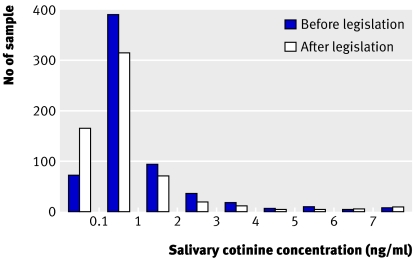
Results: Overall, geometric mean cotinine concentrations in adult non-smokers fell by 39% (95% confidence interval 29% to 47%), from 0.43 ng/ml at baseline to 0.26 ng/ml after legislation (P<0.001). In non-smokers from non-smoking households, geometric mean cotinine concentrations fell by 49% (40% to 56%), from 0.35 ng/ml to 0.18 ng/ml (P<0.001). The 16% fall in cotinine concentrations in non-smokers from smoking households was not statistically significant. Reduction in exposure to secondhand smoke was associated with a reduction after legislation in reported exposure to secondhand smoke in public places (pubs, other workplaces, and public transport) but not in homes and cars. We found no evidence of displacement of smoking from public places into the home.
Conclusions: Implementation of Scotland's smoke-free legislation has been accompanied within one year by a large reduction in exposure to secondhand smoke, which has been greatest in non-smokers living in non-smoking households. Non-smokers living in smoking households continue to have high levels of exposure to secondhand smoke.
Conflict of interest statement
Figures
Comment in
-
The future of smoke-free legislation.BMJ. 2007 Sep 15;335(7619):521-2. doi: 10.1136/bmj.39315.616169.BE. Epub 2007 Sep 9. BMJ. 2007. PMID: 17827486 Free PMC article.
-
Banning smoking: Confessions of an accordion cleaner.BMJ. 2007 Sep 29;335(7621):630. doi: 10.1136/bmj.39346.507778.3A. BMJ. 2007. PMID: 17901481 Free PMC article. No abstract available.
References
-
- Brennan P, Buffler PA, Reynolds P, Wu AH, Wichmann HE, Agudo A, et al. Second hand smoke exposure in adulthood and risk of lung cancer among never smokers: a pooled analysis of two large studies. Int J Cancer 2004;109:125-31. - PubMed
-
- Chan-Yeung M, Dimich-Ward H. Respiratory health effects of exposure to environmental tobacco smoke. Respirology 2003;8:131-9. - PubMed
-
- California Environmental Health Protection Agency. Proposed identification of environmental tobacco smoke as a toxic air contaminant. Part B: health effects. 2005. http://repositories.cdlib.org/tc/surveys/CALEPA2005/
Publication types
MeSH terms
Substances
LinkOut - more resources
Full Text Sources
Medical