Reduced inhibition of cortical glutamate and GABA release by halothane in mice lacking the K+ channel, TREK-1
- PMID: 17828284
- PMCID: PMC2078222
- DOI: 10.1038/sj.bjp.0707450
Reduced inhibition of cortical glutamate and GABA release by halothane in mice lacking the K+ channel, TREK-1
Abstract
Background and purpose: Deletion of TREK-1, a two-pore domain K(+) channel (K(2P)) activated by volatile anaesthetics, reduces volatile anaesthetic potency in mice, consistent with a role for TREK-1 as an anaesthetic target. We used TREK-1 knockout mice to examine the presynaptic function of TREK-1 in transmitter release and its role in the selective inhibition of glutamate vs GABA release by volatile anaesthetics.
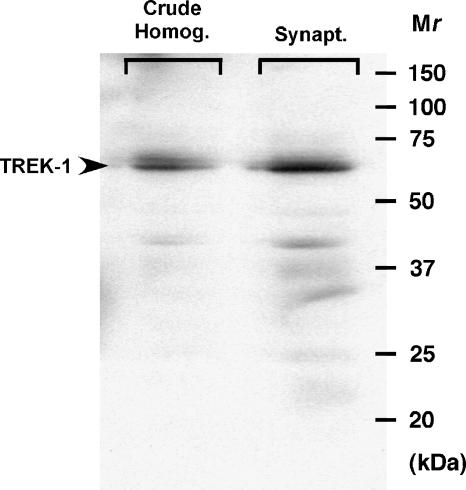
Experimental approach: The effects of halothane on 4-aminopyridine-evoked and basal [(3)H]glutamate and [(14)C]GABA release from cerebrocortical nerve terminals isolated from TREK-1 knockout (KO) and littermate wild-type (WT) mice were compared. TREK-1 was quantified by immunoblotting of nerve terminal preparations.
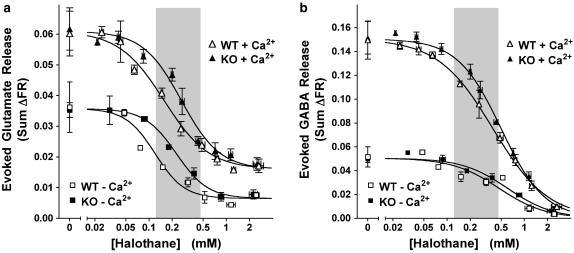
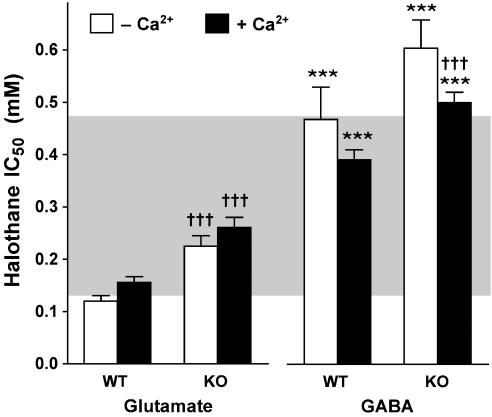
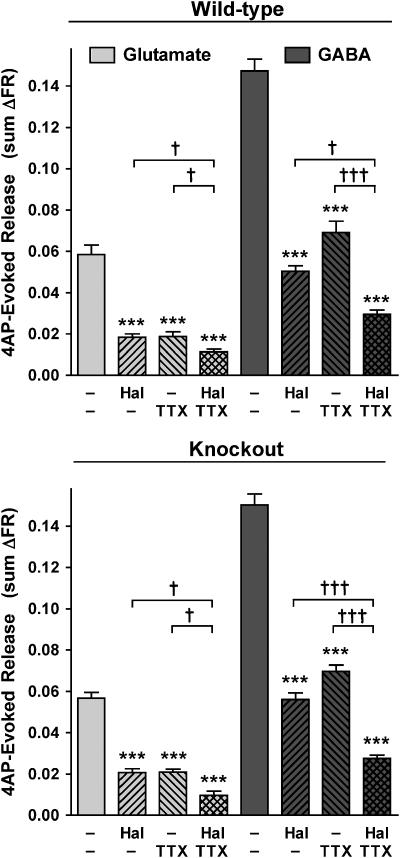
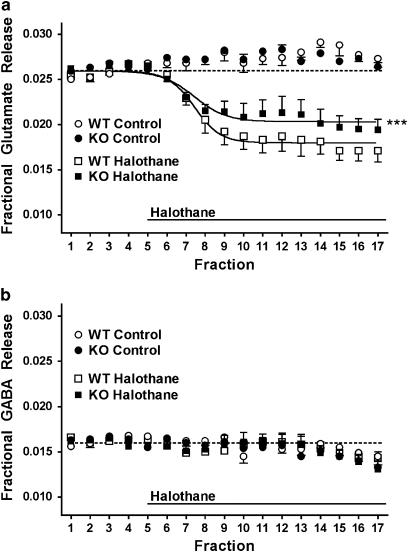
Key results: Deletion of TREK-1 significantly reduced the potency of halothane inhibition of 4-aminopyridine-evoked release of both glutamate and GABA without affecting control evoked release or the selective inhibition of glutamate vs GABA release. TREK-1 deletion also reduced halothane inhibition of basal glutamate release, but did not affect basal GABA release.
Conclusions and implications: The reduced sensitivity of glutamate and GABA release to inhibition by halothane in TREK-1 KO nerve terminals correlates with the reduced anaesthetic potency of halothane in TREK-1 KO mice observed in vivo. A presynaptic role for TREK-1 was supported by the enrichment of TREK-1 in isolated nerve terminals determined by immunoblotting. This study represents the first evidence for a link between an anaesthetic-sensitive 2-pore domain K(+) channel and presynaptic function, and provides further support for presynaptic mechanisms in determining volatile anaesthetic action.
Figures
References
-
- Bai X, Bugg GJ, Greenwood SL, Glazier JD, Sibley CP, Baker PN, et al. Expression of TASK and TREK, two-pore domain K+ channels, in human myometrium. Reproduction. 2005;129:525–530. - PubMed
-
- Franks NP, Honore E. The TREK K2P channels and their role in general anaesthesia and neuroprotection. Trends Pharmacol Sci. 2004;25:601–608. - PubMed
-
- Gruss M, Bushell TJ, Bright DP, Lieb WR, Mathie A, Franks NP. Two-pore domain K+ channels are a novel target for the anesthetic gases xenon, nitrous oxide, and cyclopropane. Mol Pharmacol. 2004;65:443–452. - PubMed
Publication types
MeSH terms
Substances
Grants and funding
LinkOut - more resources
Full Text Sources
Other Literature Sources
Molecular Biology Databases
Research Materials