


Alzheimer's disease; taking the edge off with cannabinoids?
- PMID: 17828287
- PMCID: PMC2190031
- DOI: 10.1038/sj.bjp.0707446
Alzheimer's disease; taking the edge off with cannabinoids?
Abstract
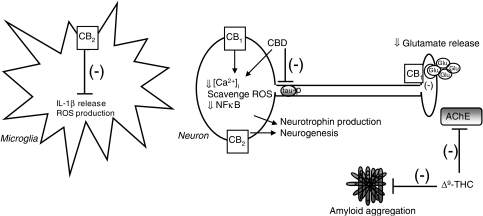
Alzheimer's disease is an age-related neurodegenerative condition associated with cognitive decline. The pathological hallmarks of the disease are the deposition of beta-amyloid protein and hyperphosphorylation of tau, which evoke neuronal cell death and impair inter-neuronal communication. The disease is also associated with neuroinflammation, excitotoxicity and oxidative stress. In recent years the proclivity of cannabinoids to exert a neuroprotective influence has received substantial interest as a means to mitigate the symptoms of neurodegenerative conditions. In brains obtained from Alzheimer's patients alterations in components of the cannabinoid system have been reported, suggesting that the cannabinoid system either contributes to, or is altered by, the pathophysiology of the disease. Certain cannabinoids can protect neurons from the deleterious effects of beta-amyloid and are capable of reducing tau phosphorylation. The propensity of cannabinoids to reduce beta-amyloid-evoked oxidative stress and neurodegeneration, whilst stimulating neurotrophin expression neurogenesis, are interesting properties that may be beneficial in the treatment of Alzheimer's disease. Delta 9-tetrahydrocannabinol can also inhibit acetylcholinesterase activity and limit amyloidogenesis which may improve cholinergic transmission and delay disease progression. Targeting cannabinoid receptors on microglia may reduce the neuroinflammation that is a feature of Alzheimer's disease, without causing psychoactive effects. Thus, cannabinoids offer a multi-faceted approach for the treatment of Alzheimer's disease by providing neuroprotection and reducing neuroinflammation, whilst simultaneously supporting the brain's intrinsic repair mechanisms by augmenting neurotrophin expression and enhancing neurogenesis. The evidence supporting a potential role for the cannabinoid system as a therapeutic target for the treatment of Alzheimer's disease will be reviewed herewith.
Figures
References
-
- Abood ME, Rizvi G, Sallapudi N, McAllister S. Activation of the CB1 cannabinoid receptor protects cultured mouse spinal neurons against excitotoxicity. Neuroscience Lett. 2001;309:197–201. - PubMed
-
- Alger BE. Not too excited? Thank your endocannabinoids. Neuron. 2006;51:393–395. - PubMed
-
- Ashton JC, Friberg D, Darlington CL, Smith PF. Expression of the cannabinoid CB2 receptor in the rat cerebellum: an immunohistochemical study. Neurosci Lett. 2006;396:113–116. - PubMed
Publication types
MeSH terms
Substances
LinkOut - more resources
Full Text Sources
Other Literature Sources
Medical
