


doi: 10.1086/521200.
Epub 2007 Aug 20.
Allele-specific targeting of microRNAs to HLA-G and risk of asthma
Affiliations
- PMID: 17847008
- PMCID: PMC2227932
- DOI: 10.1086/521200
Item in Clipboard
Allele-specific targeting of microRNAs to HLA-G and risk of asthma
Am J Hum Genet.
2007 Oct.
Erratum in
- Am J Hum Genet. 2008 Jan;82(1):251
Abstract
HLA-G is a nonclassic, class I HLA molecule that has important immunomodulatory properties. Previously, we identified HLA-G as an asthma-susceptibility gene and discovered that the risk of asthma in a child was determined by both the child's HLA-G genotype and the mother's affection status. Here we report a SNP in the 3' untranslated region of HLA-G that influences the targeting of three microRNAs (miRNAs) to this gene, and we suggest that allele-specific targeting of these miRNAs accounts, at least in part, for our earlier observations on HLA-G and the risk of asthma.
Figures
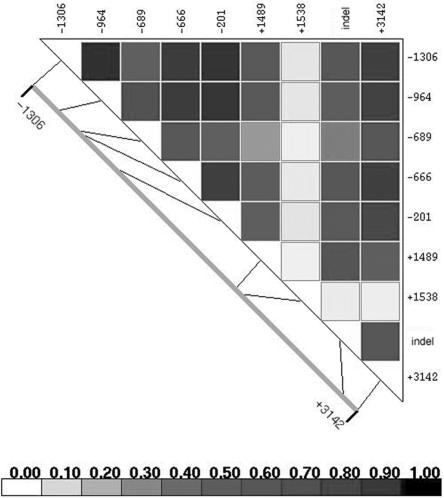
Pairwise linkage disequilibrium (r2 ) map of HLA-G in the Chicago families. The LD plot was made by LDPlotter.
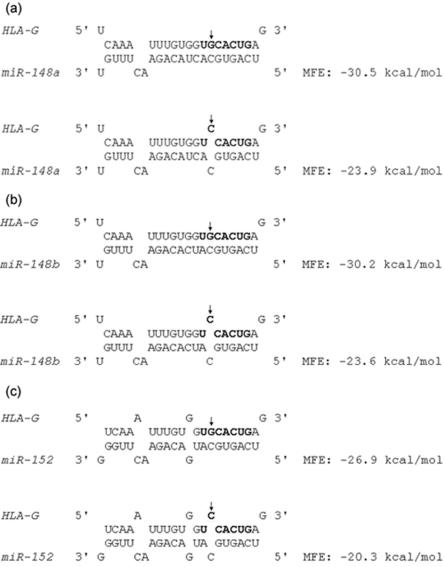
Predicted binding of miR-148a, miR-148b, and miR-152 to HLA-G. The seed region of the target site is shown in bold letters, and +3142C/G is indicated by an arrow. The minimum free energy (MFE) of the RNA duplex was analyzed by RNAhybrid.
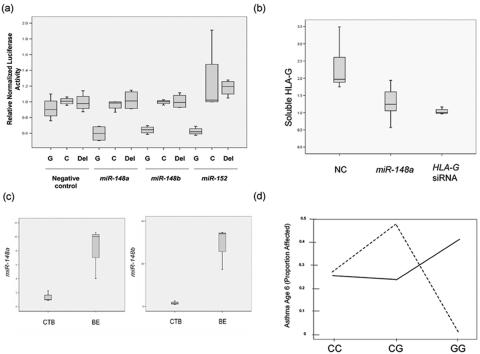
HLA-G +3142C/G affects the targeting of miR-148a, miR-148b, and miR-152 to HLA-G and interacts with mother’s asthma status to determine risk of asthma in the child. a, Luciferase assays showing the allele-specific targeting of the three miRNAs to HLA-G in 16HBE14o- cells. pluc-HLAG-G (G), pluc-HLAG-C (C), or pluc-HLA-G-Del (Del) luciferase plasmid was cotransfected with negative control miRNA, miR-148a, miR-148b, or miR-152. At least six replicate assays were performed for each transfection. For each sample, luciferase activity was normalized by renilla activity and then normalized again by the median value of the pluc-HLAG-C plasmid within each miRNA transfection group. The P values for the difference in luciferase activity of the three plasmids are as follows. For NC miRNA transfection: G versus C, P>.05 ; G versus Del, P>.05 . For miR-148a transfection: G versus C, P=.0002 ; G versus Del, P<.0001 . For miR-148b transfection: G versus C, P<.0001 ; G versus Del, P<.0001 . For miR-152 transfection: G versus C, P=.0002 ; G versus Del, P=.0016 . b, Endogenous HLA-G expression is inhibited by miR-148a in JEG3 cells. JEG3 cells, which are +3142GG, were transfected with either negative control miRNA, miR-148a, or HLA-G siRNA as a positive control. A total of seven replicate assays were performed for each RNA. miR-148a and HLA-G siRNA significantly reduced the level of sHLA-G in JEG3 supernatant compared with the NC miRNA. sHLA-G level was normalized to the median of the HLA-G siRNA group. c, miR-148a and miR-148b levels in primary cytotrophoblast (CTB) cells from six individuals and primary bronchial epithelial (BE) cells from three individuals, determined by miRNA real-time PCR. miR-148a (P=.0016 ) and miR-148b (P=.0006 ) levels were significantly lower in CTB cells than in BE cells. d, +3142C/G interacts with maternal asthma status and is associated with asthma in the COAST children. Dashed lines are the children of mothers with asthma (N=58 ), and solid lines are the children of mothers without asthma (N=119 ). The interaction P=.0011 .
References
Web Resources
-
- dbSNP, http://www.ncbi.nlm.nih.gov/entrez/query.fcgi?CMD=search&DB=snp (for HLA-G —1306A/G [accession number rs1736936], HLA-G +1489C/T [accession number rs1130356], HLA-G exon 8 indel [accession number rs16375], and HLA-G +3142C/G [accession number rs1063320])
-
- Online Mendelian Inheritance in Man (OMIM), http://www.ncbi.nlm.nih.gov/Omim/ (for HLA-G and asthma)
References
Publication types
MeSH terms
Substances
Grants and funding
LinkOut - more resources
Full Text Sources
Other Literature Sources
Medical
Research Materials
