. 2007 Oct;81(4):842-6.
doi: 10.1086/521201. Epub 2007 Aug 24.

Geographically separate increases in the frequency of the derived ADH1B*47His allele in eastern and western Asia

Affiliations

Geographically separate increases in the frequency of the derived ADH1B*47His allele in eastern and western Asia

Hui Li et al. Am J Hum Genet. 2007 Oct.

Abstract

The ADH1B Arg47His polymorphism has been convincingly associated with alcoholism in numerous studies of several populations in Asia and Europe. In a review of literature from the past 30 years, we have identified studies that report allele frequencies of this polymorphism for 131 population samples from many different parts of the world. The derived ADH1B*47His allele reaches high frequencies only in western and eastern Asia. To pursue this pattern, we report here new frequency data for 37 populations. Most of our data are from South and Southeast Asia and confirm that there is a low frequency of this allele in the region between eastern and western Asia. The distribution suggests that the derived allele increased in frequency independently in western and eastern Asia after humans had spread across Eurasia.


Figures
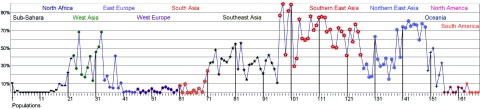
Figure  1.
Figure 1.
ADH1B*47His frequencies in populations from different regions of the world. Descriptions of the specific samples, full references, and allele frequencies are available in ALFRED. The geographic-region labels are colored the same as the corresponding population values. “Southeast Asia” corresponds primarily to populations in peninsular eastern Asia and island regions; “Southern East Asia” corresponds primarily to populations in southern China. The numbers on the X-axis correspond to the following populations: 1, Western Cape; 2, !Kung San; 3, Negroid Makrani; 4, Sandawe; 5, Chagga; 6, Biaka; 7, Mbuti; 8, southwestern Bantu; 9, Hausa; 10, Ibo; 11, Yoruba; 12, Yoruba; 13, Masai; 14, African; 15, African American; 16, African American; 17, Somali; 18, Saharans; 19, northern Moroccans; 20, central Moroccans; 21, black American; 22, Ethiopian Jews; 23, Yemenite Jews; 24, Druze; 25, Samaritans; 26, non-Russian Ashkenazi; 27, Russian Ashkenazi; 28, Ashkenazi Jews; 29, Sephardic Jews; 30, Turks (Turkey); 31, Turks (Iran); 32, Turkomans; 33, Persian Zoroastrians; 34, Adygei; 35, Chuvash; 36, Russian (Vologda); 37, Russian (Archangelsk); 38, Russian (Moscow); 39, Hungarians; 40, Hungarian; 41, Finns; 42, Finns; 43, Lapps; 44, Khanty; 45, Komi; 46, Swedes (Stockholm); 47, Swedes; 48, Poles (Krakow); 49, Danes; 50, German; 51, Germans; 52, German (Heidelberg); 53, French (Bordeaux); 54, Irish; 55, Spanish (Tarragona); 56, Spanish (Catalans); 57, Basque; 58, European American; 59, European American; 60, white American; 61, Mohanna; 62, Keralite; 63, Indians; 64, Bhil; 65, Gond; 66, Sahariya; 67, Korku; 68, Pattapu; 69, Onge; 70, Kachari; 71, Hazara; 72, Thais; 73, Cambodian; 74, Oy; 75, Brao; 76, Talieng; 77, Alak; 78, Jeh; 79, Ngeq; 80, Taoih; 81, Kataang; 82, Suy; 83, Inh; 84, So; 85, Phuthai; 86, Aheu; 87, Bo; 88, Tai Mene; 89, Phuan; 90, Rien; 91, Mal; 92, Kang; 93, Tai Deang; 94, Tai Dam; 95, Puoc; 96, Bit; 97, Bugan; 98, Lachi; 99, Yerong; 100, Cao Lan; 101, Pahng; 102, Bouyei (Yunnan); 103, Hui (Guizhou); 104, Pou; 105, Tujia; 106, Malays; 107, Filipinos; 108, Paiwan; 109, Ami; 110, Ami; 111, Bunun; 112, Atayal; 113, Atayal; 114, Chinese; 115, Han (Canton); 116, Han (Fujian); 117, Han (South Taiwan); 118, Han (Taiwan); 119, Han (Hakka); 120, Han (Jiangsu); 121, Han (Sichuan); 122, Han (Shandong); 123, Han (Henan); 124, Han (Beijing); 125, Han (Jilin); 126, Han (Xinjiang); 127, Uygur (Urumqi); 128, Xibo (Ili); 129, Kazak (Ili); 130, Yakut; 131, Mongolian (Baotou); 132, Manchu; 133, Daur; 134, Mongol (Hulunbel); 135, Ewenk (Hulunbel); 136, Oroqen (Hulunbel); 137, Elunchun (Mohe); 138, Hezhen; 139, Korean (Changchun); 140, Korean (Yanbian); 141, Korean; 142, Korean (Incheon); 143, Korean; 144, Japanese (Gunma); 145, Japanese (Kyoto); 146, Japanese; 147, Japanese; 148, Japanese (Aichi); 149, Japanese (Tokyo); 150, Micronesian; 151, Maori; 152, Polynesian; 153, Papua New Guineans; 154, Nasioi; 155, Australia Aborigines; 156, Eskimos; 157, Cheyenne; 158, Mexican American; 159, Pima (Arizona); 160, southwestern Amerindian; 161, Maya (Yucatan); 162, Mestizos; 163, Pima (Mexico); 164, Caboclos; 165, Karitiana; 166, Surui; 167, Ticuna; and 168, Aurocanians.
Figure  2.
Figure 2.
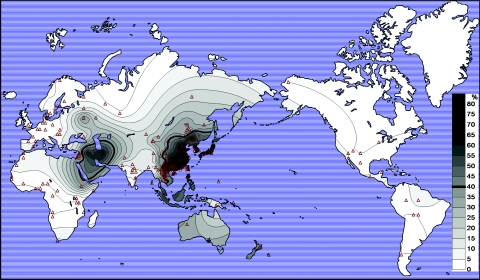
Global contour plot of the ADH1B*47His allele frequency drawn by the Surface Mapping System program Surfer 8.00 developed by Golden Software. The frequency data are the same as in figure 1, with the use of the geographic coordinates in table 1 and in ALFRED.

Comment in

  • Distribution of the alcohol dehydrogenase ADH1B*47His allele in Eurasia.
    Borinskaya S, Kal'ina N, Marusin A, Faskhutdinova G, Morozova I, Kutuev I, Koshechkin V, Khusnutdinova E, Stepanov V, Puzyrev V, Yankovsky N, Rogaev E. Borinskaya S, et al. Am J Hum Genet. 2009 Jan;84(1):89-92; author reply 92-4. doi: 10.1016/j.ajhg.2008.12.007. Am J Hum Genet. 2009. PMID: 19124091 Free PMC article. No abstract available.

References

Web Resources

    1. ALFRED, http://alfred.med.yale.edu/alfred/SiteTable1A_working.asp?siteuid=SI000229N
    1. Ethnologue, http://www.ethnologue.com/ (for ISO639-3 symbols and linguistic relationships) and http://www.ethnologue.com/show_country.asp?name=LA (for Laotian population information)
    1. Online Mendelian Inheritance in Man (OMIM) http://www.ncbi.nlm.nih.gov/Omim/ (for ADH1B and ADH1C)

References

    1. Li TK, Bosron WF, Dafeldecker WP, Lange LG, Vallee BL (1977) Isolation of pi-alcohol dehydrogenase of human liver: is it a determinant of alcoholism? Proc Natl Acad Sci USA 74:4378–438110.1073/pnas.74.10.4378 - DOI - PMC - PubMed
    1. Thomasson HR, Edenberg HJ, Crabb DW, Mai XL, Jerome RE, Li TK, Wang SP, Lin YT, Lu RB, Yin SJ (1991) Alcohol and aldehyde dehydrogenase genotypes and alcoholism in Chinese men. Am J Hum Genet 48:677–681 - PMC - PubMed
    1. Goedde HW, Agarwal DP, Fritze G, Meier-Tackmann D, Singh S, Beckmann G, Bhatia K, Chen LZ, Fang B, Lisker R (1992) Distribution of ADH2 and ALDH2 genotypes in different populations. Hum Genet 88:344–34610.1007/BF00197271 - DOI - PubMed
    1. Nakamura K, Iwahashi K, Matsuo Y, Miyatake R, Ichikawa Y, Suwaki H (1996) Characteristics of Japanese alcoholics with the atypical aldehyde dehydrogenase 2*2. I. A comparison of the genotypes of ALDH2, ADH2, ADH3, and cytochrome P-450E1 between alcoholics and nonalcoholics. Alcohol Clin Exp Res 20:52–5510.1111/j.1530-0277.1996.tb01043.x - DOI - PubMed
    1. Mulligan CJ, Robin RW, Osier MV, Sambuughin N, Goldfarb LG, Kittles RA, Hesselbrock D, Goldman D, Long JC (2003) Allelic variation at alcohol metabolism genes (ADH1B, ADH1C, ALDH2) and alcohol dependence in an American Indian population. Hum Genet 113:325–33610.1007/s00439-003-0971-z - DOI - PubMed

Publication types