


What is the required energy deficit per unit weight loss?
- PMID: 17848938
- PMCID: PMC2376744
- DOI: 10.1038/sj.ijo.0803720
What is the required energy deficit per unit weight loss?
Abstract
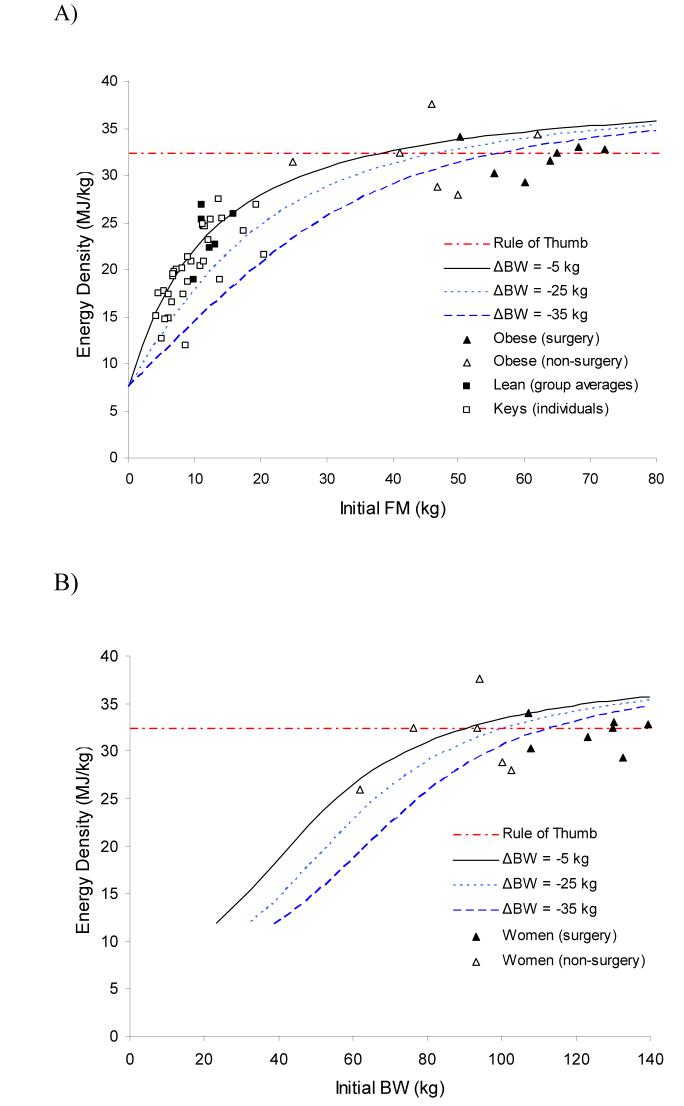
One of the most pervasive weight loss rules is that a cumulative energy deficit of 3500 kcal is required per pound of body weight loss, or equivalently 32.2 MJ kg(-1). Under what conditions is it appropriate to use this rule of thumb and what are the factors that determine the cumulative energy deficit required per unit weight loss? Here, I examine this question using a modification of the classic Forbes equation that predicts the composition of weight loss as a function of the initial body fat and magnitude of weight loss. The resulting model predicts that a larger cumulative energy deficit is required per unit weight loss for people with greater initial body fat-a prediction supported by published weight loss data from obese and lean subjects. This may also explain why men can lose more weight than women for a given energy deficit since women typically have more body fat than men of similar body weight. Furthermore, additional weight loss is predicted to be associated with a lower average cumulative energy deficit since a greater proportion of the weight loss is predicted to result from loss of lean body mass, which has a relatively low energy density in comparison with body fat. The rule of thumb approximately matches the predicted energy density of lost weight in obese subjects with an initial body fat above 30 kg but overestimates the cumulative energy deficit required per unit weight loss for people with lower initial body fat. International Journal of Obesity (2008) 32, 573-576; doi:10.1038/sj.ijo.0803720; published online 11 September 2007.
Figures
References
-
- McArdle WD. Exercise physiology: energy, nutrition, and human performance. 4th edition edn. Williams & Wilkins; Baltimore: 1996.
-
- Wishnofsky M. Caloric equivalents of gained or lost weight. The American journal of clinical nutrition. 1958;6:542–546. - PubMed
-
- Forbes GB. Lean body mass-body fat interrelationships in humans. Nutrition reviews. 1987;45:225–231. - PubMed
-
- Forbes GB. Body fat content influences the body composition response to nutrition and exercise. Annals of the New York Academy of Sciences. 2000;904:359–365. - PubMed
-
- Livesey G, Elia M. Estimation of energy expenditure, net carbohydrate utilization, and net fat oxidation and synthesis by indirect calorimetry: evaluation of errors with special reference to the detailed composition of fuels. The American journal of clinical nutrition. 1988;47:608–628. - PubMed
Publication types
MeSH terms
Grants and funding
LinkOut - more resources
Full Text Sources
Other Literature Sources
Medical
