


Modeling the Etiology of Adolescent Substance Use: A Test of the Social Development Model
- PMID: 17848978
- PMCID: PMC1976125
- DOI: 10.1177/002204269602600207
Modeling the Etiology of Adolescent Substance Use: A Test of the Social Development Model
Abstract
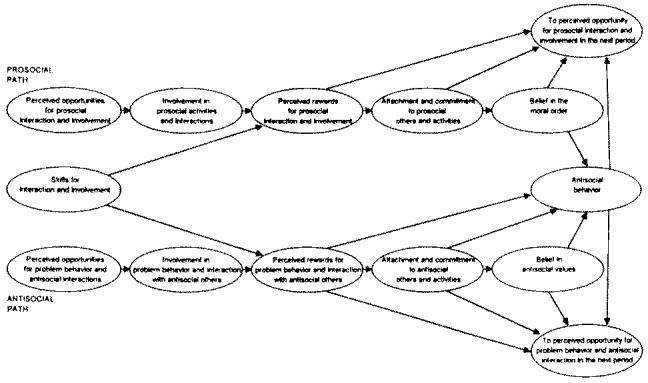
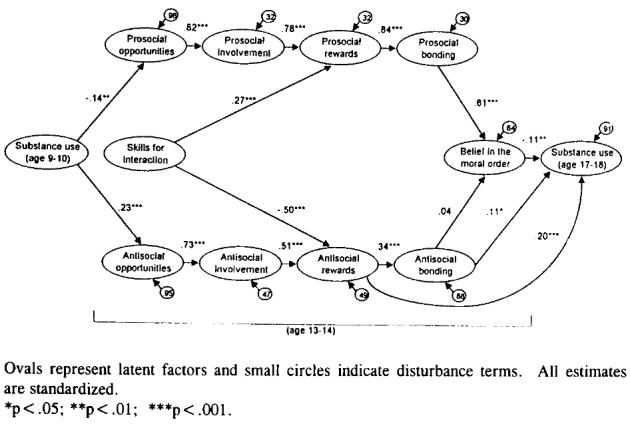
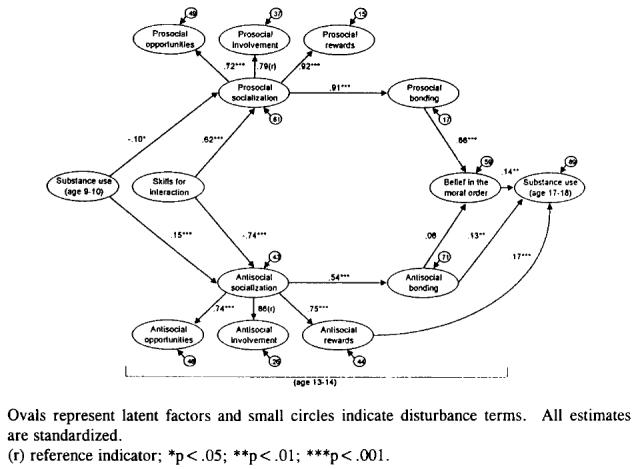
The social development model is a general theory of human behavior that seeks to explain antisocial behaviors through specification of predictive developmental relationships. It incorporates the effects of empirical predictors ("risk factors" and "protective factors") for antisocial behavior and attempts to synthesize the most strongly supported propositions of control theory, social learning theory, and differential association theory. This article examines the power of social development model constructs measured at ages 9 to 10 and 13 to 14 to predict drug use at ages 17 to 18. The sample of 590 is from the longitudinal panel of the Seattle Social Development Project, which in 1985 sampled fifth grade students from high crime neighborhoods in Seattle, Washington. Structural equation modeling techniques were used to examine the fit of the model to the data. Although all but one path coefficient were significant and in the expected direction, the model did not fit the data as well as expected (CFI=.87). We next specified second-order factors for each path to capture the substantial common variance in the constructs' opportunities, involvement, and rewards. This model fit the data well (CFI=.90). We conclude that the social development model provides an acceptable fit to predict drug use at ages 17 to 18. Implications for the temporal nature of key constructs and for prevention are discussed.
Figures
References
-
- Achenbach TM, Edelbrock C. Manual for the child behavior checklist and revised child behavior profile. University of Vermont Press; Burlington: 1983.
-
- Agnew R. The interactive effects of peer variables on delinquency. Criminology. 1991;29:47–72.
-
- Akers RL. Deviant behavior: A social learning approach. 2d ed. Wadsworth Press; Belmont, Calif.: 1977.
-
- Akers RL, Krohn MD, Lanza-Kaduce L, Radosevich M. Social learning and deviant behavior: A specific test of a general theory. American Sociological Review. 1979;44:636–655. - PubMed
-
- Bandura A. Aggression: A social learning analysis. Prentice-Hall; Englewood Cliffs, N.J.: 1973.
Grants and funding
LinkOut - more resources
Full Text Sources
Miscellaneous