


Left-right differences on timed motor examination in children
- PMID: 17852124
- PMCID: PMC2564283
- DOI: 10.1080/09297040701370016
Left-right differences on timed motor examination in children
Abstract
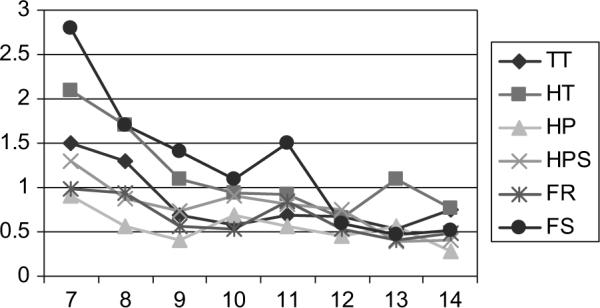
Age-related change in the difference between left- and right-side speed on motor examination may be an important indicator of maturation. Cortical maturation and myelination of the corpus callosum are considered to be related to increased bilateral skill and speed on timed motor tasks. We compared left minus right foot, hand, and finger speed differences using the Revised Physical and Neurological Assessment for Subtle Signs (PANESS; Denckla, 1985); examining 130 typically developing right-handed children (65 boys, 65 girls) ages 7-14. Timed tasks included right and left sets of 20 toe taps, 10 toe-heel alternation sequences, 20 hand pats, 10 hand pronate-supinate sets, 20 finger taps, and 5 sequences of each finger-to-thumb apposition. For each individual, six difference scores between left- and right-sided speeded performances of timed motor tasks were analyzed. Left-right differences decreased significantly with age on toe tapping, heel-toe alternations, hand pronation-supination, finger repetition, and finger sequencing. There were significant gender effects for heel-toe sequences (boys showing a greater left-right difference than girls), and a significant interaction between age and gender for hand pronation-supination, such that the magnitude of the left-right difference was similar for younger, compared with older girls, while the difference was significantly larger for younger, compared to older boys. Speed of performing right and left timed motor tasks equalizes with development; for some tasks, the equalization occurs earlier in girls than in boys.
Figures
References
-
- Aboitiz F, Montiel J. One hundred million years of interhemispheric communication: The history of the corpus callosum. Brazilian Journal of Medical and Biological Research. 2003;36:409–420. - PubMed
-
- Aranyi Z, Rosler KM. Effort-induced mirror movements: A study of transcallosal inhibition in humans. Experimental Brain Research. 2002;145:76–82. - PubMed
-
- Baliz Y, Armatas C, Farrow M, Hoy KE, Fitzgerald PB, Bradshaw JL, Georgiou-Karistianis N. The influence of attention and age on the occurrence of mirror movements. Journal of the International Neuropsychological Society. 2004;11:855–862. - PubMed
-
- Barnea-Goraly N, Menon V, Eckert M, Tamm L, Bammer R, Karchemskiy A, Dant CC, Reiss AL. White matter development during childhood and adolescence: A cross-sectional diffusion tensor imaging study. Cerebral Cortex. 2005;15:1848–1854. - PubMed
-
- Baumgardner TL, Singer GS, Denckla MB, Rubin MA, Abrams MT, Colli MJ, Reiss AL. Corpus callosum morphology in children with Tourette syndrome and attention deficit hyperactivity disorder. Neurology. 1996;47:1–6. - PubMed
Publication types
MeSH terms
Grants and funding
- P01 HD035468/HD/NICHD NIH HHS/United States
- R01 NS047781/NS/NINDS NIH HHS/United States
- R01 NS 047781/NS/NINDS NIH HHS/United States
- K08 NS 02039/NS/NINDS NIH HHS/United States
- R01 MH078160/MH/NIMH NIH HHS/United States
- K02 NS044850/NS/NINDS NIH HHS/United States
- R29 MH052432/MH/NIMH NIH HHS/United States
- R29 MH 52432/MH/NIMH NIH HHS/United States
- AS2506/AS/Autism Speaks/United States
- K02 NS 04485/NS/NINDS NIH HHS/United States
- K01 MH 01824/MH/NIMH NIH HHS/United States
- P01 HD 35468/HD/NICHD NIH HHS/United States
- R01 NS048527/NS/NINDS NIH HHS/United States
- K01 MH001824/MH/NIMH NIH HHS/United States
- NS 25806/NS/NINDS NIH HHS/United States
- R01 MH085328/MH/NIMH NIH HHS/United States
- P30 HD024061/HD/NICHD NIH HHS/United States
- K08 NS002039/NS/NINDS NIH HHS/United States
- HD 24061/HD/NICHD NIH HHS/United States
LinkOut - more resources
Full Text Sources
