


Mislocated fixations can account for parafoveal-on-foveal effects in eye movements during reading
- PMID: 17853202
- PMCID: PMC2662923
- DOI: 10.1080/17470210701467953
Mislocated fixations can account for parafoveal-on-foveal effects in eye movements during reading
Abstract
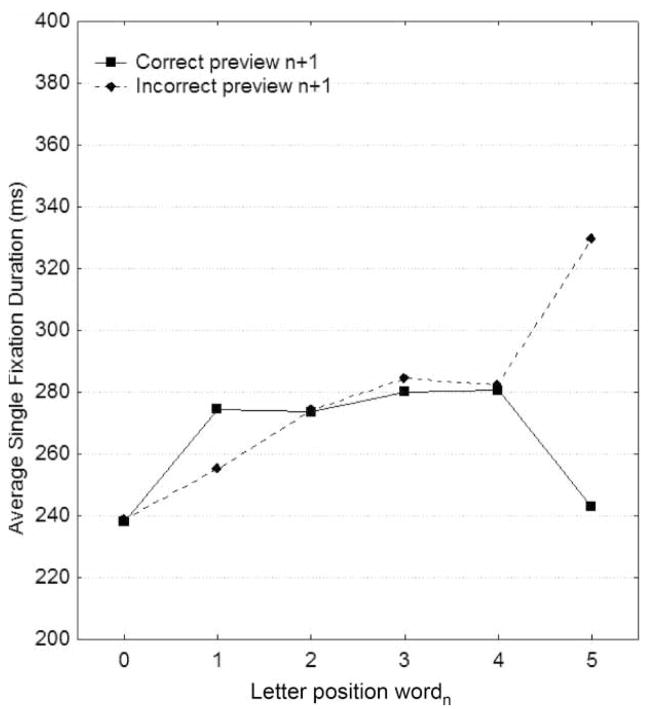
Contrasting predictions of serial and parallel views on the processing of foveal and parafoveal information during reading were tested. A high-frequency adjective (young) was followed by either a high-frequency word(n) (child) or a low-frequency word(n) (tenor), which in turn was followed by either a correct (performing) or an orthographic illegal word(n+1) (pxvforming) as a parafoveal preview. A limited parafoveal-on-foveal effect was observed: There were inflated fixation times on word(n) when the preview of word(n+1) was orthographically illegal. However, this parafoveal-on-foveal effect was (a) independent of the frequency of word(n), (b) restricted to those instances when the eyes were very close to word(n+1), and (c) associated with relatively long prior saccades. These observations are all compatible with a mislocated fixation account in which parafoveal-on-foveal effects result from saccadic undershoots of word(n+1) and with a serial model of eye movement control during reading.
Figures
References
-
- Brysbaert M, Drieghe D, Vitu F. Word skipping: Implications for theories of eye movement control in reading. In: Underwood G, editor. Cognitive processes in eye guidance. Oxford, UK: Oxford University Press; 2005. pp. 53–78.
-
- Drieghe D, Brysbaert M, Desmet T. Parafoveal-on-foveal effects on eye movements in text reading: Does an extra space make a difference? Vision Research. 2005a;45:1693–1706. - PubMed
-
- Drieghe D, Rayner K, Pollatsek A. Word skipping during reading revisited. Journal of Experimental Psychology: Human Perception and Performance. 2005b;31:954–969. - PubMed
-
- Engbert R, Nuthmann A, Kliegl R. An iterative algorithm for the estimation of the distribution of mislocated fixations during reading. In: Van Gompel RPG, Fischer MF, Murray WS, Hill RL, editors. Eye movements: A window on mind and brain. Oxford, UK: Elsevier; 2007. pp. 319–337.
-
- Engbert R, Nuthmann A, Richter E, Kliegl R. SWIFT: A dynamical model of saccade generation during reading. Psychological Review. 2005;112:777–813. - PubMed
Publication types
MeSH terms
Grants and funding
LinkOut - more resources
Full Text Sources
