


Case Reports
doi: 10.1016/j.cancergencyto.2007.07.002.
C/EBPbeta suppression by interruption of CUGBP1 resulting from a complex rearrangement of MLL
Affiliations
- PMID: 17854664
- PMCID: PMC3311538
- DOI: 10.1016/j.cancergencyto.2007.07.002
Item in Clipboard
Case Reports
C/EBPbeta suppression by interruption of CUGBP1 resulting from a complex rearrangement of MLL
Cancer Genet Cytogenet.
2007 Sep.
Abstract
Translocations involving the mixed-lineage leukemia gene (MLL) confer a poor prognosis in acute leukemias. In t(1;11)(q21;q23), MLL is fused reciprocally with AF1q. Here we describe a t(1;11)(q21;q23) with a secondary event involving insertion of the telomeric portion of MLL into the p arm of chromosome 11 (11p11). We show that this latter event interrupts the CUG triplet repeat binding protein-1 (CUGBP1) gene, a translational enhancer of C/EBPbeta. We then showed that these cells have reduced expression of CUGBP1 and C/EBPbeta when compared to other AML blasts. This is the first report to describe insertional disruption of the CUGBP1 gene and to suggest a role for the CUGBP1-C/EBPbeta pathway in leukemogenesis.
Figures
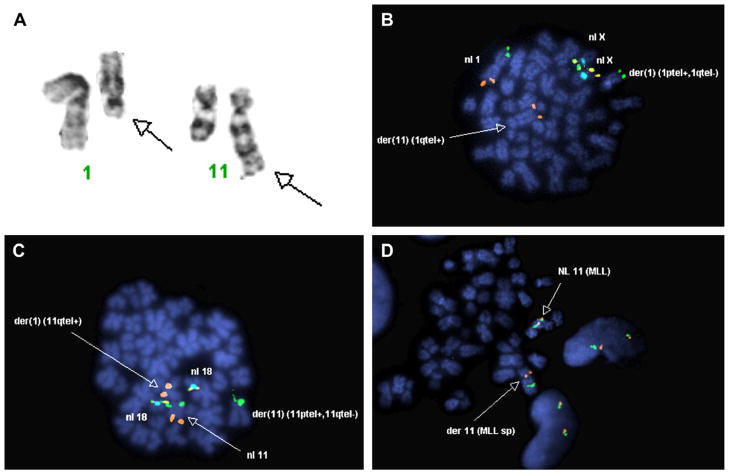
Cytogenetics of AML17. (A) G-banding analysis shows derivative chromosomes 1 and 11 (arrows). Metaphase FISH using telomere region–specific probes for chromosomes 1 (B) and 11 (C) shows a pattern consistent with a balanced reciprocal translocation. (D) FISH using a break-apart rearrangement probe for the MLL gene shows both portions of MLL on the derivative chromosome 11.
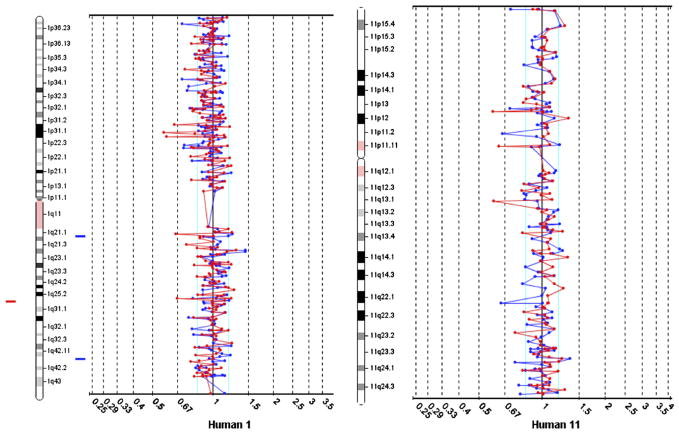
Array CGH of AML17. DNA was purified from banked samples of AML17 and hybridized to the BAC-based human genome array as described, showing no apparent losses or gains of genetic material. Chromosomes 1 (left) and 11 (right) are shown.
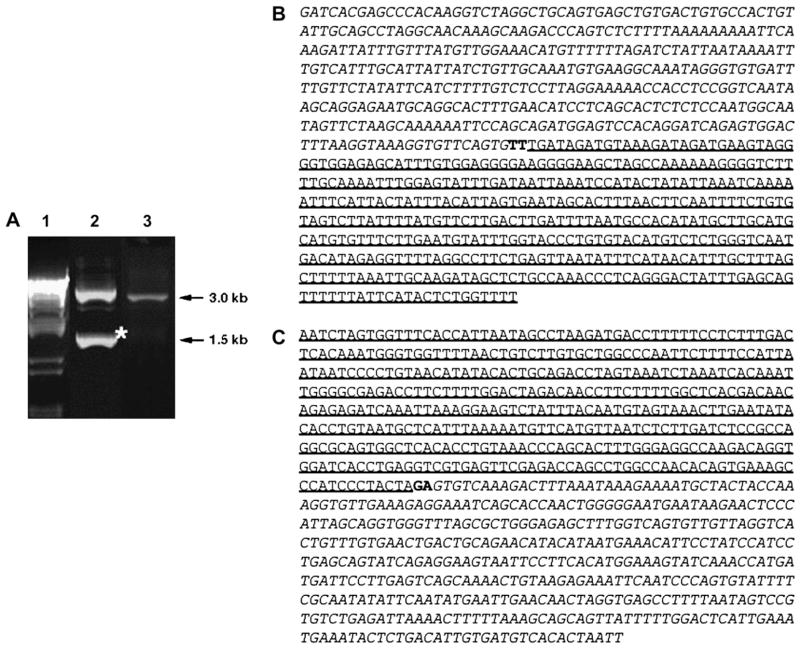
Genomic breakpoints within MLL. (A) LDI-PCR analysis of AML17 genomic DNA. Lane 1, marker; lane 2, LDI-PCR analysis of MLL-translocation partner (TP) fusion showing the wild-type band and the additional MLL-TP band (asterisk); lane 3, LDI-PCR analysis of TP-MLL fusion (in this case, only the TP-MLL amplimer appeared). (B) The sequence of the MLL-TP amplimer reveals a fusion between intron 10/11 of MLL (italic) and intron 1/2 of AF1q (underline) linked by two filler nucleotides (bold). (C) The sequence TP-MLL reveals a fusion between intron 9/10 of CUGBP1 (underline) and intron 10/11 of MLL (italic) linked by two filler nucleotides (bold).
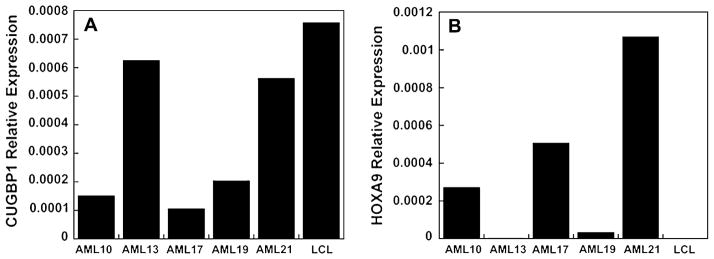
Quantitative RT-PCR analysis. Quantitative RT-PCR for CUGBP1 (A) and HOXA9 (B) was performed on RNA from representative primary AML blasts and a control LCL line. Expression levels are normalized to 18S rRNA.
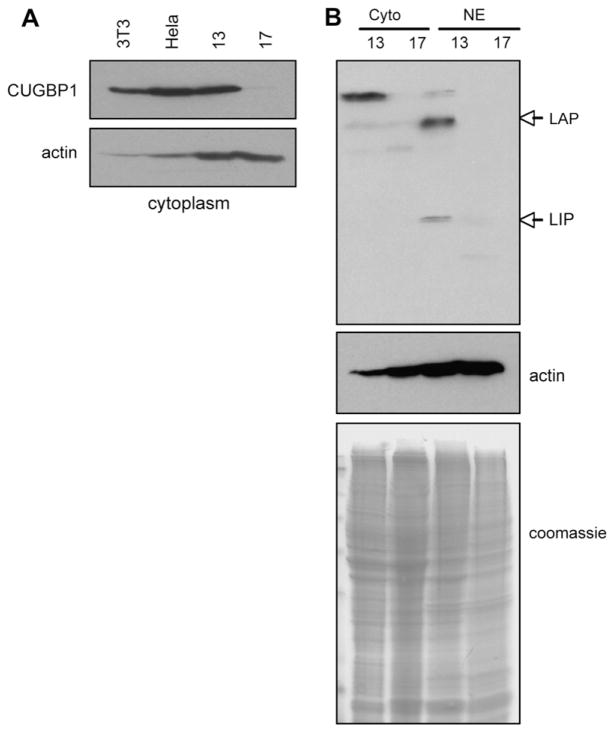
Expression of CUGBP1 and C/EBPβ proteins. (A) Western blot analysis of CUGBP1 in protein lysates from AML13 and AML17 with actin-loading controls. Protein lysates from 3T3-L1 and HeLa cells were used as controls. (B) Western blot analysis of C/EBPβ in cytoplasmic (Cyto) and nuclear extract (NE) proteins from AML13 and AML17. Positions of LAP and LIP isoforms are shown by arrows. Coomassie staining and actin show equal protein loading of all lanes.
References
-
- Thirman MJ, Gill HJ, Burnett RC, Mbangkollo D, McCabe NR, Kobayashi H, Zieminvan der Poel S, Kaneko Y, Morgan R, Sandberg AA, Chaganti RSK, Larson RA, Le Beau MM, Diaz MO, Rowley JD. Rearrangement of the MLL gene in acute lymphoblastic and acute myeloid leukemias with 11q23 chromosomal translocations. N Engl J Med. 1993;329:909–14. - PubMed
-
- Rubnitz JE, Behm FG, Downing JR. 11q23 rearrangements in acute leukemia. Leukemia. 1996;10:74–82. - PubMed
-
- Mrozek K, Heinonen K, Lawrence D, Carroll AJ, Koduru PR, Rao KW, Strout MP, Hutchison RE, Moore JO, Mayer RJ, Schiffer CA, Bloomfield CD. Adult patients with de novo acute myeloid leukemia and t(9; 11)(p22; q23) have a superior outcome to patients with other translocations involving band 11q23: a cancer and leukemia group B study. Blood. 1997;90:4532–8. - PubMed
-
- Raffini LJ, Slater DJ, Rappaport EF, Lo Nigro L, Cheung NK, Biegel JA, Nowell PC, Lange BJ, Felix CA. Panhandle and reverse-panhandle PCR enable cloning of der(11) and der(other) genomic breakpoint junctions of MLL translocations and identify complex translocation of MLL, AF-4, and CDK6. Proc Natl Acad Sci USA. 2002;99:4568–73. - PMC - PubMed
-
- Meyer C, Schneider B, Jakob S, Strehl S, Attarbaschi A, Schnittger S, Schoch C, Jansen MW, van Dongen JJ, den Boer ML, Pieters R, Ennas MG, Angelucci E, Koehl U, Greil J, Griesinger F, Zur Stadt U, Eckert C, Szczepanski T, Niggli FK, Schafer BW, Kempski H, Brady HJ, Zuna J, Trka J, Nigro LL, Biondi A, Delabesse E, Macintyre E, Stanulla M, Schrappe M, Haas OA, Burmeister T, Dingermann T, Klingebiel T, Marschalek R. The MLL recombinome of acute leukemias. Leukemia. 2006;20:777–84. - PubMed
Publication types
MeSH terms
Substances
Grants and funding
LinkOut - more resources
Full Text Sources
Research Materials
