Child-parent screening for familial hypercholesterolaemia: screening strategy based on a meta-analysis
- PMID: 17855284
- PMCID: PMC1989026
- DOI: 10.1136/bmj.39300.616076.55
Child-parent screening for familial hypercholesterolaemia: screening strategy based on a meta-analysis
Abstract
Objective: To develop a population screening strategy for familial hypercholesterolaemia.
Design: Meta-analysis of published data on total and low density lipoprotein (LDL) cholesterol in people with and without familial hypercholesterolaemia according to age. Thirteen studies reporting on 1907 cases and 16 221 controls were used in the analysis. Included studies had at least 10 cases and controls with data on the distribution of cholesterol in affected and unaffected individuals.
Main outcome measures: Detection rates (sensitivity) for specified false positive rates (0.1%, 0.5%, and 1%) in newborns and in age groups 1-9, 10-19, 20-39, 40-59, and > or =60 years.
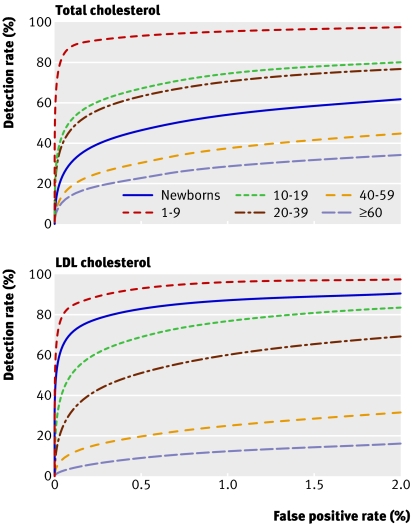
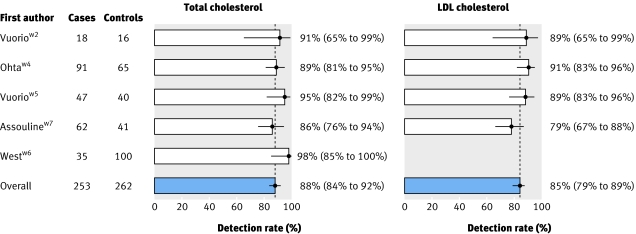
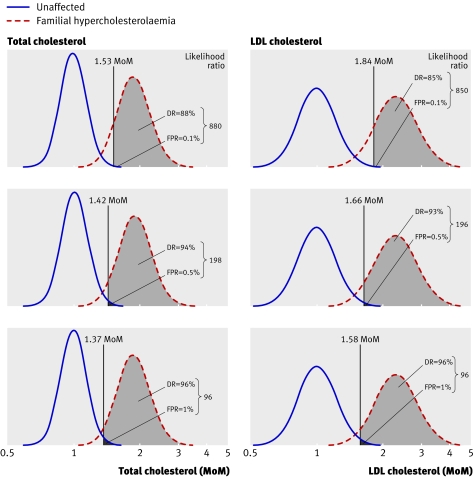
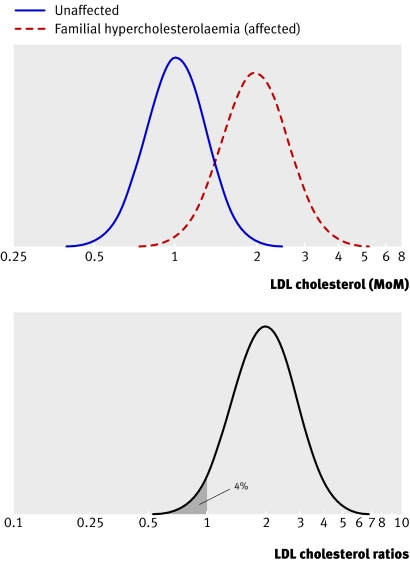
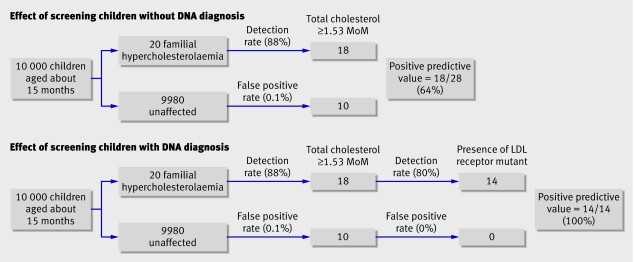
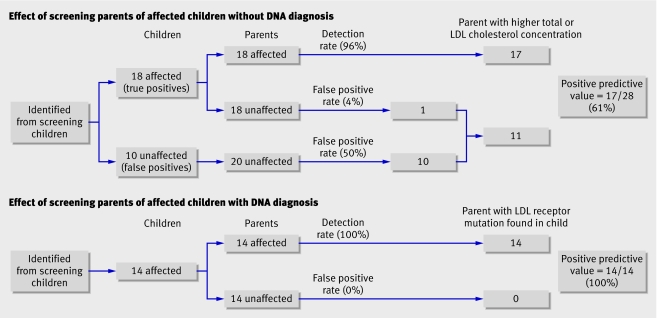
Results: Serum cholesterol concentration discriminated best between people with and without familial hypercholesterolaemia at ages 1-9, when the detection rates with total cholesterol were 88%, 94%, and 96% for false positive rates of 0.1%, 0.5%, and 1%. The results were similar with LDL cholesterol. Screening newborns was much less effective. Once an affected child is identified, measurement of cholesterol would detect about 96% of parents with the disorder, using the simple rule that the parent with the higher serum cholesterol concentration is the affected parent.
Conclusions: The proposed strategy of screening children and parents for familial hypercholesterolaemia could have considerable impact in preventing the medical consequences of this disorder in two generations simultaneously.
Conflict of interest statement
Competing interests: DW has filed a patent application (GB 2414186A) for a medical device that combines medicinal injection and blood sampling.
Figures
Comment in
-
Screening for familial hypercholesterolaemia.BMJ. 2007 Sep 22;335(7620):573-4. doi: 10.1136/bmj.39335.668646.80. BMJ. 2007. PMID: 17884865 Free PMC article.
-
Familial hypercholesterolaemia: Child-parent screening may have adverse psychological effects.BMJ. 2007 Oct 6;335(7622):683. doi: 10.1136/bmj.39353.368553.BE. BMJ. 2007. PMID: 17916819 Free PMC article. No abstract available.
-
Familial hypercholesterolaemia: Cascade testing is tried and tested and cost effective.BMJ. 2007 Oct 6;335(7622):683. doi: 10.1136/bmj.39353.483160.BE. BMJ. 2007. PMID: 17916820 Free PMC article. No abstract available.
-
Screening for familial hypercholesterolemia: what is the most effective strategy?Nat Clin Pract Cardiovasc Med. 2008 Mar;5(3):130-1. doi: 10.1038/ncpcardio1084. Epub 2007 Dec 4. Nat Clin Pract Cardiovasc Med. 2008. PMID: 18059381 No abstract available.
-
Child-parent screening for familial hypercholesterolaemia: screening strategy based on a meta-analysis.Ann Clin Biochem. 2008 Jan;45(Pt 1):114. doi: 10.1258/acb.2008.200801. Ann Clin Biochem. 2008. PMID: 18275690 No abstract available.
References
-
- Goldstein JL, Brown MS. Familial hypercholesterolemia. In: Scriver CR, Beudet AL, Sly WS, Valle D, eds. The metabolic basis of inherited disease New York: McGraw Hill, 1995:1215-45.
-
- Scientific Steering Committee on behalf of the Simon Broome Familial Hyperlipidemia Register Group. Mortality in treated heterozygous familial hypercholesterolemia: implications for patient management. Atherosclerosis 1999;142:105-12. - PubMed
-
- Morris JK, Law MR, Wald NJ. Is cascade testing a sensible method of screening a population for autosomal recessive disorders? Am J Med Genet 2004;128:271-5. - PubMed
-
- Boulton TJC, Craig IH, Hill G. Screening of cord blood low density—lipoprotein cholesterol in the diagnosis of familial hypercholesterolaemia: a study of 2000 infants. Acta Paediatr Scand 1979;68:363-70. - PubMed
Publication types
MeSH terms
Substances
Grants and funding
LinkOut - more resources
Full Text Sources
Medical