. 2007 Nov;81(22):12128-34.
doi: 10.1128/JVI.01356-07. Epub 2007 Sep 12.

Analysis of the role of autophagy in replication of herpes simplex virus in cell culture

Affiliations

Analysis of the role of autophagy in replication of herpes simplex virus in cell culture

Diane E Alexander et al. J Virol. 2007 Nov.

Abstract

The herpes simplex virus type 1 (HSV-1) neurovirulence gene encoding ICP34.5 controls the autophagy pathway. HSV-1 strains lacking ICP34.5 are attenuated in growth and pathogenesis in animal models and in primary cultured cells. While this growth defect has been attributed to the inability of an ICP34.5-null virus to counteract the induction of translational arrest through the PKR antiviral pathway, the role of autophagy in the regulation of HSV-1 replication is unknown. Here we show that HSV-1 infection induces autophagy in primary murine embryonic fibroblasts and that autophagosome formation is increased to a greater extent following infection with an ICP34.5-deficient virus. Elimination of the autophagic pathway did not significantly alter the replication of wild-type HSV-1 or ICP34.5 mutants. The phosphorylation state of eIF2alpha and viral protein accumulation were unchanged in HSV-1-infected cells unable to undergo autophagy. These data show that while ICP34.5 regulates autophagy, it is the prevention of translational arrest by ICP34.5 rather than its control of autophagy that is the pivotal determinant of efficient HSV-1 replication in primary cell culture.


Figures
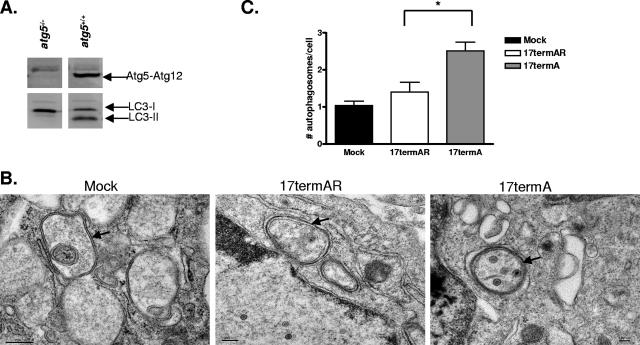
FIG. 1.
FIG. 1.
ICP34.5 partially controls HSV-1-induced autophagosome formation and engulfment of virions. (A) Western blot analysis of lysates harvested from atg5−/− and atg5+/+ MEFs probed with polyclonal antibodies to Atg5 (SO4) and LC3. The majority of Atg5 was conjugated to Atg12 in the cytoplasm. (B) Representative electron micrographs of mock-, 17termAR-, and 17termA-infected Atg5+/+ MEFs. Arrows indicate representative autophagosomes that would be scored positive in panel C. Scale bars, 200 nm (left part) and 100 nm (middle and right parts). (C) Quantitation of the numbers of autophagosomes in mock-, 17termAR-, and 17termA-infected Atg5+/+ MEFs. Results shown represent data collected from three independent experiments. Data shown represent the mean number of autophagosomes per cell per condition ± the standard error of the mean. An asterisk indicates P < 0.05 by Student's t test.
FIG. 2.
FIG. 2.
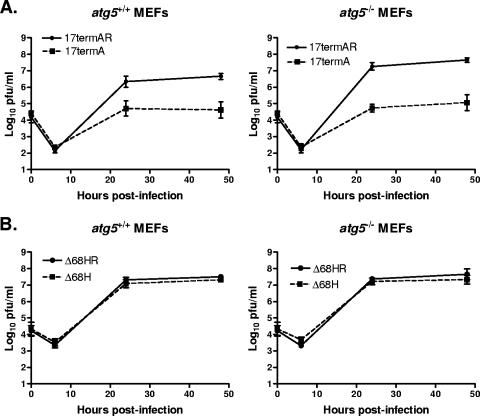
Autophagy does not significantly affect HSV-1 growth. Primary Atg5−/− and Atg5+/+ MEFs were infected at a multiplicity of 0.01 PFU/cell. Cells and supernatants were collected at the indicated times postinfection, and titers were determined on Vero cells. Results shown represent data collected from three independent experiments. Data points represent the geometric mean number of PFU/ml of material in which titers were determined ± the standard error of the mean for three samples per virus per time point. The growth of 17termAR was significantly different (P < 0.05 by Student's t test) at 48 h postinfection. The limit of detection of this assay, as indicated on the y axis, is 10 PFU/ml.
FIG. 3.
FIG. 3.
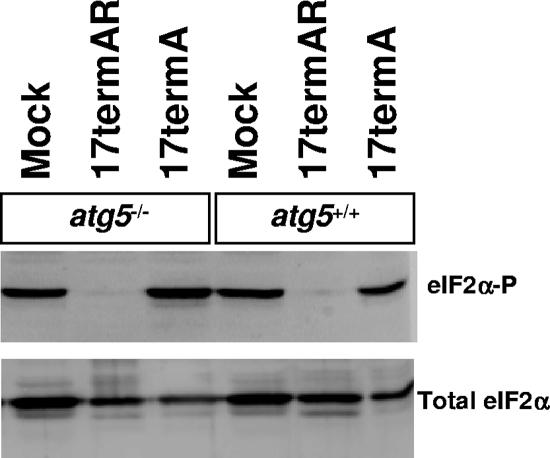
The phosphorylation state of eIF2α is not affected by the autophagic pathway. Shown is a Western blot analysis of lysates of primary Atg5−/− and Atg5+/+ MEFs mock infected or infected with 17termAR or 17termA at a multiplicity of 5 PFU/cell for 15 h. Immunoblots were probed with polyclonal antibodies specific for eIF2α phosphorylated on Ser51 and total eIF2α.
FIG. 4.
FIG. 4.
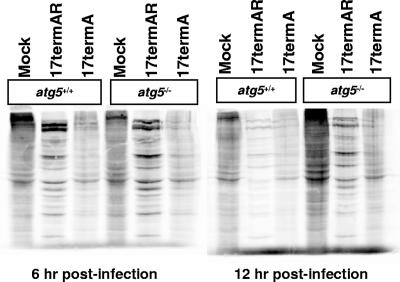
The lack of viral protein accumulation following infection with 17termA is due to translational arrest mediated by phosphorylated eIF2α rather than autophagy-dependent protein degradation. Shown is an autoradiograph of Atg5−/− and Atg5+/+ MEFs mock infected or infected with 17termAR or 17termA at a multiplicity of 5 PFU/cell. At 6 and 12 h postinfection, 35S-containing methionine and cysteine were incorporated into newly synthesized proteins for 2 h, harvested, and then visualized via autoradiography.

References

    1. Ackermann, M., J. Chou, M. Sarmiento, R. A. Lerner, and B. Roizman. 1986. Identification by antibody to a synthetic peptide of a protein specified by a diploid gene located in the terminal repeats of the L component of herpes simplex virus genome. J. Virol. 58:843-850. - PMC - PubMed
    1. Andrade, R. M., M. Wessendarp, M. J. Gubbels, B. Striepen, and C. S. Subauste. 2006. CD40 induces macrophage anti-Toxoplasma gondii activity by triggering autophagy-dependent fusion of pathogen-containing vacuoles and lysosomes. J. Clin. Investig. 116:2366-2377. - PMC - PubMed
    1. Balliet, J. W., and P. A. Schaffer. 2006. Point mutations in herpes simplex virus type 1 oriL, but not in oriS, reduce pathogenesis during acute infection of mice and impair reactivation from latency. J. Virol. 80:440-450. - PMC - PubMed
    1. Birmingham, C. L., A. C. Smith, M. A. Bakowski, T. Yoshimori, and J. H. Brumell. 2006. Autophagy controls Salmonella infection in response to damage to the Salmonella-containing vacuole. J. Biol. Chem. 281:11374-11383. - PubMed
    1. Bolovan, C. A., N. M. Sawtell, and R. L. Thompson. 1994. ICP34.5 mutants of herpes simplex virus type 1 strain 17syn+ are attenuated for neurovirulence in mice and for replication in confluent primary mouse embryo cell cultures. J. Virol. 68:48-55. - PMC - PubMed

Publication types

Substances

LinkOut - more resources