. 2008 Jan;46(1):177-84.
doi: 10.1128/JCM.00428-07. Epub 2007 Sep 12.

Molecular characterization of human immunodeficiency virus type 1 (HIV-1) and HIV-2 in Yaounde, Cameroon: evidence of major drug resistance mutations in newly diagnosed patients infected with subtypes other than subtype B

Affiliations

Molecular characterization of human immunodeficiency virus type 1 (HIV-1) and HIV-2 in Yaounde, Cameroon: evidence of major drug resistance mutations in newly diagnosed patients infected with subtypes other than subtype B

Nicaise Ndembi et al. J Clin Microbiol. 2008 Jan.

Abstract

Prior to current studies on the emergence of drug resistance with the introduction of antiretroviral therapy (ART) in Cameroon, we performed genotypic analysis on samples from drug-naïve, human immunodeficiency virus (HIV)-infected individuals in this country. Of the 79 HIV type 1 (HIV-1) pol sequences analyzed from Cameroonian samples, 3 (3.8%) were identified as HIV-1 group O, 1 (1.2%) was identified as an HIV-2 intergroup B/A recombinant, and the remaining 75 (95.0%) were identified as HIV-1 group M. Group M isolates were further classified as subtypes A1 (n = 4), D (n = 4), F2 (n = 6), G (n = 12), H (n = 2), and K (n = 1) and as circulating recombinant forms CRF02_AG (n = 41), CRF11_cpx (n = 1), and CRF13_cpx (n = 2). Two pol sequences were identified as unique recombinant forms of CRF02_AG/F2 (n = 2). M46L (n = 2), a major resistance mutation associated with resistance to protease inhibitors, was observed in 2/75 (2.6%) group M samples. Single mutations associated with resistance to nucleoside reverse transcriptase inhibitors (T215Y/F [n = 3]) and nonnucleoside reverse transcriptase inhibitors (V108I [n = 1], L100I [n = 1], and Y181C [n = 2]) were observed in 7 of 75 (9.3%) group M samples. None of the patients had any history of ART exposure. Population surveillance of transmitted HIV drug resistance is required and should be included to aid in the development of appropriate guidelines.


Figures
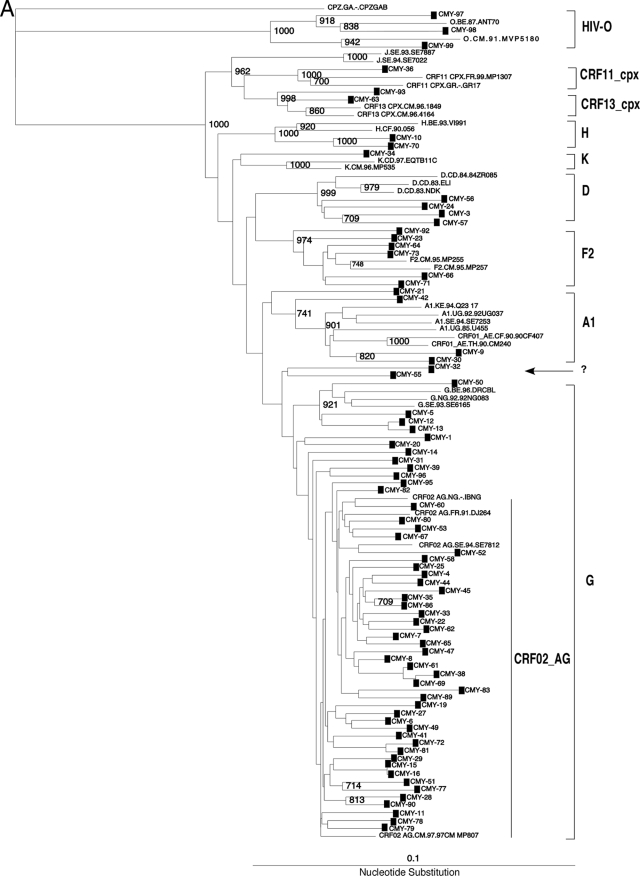
FIG. 1.
FIG. 1.
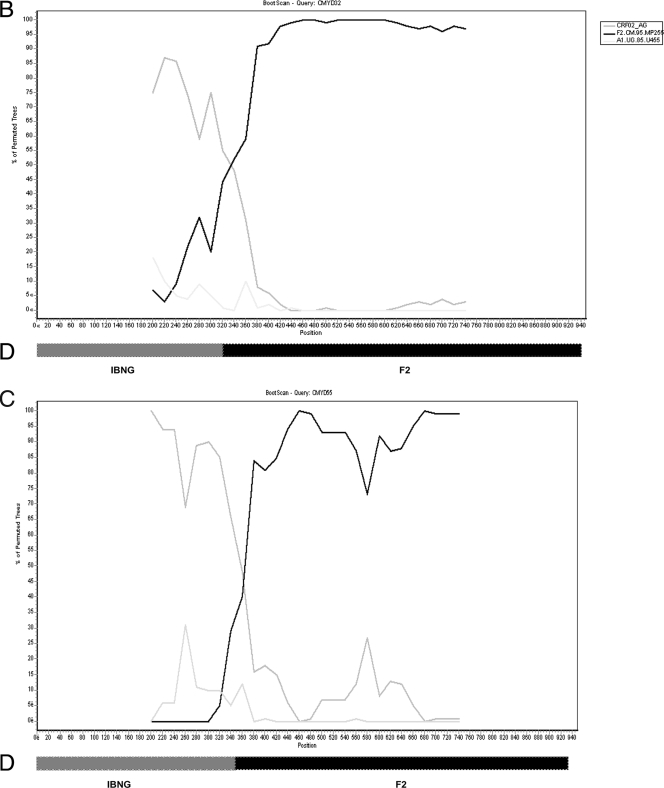
(A) Phylogenetic tree of HIV-1 PR-RT sequences from 78 HIV-1 group M and O isolates. “CMY” refers to PR-RT sequences from the cross-sectional analysis and indicates the country (Cameroon) and location (Yaoundé) of sample collection. The bootstrap value at each node represents the number among 1,000 bootstrap replicates that supported the branching order. Bootstrap resampling values of 70% or higher are shown. Brackets on the right represent the major group M subtypes. Newly derived sequences are marked with filled squares, and the novel unique recombinant form CRF02_AG/F2 is shown by an arrow. A 950-nt segment of the PR-RT coding region was used to construct this tree by the neighbor-joining method. PR-RT genetic subtypes A, D, F, G, H, and K and recombinants CRF02_AG, CRF11.cpx, and CRF13.cpx, as well as HIV-1 group O, are indicated. GenBank accession numbers for the reference sequences are as follows: A1.KE.93.Q23-17, AF004885; A1.UG.85.U455, M62320; A1.UG.92.92UG037, U51190; D.CD.83.ELI, K03454; D.CD.83.NDK, M27323; DCD.84.84ZR085, U88822; F2.CM.95.MP257, AJ249237; G.NG.92.92NG083, U88826; G.SE.93.SE6165, AF061642; G.BE.96.DRCBL, AF084936; H.BE.93.VI991, AF190127; J.SE.93SE7887, AF082394; J.SE.94.SE7022, AF082395; K.CM.96.MP535, AJ249239; K.CD.97.EQTB11C, AJ249234; 01_AE.TH.90.90CM240, U54771; 01_AE.CF.90.90CF4071, AF197341; 02_AG.NG.-.IBNG, L39106; 02_AG.FR91.DJ264, AF063224; 02_AG.SE.94.SE7812, AF107770; 02_AG.CM.97.97CM.MP807, AJ251056; 11_CPX.CM.97.MP818, AJ291718; 13 CPX.CM.96.1849, AF460972; 13 CPX.CM.96.4164, AF460974; O.CM.-.ANT70, L20587; O.CM.91.MVP5180, L20571; and CPZ.GA.-.CPZGAB, X52154. (B and C) SimPlot analyses of unclassifiable Cameroonian PR-RT (approximately 1,000 nt) sequences 04CMY-32 (B) and 04CMY-55 (C), showing the recombination between subtype F2 and CRF02_AG (A). The bootscan analysis was performed against reference strains from clades A (strain A1.UG.85.U455), B (strain B.US.83.RF), D (strain D,CD.84.84ZR085), F1 (strain F1.FI.93.FIN9363), F2 (strain F2.CM.95,MP255), G (strain G.SE.93.SE6155), and 02_AG (strain AG.NG.-.IBNG). (D) Segments derived from an IBNG-like strain and subtype F2 are shown.
FIG. 1.
FIG. 1.
(A) Phylogenetic tree of HIV-1 PR-RT sequences from 78 HIV-1 group M and O isolates. “CMY” refers to PR-RT sequences from the cross-sectional analysis and indicates the country (Cameroon) and location (Yaoundé) of sample collection. The bootstrap value at each node represents the number among 1,000 bootstrap replicates that supported the branching order. Bootstrap resampling values of 70% or higher are shown. Brackets on the right represent the major group M subtypes. Newly derived sequences are marked with filled squares, and the novel unique recombinant form CRF02_AG/F2 is shown by an arrow. A 950-nt segment of the PR-RT coding region was used to construct this tree by the neighbor-joining method. PR-RT genetic subtypes A, D, F, G, H, and K and recombinants CRF02_AG, CRF11.cpx, and CRF13.cpx, as well as HIV-1 group O, are indicated. GenBank accession numbers for the reference sequences are as follows: A1.KE.93.Q23-17, AF004885; A1.UG.85.U455, M62320; A1.UG.92.92UG037, U51190; D.CD.83.ELI, K03454; D.CD.83.NDK, M27323; DCD.84.84ZR085, U88822; F2.CM.95.MP257, AJ249237; G.NG.92.92NG083, U88826; G.SE.93.SE6165, AF061642; G.BE.96.DRCBL, AF084936; H.BE.93.VI991, AF190127; J.SE.93SE7887, AF082394; J.SE.94.SE7022, AF082395; K.CM.96.MP535, AJ249239; K.CD.97.EQTB11C, AJ249234; 01_AE.TH.90.90CM240, U54771; 01_AE.CF.90.90CF4071, AF197341; 02_AG.NG.-.IBNG, L39106; 02_AG.FR91.DJ264, AF063224; 02_AG.SE.94.SE7812, AF107770; 02_AG.CM.97.97CM.MP807, AJ251056; 11_CPX.CM.97.MP818, AJ291718; 13 CPX.CM.96.1849, AF460972; 13 CPX.CM.96.4164, AF460974; O.CM.-.ANT70, L20587; O.CM.91.MVP5180, L20571; and CPZ.GA.-.CPZGAB, X52154. (B and C) SimPlot analyses of unclassifiable Cameroonian PR-RT (approximately 1,000 nt) sequences 04CMY-32 (B) and 04CMY-55 (C), showing the recombination between subtype F2 and CRF02_AG (A). The bootscan analysis was performed against reference strains from clades A (strain A1.UG.85.U455), B (strain B.US.83.RF), D (strain D,CD.84.84ZR085), F1 (strain F1.FI.93.FIN9363), F2 (strain F2.CM.95,MP255), G (strain G.SE.93.SE6155), and 02_AG (strain AG.NG.-.IBNG). (D) Segments derived from an IBNG-like strain and subtype F2 are shown.
FIG. 2.
FIG. 2.
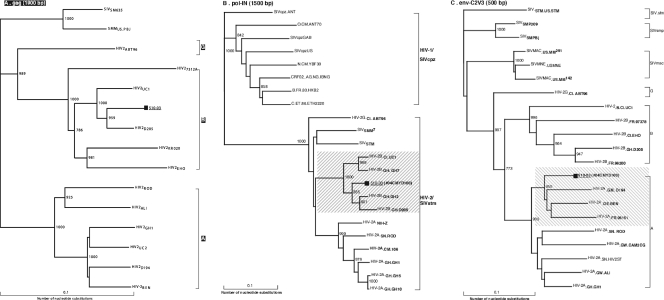
Phylogenetic trees based on gag-p17/p24 gene (1,900 bp) of HIV-2 (510-03/04CMYD-100) subtype B/A recombinant strain (A) and the pol-IN (1,500 bp) gene (B) and env-C2V3 (500 bp) gene (C) from the Cameroonian HIV-2 strain. The bootstrap value at each node represents the number among 1,000 replicates that supported the branching order. Bootstrap values of >70% are shown. The brackets on the right represent the major HIV-2 subtypes. The newly analyzed sequence (510-03) is marked with a filled square.

References

    1. Aghokeng, A. F., L. Ewane, B. Awazi, A. Nanfack, E. Delaporte, L. Zekeng, and M. Peeters. 2005. Enfuvirtide binding domain is highly conserved in non-B HIV type 1 strains from Cameroon, West Central Africa. AIDS Res. Hum. Retrovir. 21430-433. - PubMed
    1. Apetrei, C., D. Descamps, G. Collin, I. Loussert-Ajaka, F. Damond, M. Duca, F. Simon, and F. Brun-Vezinet. 1998. Human immunodeficiency virus type 1 subtype F reverse transcriptase sequence and drug susceptibility. J. Virol. 723534-3538. - PMC - PubMed
    1. Brenner, B., D. Turner, M. Oliveira, D. Moisi, M. Detorio, M. Carobene, R. G. Marlink, J. Schapiro, M. Roger, and M. A. Wainberg. 2003. A V106 mutation in HIV-1 clade C viruses exposed to efavirenz confers cross-resistance to non nucleoside reverse transcriptase inhibitors. AIDS 17F1-F5. - PubMed
    1. Bussmann, H., V. Novitsky, and W. Wester. 2002. Frequency of drug resistant mutations among HIV-1 C infected drug-naïve patients in Botswana, abstr. TuPeB4607. Abstr. 14th Int. AIDS Conf., Barcelona, Spain.
    1. Descamps, D., G. Collin, F. Letourneur, C. Apetrei, F. Damon, I. Loussert-Ajaka, F. Simon, S. Saragosti, and F. Brun-Vezinet. 1997. Susceptibility of human immunodeficiency virus type 1 group O isolates to antiretroviral agents: in vitro phenotypic and genotypic analyses. J. Virol. 718893-8898. - PMC - PubMed

Publication types

MeSH terms

Substances

Associated data