


Interactions between estrogen effects and hunger effects in ovariectomized female mice. I. Measures of arousal
- PMID: 17868674
- PMCID: PMC2080855
- DOI: 10.1016/j.yhbeh.2007.07.009
Interactions between estrogen effects and hunger effects in ovariectomized female mice. I. Measures of arousal
Abstract
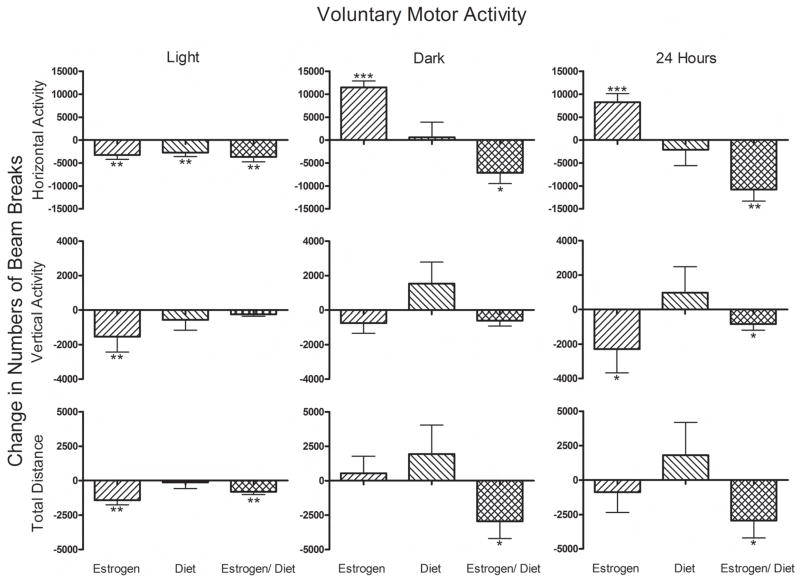
Measures of arousal were used to study effects of estradiol and food restriction, and their potential interactions, in ovariectomized female C57Bl/6 mice. It was hypothesized based on a proposed theoretical equation [Pfaff, D.W., 2006a. Brain Arousal and Information Theory. Harvard University Press, Cambridge, Pfaff, D.W., (Ed.), 2006b. Knobil and Neill's The Physiology of Reproduction, 3rd edition. Elsevier/Academic Press, San Diego] that each treatment would increase arousal-related behaviors and that their combination would further increase arousal behavior. Following baseline testing, animals (n=28) were divided into 3 groups that, in different experimental phases, received either estradiol (in subcutaneous capsules), restricted diet (a liquid diet providing 60% of daily caloric requirements) or a combination of those two. An automated arousal behavior monitoring system was used to measure home cage voluntary motor activity and sensory responsiveness, these being components of a new operational definition of 'generalized arousal'.
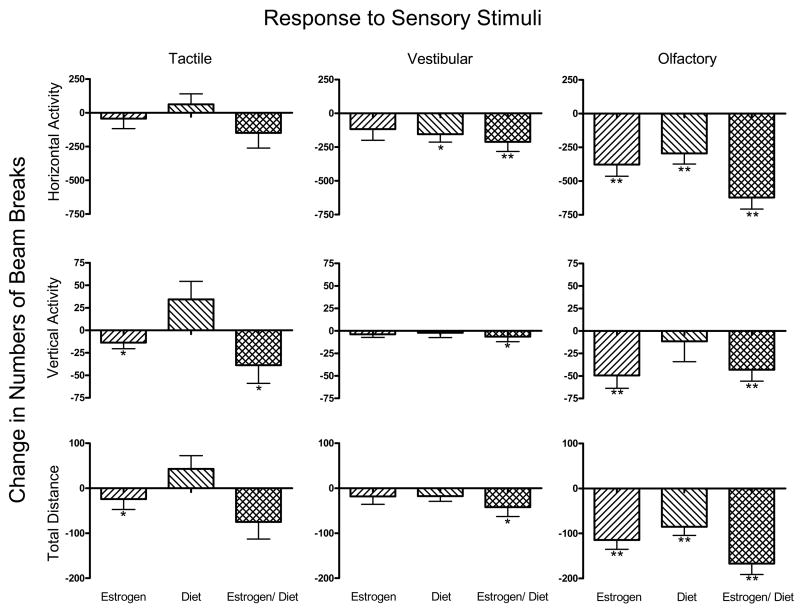
Key findings: (1) During the light, all treatments reduced voluntary activity. (2) In the dark, estrogens increased, while estrogens in combination with restricted diet decreased, horizontal activity. (3) In the dark, restricted diet alone had little effect on voluntary activity, but reduced it when combined with estrogen treatment. (4) All treatments reduced responses to the olfactory stimulus. The dependence of results on time of day was unexpected. Further, different patterns of results for the three treatments suggest that estrogens and food restriction did not have equivalent or additive effects on arousal. While contrary to the main prediction, these findings are discussed in terms of the animals' adaptive preparations for reproduction [Schneider, J.E., 2006. Metabolic and hormonal control of the desire for food and sex: implications for obesity and eating disorders. Horm. Behav. 50, 562-571].
Figures
References
-
- Albers HE, Gerall AA, Axelson JF. Effect of reproductive state on circadian periodicity in the rat. Physiol Behav. 1981;26(1):21–5. - PubMed
-
- Ammassari-Teule M, Restivo L, Pietteur V, Passino E. Learning about the context in genetically-defined mice. Behav Brain Res. 2001;125:195–204. - PubMed
-
- Asarian L, Geary N. Cyclic estradiol treatment normalizes body weight and restores physiological patterns of spontaneous feeding and sexual receptivity in ovariectomized rats. Horm Behav. 2002;42:461–471. - PubMed
-
- Beach FA, Orndoff RK. Variation in the responsiveness of female rats to ovarian hormones as a function of preceding hormonal deprivation. Horm Behav. 1974;5:201–205. - PubMed
-
- Beach FA. Sexual attractivitiy, proceptivity, and receptivity in female mammals. Horm Behav. 1976;7:105–138. - PubMed
Publication types
MeSH terms
Substances
Grants and funding
LinkOut - more resources
Full Text Sources
