


Neuropsychological function in children with blood lead levels <10 microg/dL
- PMID: 17868887
- PMCID: PMC2276844
- DOI: 10.1016/j.neuro.2007.07.007
Neuropsychological function in children with blood lead levels <10 microg/dL
Abstract
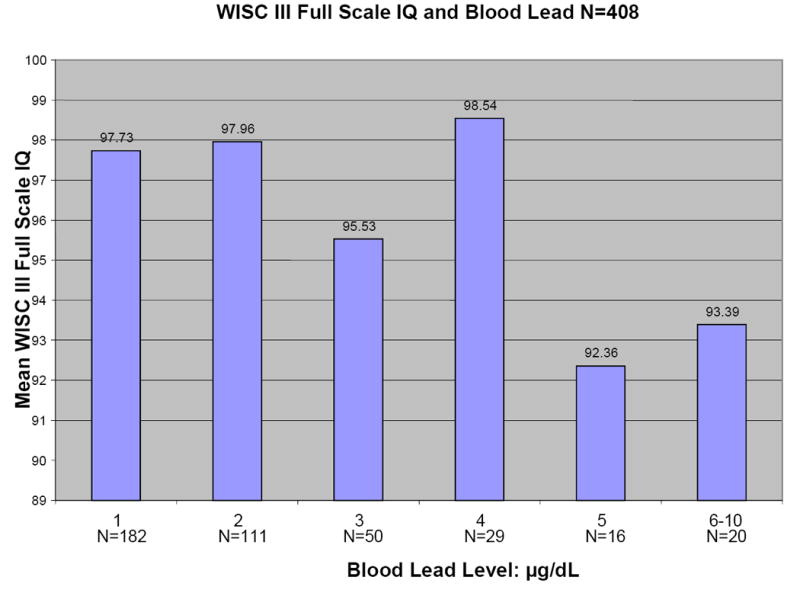
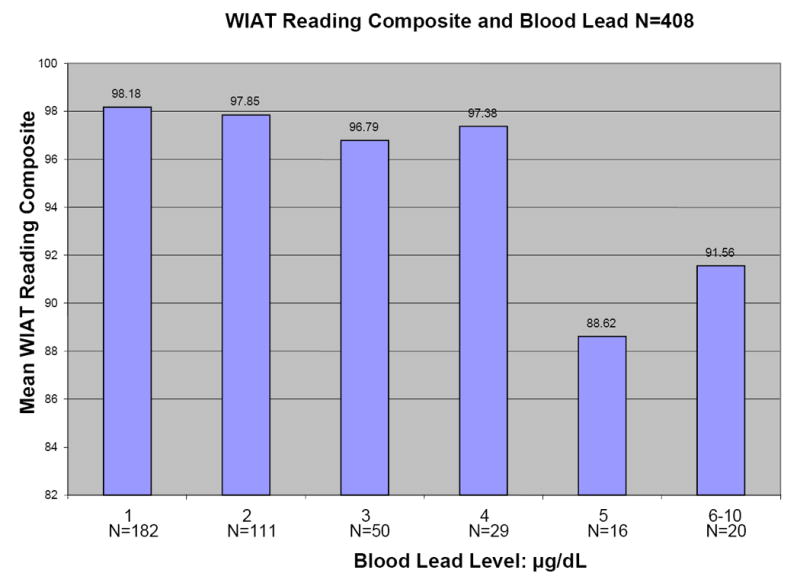
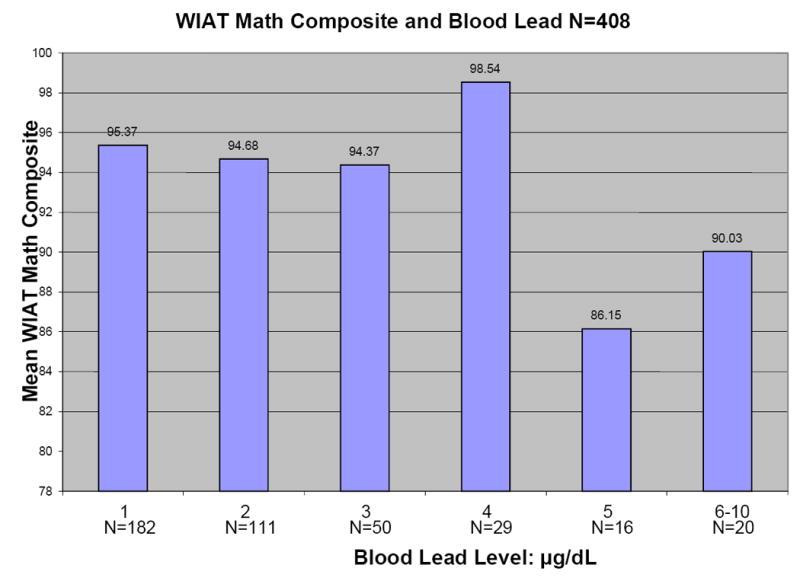
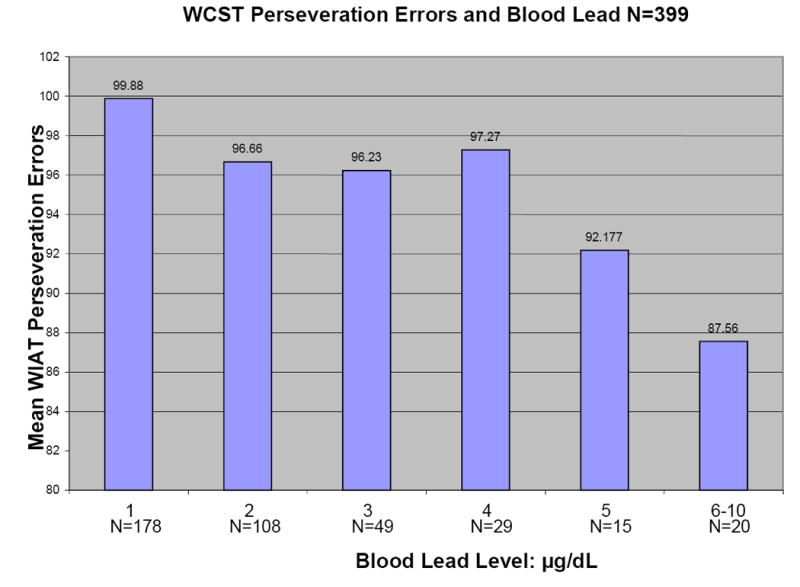
Clear adverse effects of blood lead levels >or=10 microg/dL have been documented in children. Given that the majority of US children have levels below 10 microg/dL, clarification of adverse effects below this cutoff value is needed. Our study evaluated the associations between blood lead levels <10 microg/dL and a broad spectrum of children's cognitive abilities. Data were analyzed from 534 children aged 6-10, enrolled in the New England Children's Amalgam Trial (NECAT) from the urban area of Boston, Massachusetts and rural Farmington, Maine. Adjusting for covariates (age, race, socioeconomic status, and primary caregiver IQ), children with 5-10 microg/dL had 5.0 (S.D. 2.3) points lower IQ scores compared to children with blood lead levels of 1-2 microg/dL (p=0.03). Verbal IQ was more negatively affected than performance IQ, with the most prominent decrement occurring in children's vocabulary. Wechsler Individual Achievement Test scores were strongly negatively associated with blood lead levels of 5-10 microg/dL. In adjusted analyses, children with levels of 5-10 microg/dL scored 7.8 (S.D. 2.4) and 6.9 (S.D. 2.2) points lower on reading and math composite scores, respectively, compared to children with levels of 1-2 microg/dL (p<0.01). Finally, levels of 5-10 microg/dL were associated with decreased attention and working memory. Other than associations of lead exposure with achievement, which even persisted after adjustment for child IQ, the most pronounced deficits were in the areas of spatial attention and executive function. Overall, our analyses support prior research that children's blood levels <10 microg/dL are related to compromised cognition and highlight that these may especially be related to academic achievement.
Figures
References
-
- The Children’s Amalgam Trial: design and methods. Control Clin Trials. 2003;24:795–814. - PubMed
-
- Centers of Disease Control. Blood lead levels--United States, 1999-2002. MMWR Morb Mortal Wkly Rep. 2005;54:513–6. - PubMed
-
- Bellinger D, Dietrich KN. Low-level lead exposure and cognitive function in children. Pediatr Ann. 1994;23:600–5. - PubMed
-
- Bellinger DC, Trachtenberg F, Barregard L, Tavares M, Cernichiari E, Daniel D, McKinlay S. Neuropsychological and renal effects of dental amalgam in children: a randomized clinical trial. JAMA. 2006;295:1775–83. - PubMed
-
- Brody DJ, Pirkle JL, Kramer RA, Flegal KM, Matte TD, Gunter EW, Paschal DC. Blood lead levels in the US population. Phase 1 of the Third National Health and Nutrition Examination Survey (NHANES III, 1988 to 1991) JAMA. 1994;272:277–83. - PubMed
Publication types
MeSH terms
Substances
Grants and funding
LinkOut - more resources
Full Text Sources
