


Review
doi: 10.1016/j.addr.2007.08.012.
Epub 2007 Aug 16.
Spatiotemporal control over growth factor signaling for therapeutic neovascularization
Affiliations
- PMID: 17868951
- PMCID: PMC2581871
- DOI: 10.1016/j.addr.2007.08.012
Item in Clipboard
Review
Spatiotemporal control over growth factor signaling for therapeutic neovascularization
Adv Drug Deliv Rev.
.
Abstract
Many of the qualitative roles of growth factors involved in neovascularization have been delineated, but it is unclear yet from an engineering perspective how to use these factors as therapies. We propose that an approach that integrates quantitative spatiotemporal measurements of growth factor signaling using 3-D in vitro and in vivo models, mathematic modeling of factor tissue distribution, and new delivery technologies may provide an opportunity to engineer neovascularization on demand.
Figures
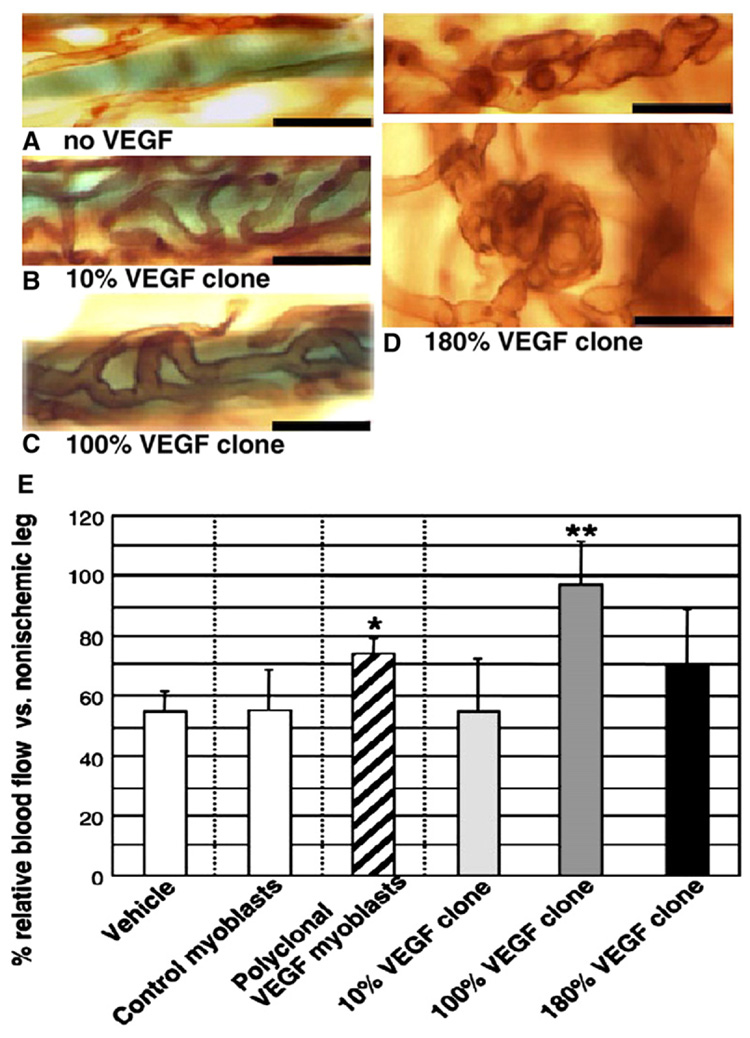
The impact of the local concentration of vascular endothelial growth factor (VEGF) on new blood vessel size (A–D) and blood flow in the ischemia region (E). Transgenic mice myoblasts expressing VEGF were implanted into mice ear muscle (A–D) and mice hindlimb muscle (E) subject to femoral artery ligation. Three monoclonal populations secreted 10%, 100% and 180% of the average VEGF levels of the parental polyclonal population per cell in vitro. Vessel size increased with the increase of VEGF concentration (A–C), but the 180% VEGF clone led to enlarged and glomeruloid bodies (D). The optimal concentration of VEGF (100% clone) induced larger blood flow than either higher (180% clone) or lower (10% clone) VEGF concentrations (E). (Ref. [45], with permission from the FASEB Journal).
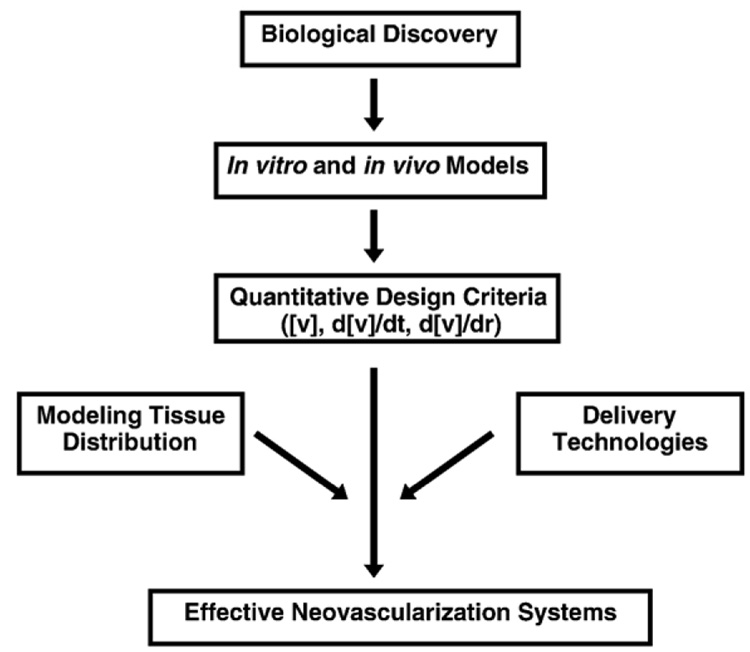
Schematic illustration of the proposed integrated approach to develop effective neovascularization strategies. Quantitative design criteria are the core to developing effective neovascularization therapies and these criteria are based on biological discovery and appropriate in vitro and in vivo models. The translation of the design criteria into effective systems requires integration with mathematical modeling of growth factor tissue distribution and delivery technologies to achieve appropriate spatiotemporal introduction of factors into the site of interest.
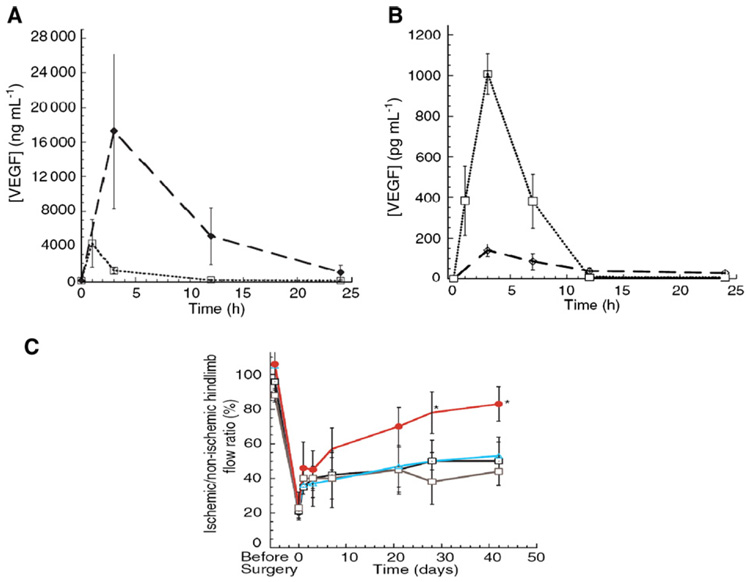
Examples of the effects of in vivo temporal and spatial presentation of exogenous vascular endothelial growth factor (VEGF) on restoring blood perfusion in ischemia. A) VEGF delivered by injectable alginate hydrogels (♦) led to a higher concentration in the local injection region than VEGF delivered by bolus injection (□). B) In contrast, VEGF delivered by injectable alginate hydrogels (♦) exhibited a lower concentration in the systemic circulation (peripheral serum) than VEGF delivered by bolus injection (□). C) Local presentation of VEGF delivered from alginate gels (●) induced higher blood perfusion in the ischemia region than VEGF delivered with bolus injection ( ), alginate vehicle alone (△), or blank control condition (□). (Ref. [130], with permission from Blackwell Publishing).
), alginate vehicle alone (△), or blank control condition (□). (Ref. [130], with permission from Blackwell Publishing).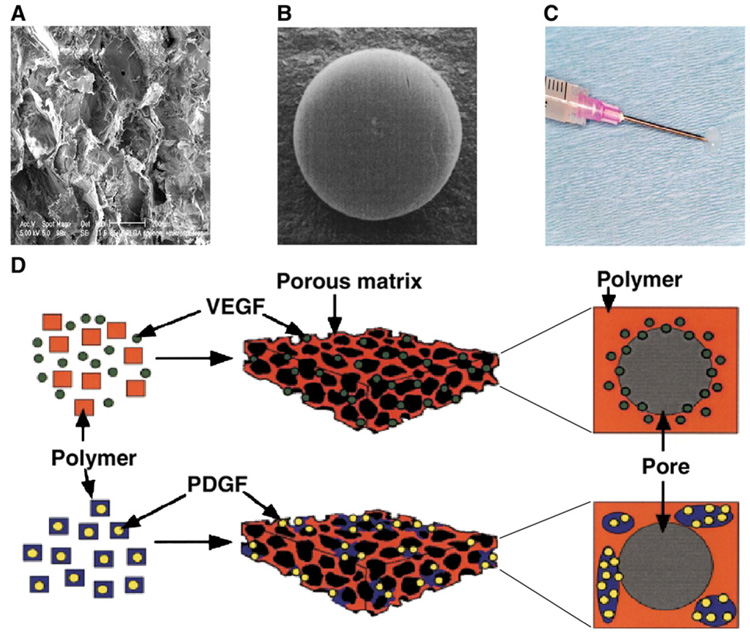
Examples of delivery systems for neovascularization factors. A) Scanning electron micrograph of a typical poly(lactide-co-glycolide) (PLGA) scaffold. B) PLGA microspheres. C) Injectable alginate hydrogel. D) Combination of scaffolds and microspheres. Scaffold can incorporate VEGF only or be fabricated from PDGF pre-encapsulated PLGA microspheres. Reprinted by permission from Macmillan Publishers Ltd: [Nature Biotechnology], (Ref. [103]), copyright (2001).
References
-
- Carmeliet P. Angiogenesis in life, disease and medicine. Nature. 2005;438:932–936. - PubMed
-
- Ferrara N, Kerbel RS. Angiogenesis as a therapeutic target. Nature. 2005;438:967–974. - PubMed
-
- Folkman J. Diagnostic and therapeutic applications of angiogenesis research. C. R. Acad. Sci., Ser. III. 1993;316:909–918. - PubMed
-
- Isner JM. Therapeutic angiogenesis: a new frontier for vascular therapy. Vasc. Med. 1996;1:79–87. - PubMed
-
- Hughes GC, Annex BH. Angiogenic therapy for coronary artery and peripheral arterial disease. Expert Rev. Cardiovasc. Ther. 2005;3:521–535. - PubMed
Publication types
MeSH terms
Substances
Grants and funding
LinkOut - more resources
Full Text Sources
Other Literature Sources
