


The interactive effects of antisocial personality disorder and court-mandated status on substance abuse treatment dropout
- PMID: 17869050
- PMCID: PMC3586262
- DOI: 10.1016/j.jsat.2007.02.007
The interactive effects of antisocial personality disorder and court-mandated status on substance abuse treatment dropout
Abstract
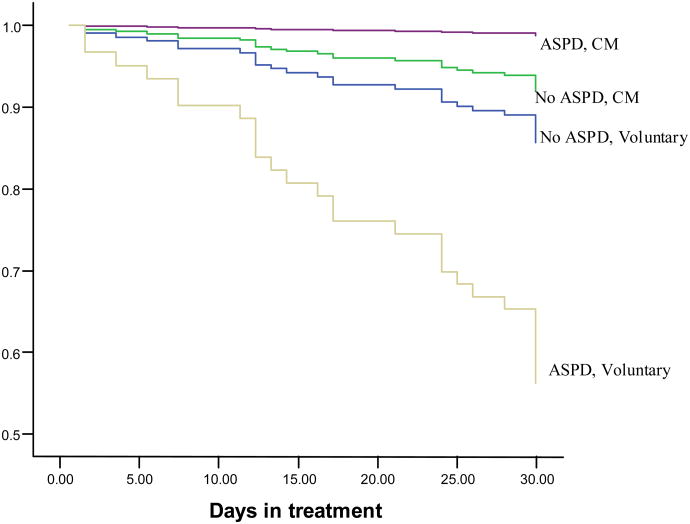
The present study sought to examine the interactive effects of court-mandated (CM) treatment and antisocial personality disorder (ASPD) on treatment dropout among 236 inner-city male substance users receiving residential substance abuse treatment. Of the 236 participants, 39.4% (n = 93) met criteria for ASPD and 72.5% (n = 171) were mandated to treatment through a pretrial release-to-treatment program. Results indicated a significant interaction between ASPD and CM status, such that patients with ASPD who were voluntarily receiving treatment were significantly more likely to drop out of treatment than each of the other groups. Subsequent discrete time survival analyses to predict days until dropout, using Cox proportional hazards regression, indicated similar findings, with patients with ASPD who were voluntarily receiving treatment completing fewer days of treatment than each of the other groups. These findings suggest the effectiveness of the court system in retaining patients with ASPD, as well as the role of ASPD in predicting treatment dropout for individuals who are in treatment voluntarily. Implications, including the potential value of the early implementation of specialized interventions aimed at improving adherence for patients with ASPD who are receiving treatment voluntarily, are discussed.
Figures
References
-
- Abrams KM. The effect of co-occurring disorders on criminal career: Interaction of antisocial personality disorder, alcoholism, and drug disorders. International Journal of Law and Psychiatry. 1989;12:133–148. - PubMed
-
- Alterman AI, Rutherford MJ, Cacciola JS, McKay JR, Boardman CR. Prediction of 7 months methadone maintenance treatment response by four measures of antisociality. Drug and Alcohol Dependence. 1998;49:217–223. - PubMed
-
- American Psychiatric Association. Diagnostic and Statistical Manual of Mental Disorders. 4th. American Psychiatric Association; Washington, DC: 1994.
-
- Brooner RK, Greenfield L, Schmidt CW, Bigelow GE. Antisocial personality disorder and HIV infection among intravenous drug abusers. American Journal of Psychiatry. 1993;150:53–58. - PubMed
-
- Brooner RK, Kidorf M, King VL, Stoller K. Preliminary evidence of good treatment response in antisocial drug abusers. Drug and Alcohol Dependence. 1998;49:249–260. - PubMed
Publication types
MeSH terms
Grants and funding
LinkOut - more resources
Full Text Sources
Medical
Miscellaneous
