Managing nonalcoholic fatty liver disease: recommendations for family physicians
- PMID: 17872748
- PMCID: PMC1949172
Managing nonalcoholic fatty liver disease: recommendations for family physicians
Abstract
Objective: To review evidence on the diagnosis and management of nonalcoholic fatty liver disease (NAFLD), the most common cause of chronic liver disease in human beings.
Sources of information: The literature was searched for clinical trials and review articles on NAFLD. Levels I and II evidence indicates the benefit of both lifestyle and pharmacologic interventions for NAFLD and nonalcoholic steatohepatitis (NASH).
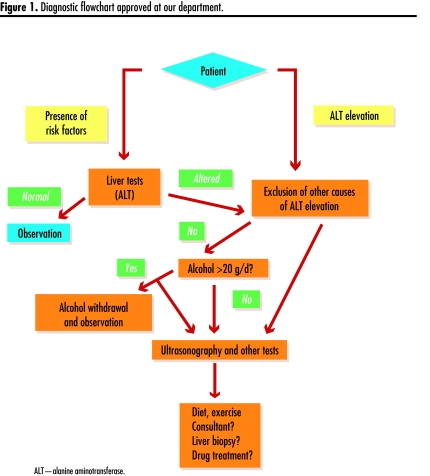
Main message: Scientific evidence does not currently support systematic screening for NAFLD. Both NAFLD and NASH are frequently discovered in overweight and obese patients with asymptomatic elevation of serum aminotransferase levels. Ultrasonography detects the presence of a fatty liver, but is unreliable for detecting and quantifying liver fibrosis. Patients with NAFLD should be monitored for possible progression to NASH, particularly if they have diabetes or metabolic syndrome. Although diet and exercise are the mainstays of treatment, medication might be warranted if an appropriate diet and regular physical activity do not improve biochemical markers and liver morphology. Referral for liver biopsy and further evaluation should be considered for those at higher risk of developing NASH.
Conclusion: Although most patients with NAFLD have a benign course, some progress to NASH, liver cirrhosis, and hepatocellular carcinoma. These patients should be carefully monitored for progression of disease and treated for associated metabolic disturbances. An integrated approach to care is essential.
OBJECTIF: Faire le point sur le diagnostic et le traitement du foie gras non alcoolique (FGNA), la cause la plus fréquente d’affection hépatique chronique chez l’humain.
SOURCE DE L’INFORMATION: On a fait une recension des ouvrages scientifiques à la recherche d’essais cliniques et d’articles de revue portant sur le FGNA. Des preuves de niveaux I et II indiquent que des interventions d’ordre comportemental et pharmacologique sont bénéfiques dans les cas de FGNA et de stéatohépatite non alcoolique (SHNA).
PRINCIPAL MESSAGE: Les données scientifiques actuelles ne sont pas en faveur d’un dépistage systématique du FGNA. On découvre souvent un FGNA ou une SHNA chez un patient souffrant d’excès de poids ou d’obésité qui présente une élévation asymptomatique des aminotransférases sériques. L’échographie est efficace pour identifier un foie gras, mais elle est peu fiable pour détecter et quantifier une fibrose hépatique. Chez les patients atteints de FGNA, on doit surveiller une éventuelle progression vers la SHNA, surtout s’ils ont le diabète ou un syndrome métabolique. Même si le régime alimentaire et la pratique régulière d’exercice sont les piliers du traitement, le recours à une médication peut devenir nécessaire si l’exercice régulier et un régime approprié n’améliorent pas les marqueurs biochimiques et la morphologie hépatique. Chez ceux qui présentent un risque élevé de développer une SHNA, on doit envisager une biopsie et une évaluation plus approfondie par un spécialiste.
CONCLUSION: Quoique la plupart des patients qui ont un FGNA évoluent de façon favorable, certains vont progresser vers une SHNA, une cirrhose ou un carcinome hépatocellulaire. Chez ces derniers, il importe de bien suivre la progression de la maladie et de traiter les anomalies métaboliques associées. Un mode de traitement intégré est essentiel.
Figures
References
-
- Bellentani S, Tiribelli C, Saccoccio G, Sodde M, Fratti N, De Martin C, et al. Prevalence of chronic liver disease in the general population of northern Italy: the Dionysos Study. Hepatology. 1994;20(6):1442–9. - PubMed
-
- Marchesini G, Bugianesi E, Forlani G, Cerrelli F, Lenzi M, Manini R, et al. Nonalcoholic fatty liver, steatohepatitis, and the metabolic syndrome. Hepatology. 2003;37(4):917–23. - PubMed
-
- Caldwell SH, Crespo DM. The spectrum expanded: cryptogenic cirrhosis and the natural history of non-alcoholic fatty liver disease. J Hepatol. 2004;40(4):578–84. - PubMed
-
- Wanless IR, Lentz JS. Fatty liver hepatitis (steatohepatitis) and obesity: an autopsy study with analysis of risk factors. Hepatology. 1990;12(5):1106–10. - PubMed
-
- Clark JM, Brancati FL, Diehl AM. Nonalcoholic fatty liver disease. Gastroenterology. 2002;122(6):1649–57. - PubMed
Publication types
MeSH terms
Substances
LinkOut - more resources
Full Text Sources
Other Literature Sources
Medical
Research Materials