Review
. 2007 Summer;5(2):96-104.
doi: 10.1007/s12021-007-0003-6.

MorphML: level 1 of the NeuroML standards for neuronal morphology data and model specification

Affiliations
Review

MorphML: level 1 of the NeuroML standards for neuronal morphology data and model specification

Sharon Crook et al. Neuroinformatics. 2007 Summer.

Abstract

Quantitative neuroanatomical data are important for the study of many areas of neuroscience, and the complexity of problems associated with neuronal structure requires that research from multiple groups across many disciplines be combined. However, existing neuron-tracing systems, simulation environments, and tools for the visualization and analysis of neuronal morphology data use a variety of data formats, making it difficult to exchange data in a readily usable way. The NeuroML project was initiated to address these issues, and here we describe an extensible markup language standard, MorphML, which defines a common data format for neuronal morphology data and associated metadata to facilitate data and model exchange, database creation, model publication, and data archiving. We describe the elements of the standard in detail and outline the mappings between this format and those used by a number of popular applications for reconstruction, simulation, and visualization of neuronal morphology.


Figures
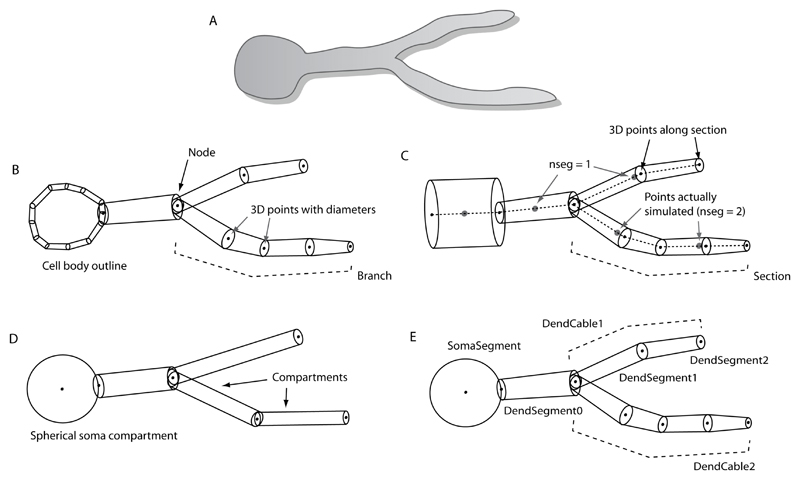
Figure 1
Figure 1
Schematic comparing handling of morphological information for a simple cell by different applications. A) Original cell structure. B) Schematic of Neurolucida reconstruction where the soma is represented by an outline and three-dimensional points are specified along each branch. C) NEURON simulator format where cell structure is specified in sections. Only the center of the section is simulated unless the nseg parameter is greater than one. D) GENESIS simulator representation using compartments that are cylinders except for the soma, which can be spherical. The optimal length of each compartment is determined by the electrotonic length. E) MorphML representation where any of the information shown in panels B through D can be encoded. Example 1 gives the XML corresponding to this morphology. Ideally, the MorphML document will contain the same amount of detail as the original source document, and each application that uses the file can extract the relevant information. Note that these are simply representative examples of how morphology is handled by each application
Figure 2
Figure 2
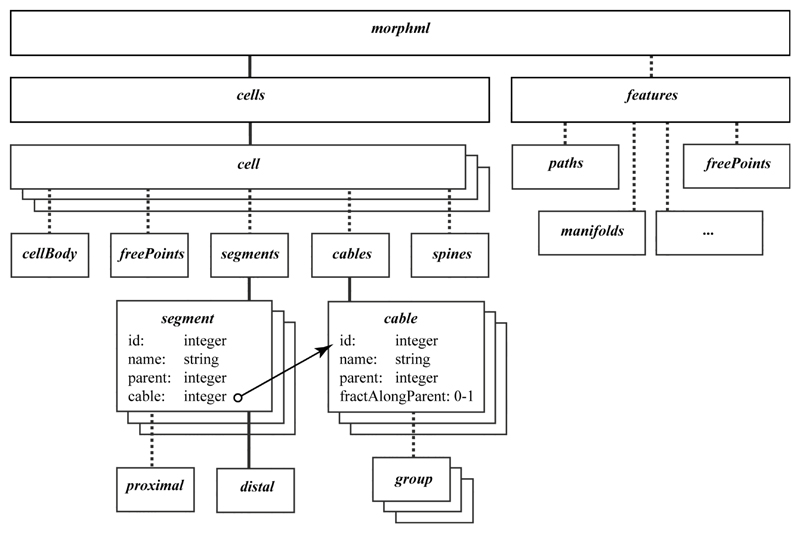
Structure of the main elements in MorphML files. A dashed line indicates an optional child element. The root element morphml contains cells, with information on the cellular structures, and features, with information on other interesting anatomical items observed in the sample. Elements for adding notes, references, and other metadata are omitted for clarity. The core of the cell element is the specification of the segments, and the optional grouping of them (by a pointer to the id of the cable) into cables.
Figure 3
Figure 3
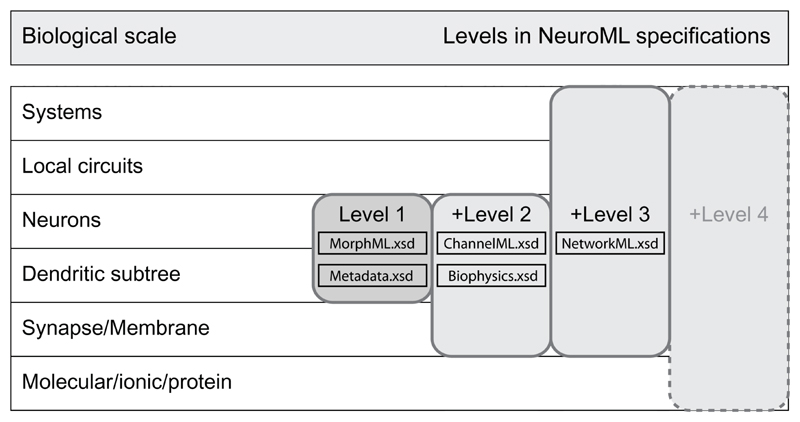
Diagram showing different levels of biological scale at which information is processed and stored in the nervous system (left) and the related levels in NeuroML. The corresponding XSD files are indicated. This paper deals only with level 1, which describes neuronal morphology. Level 2 allows specification of mechanisms at the membrane and synapse level, allowing the creation of biologically realistic models of spiking neurons. Level 3 adds network connectivity so that neuronal circuits and systems can be described. Future work includes level 4, which will allow specification of interactions with subcellular signaling pathways.

References

    1. Ascoli GA. Mobilizing the base of neuroscience data: the case of neuronal morphologies. Nature Reviews Neuroscience. 2006;7:318–324. - PubMed
    1. Ascoli GA, Krichmar JL, Nasuto SJ, Senft SL. Generation, description and storage of dendritic morphology data. Philosophical transactions of the Royal Society of London. Series B, Biological Sciences. 2001;356:1131–1145. - PMC - PubMed
    1. Beeman D, Bower JM. Simulator-independent representation of ionic conductance models with ChannelDB. Neurocomputers. 2004;58–60:1085–1090.
    1. Beeman D, Bower JM, De Schutter E, Efthimiadis EN, Goddard N, Leigh J. The GENESIS simulator-based neuronal database. In: Koslow SH, Huerta MF, editors. Neuroinformatics: An overview of the human brain project. Mahwah: Lawrence Erlbaum Associates; 1997. pp. 57–80.
    1. Bower JM, Beeman D. The book of GENESIS: Exploring realistic neural models with the general neural simulation system. 2nd ed. New York: Springer; 1998.

Publication types

LinkOut - more resources