. 2008 Dec;21(4):355-62.
doi: 10.1007/s10278-007-9073-0. Epub 2007 Sep 15.

Creating and curating a terminology for radiology: ontology modeling and analysis

Affiliations

Creating and curating a terminology for radiology: ontology modeling and analysis

Daniel L Rubin. J Digit Imaging. 2008 Dec.

Abstract

The radiology community has recognized the need to create a standard terminology to improve the clarity of reports, to reduce radiologist variation, to enable access to imaging information, and to improve the quality of practice. This need has recently led to the development of RadLex, a controlled terminology for radiology. The creation of RadLex has proved challenging in several respects: It has been difficult for users to peruse the large RadLex taxonomies and for curators to navigate the complex terminology structure to check it for errors and omissions. In this work, we demonstrate that the RadLex terminology can be translated into an ontology, a representation of terminologies that is both human-browsable and machine-processable. We also show that creating this ontology permits computational analysis of RadLex and enables its use in a variety of computer applications. We believe that adopting an ontology representation of RadLex will permit more widespread use of the terminology and make it easier to collect feedback from the community that will ultimately lead to improving RadLex.


Figures
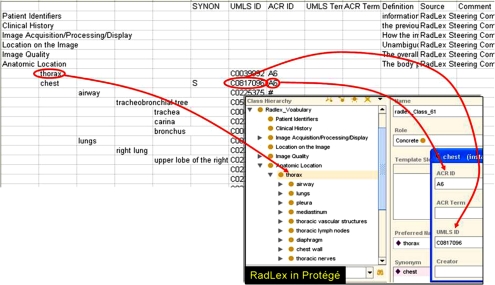
Fig 1.
Fig 1.
Constructing an ontology of RadLex from the text format in which it was originally acquired. RadLex was initially acquired in a spreadsheet (upper half), with the terminology structure represented as indented terms (left half of spreadsheet). The attributes for each term is recorded using additional columns, such as synonym, UMLS ID, ACR ID, etc. (column labels shown in right half of spreadsheet). The ontology version of RadLex was produced by creating a class for each term in the RadLex hierarchy and assigning the appropriate attributes for each term (arrows). The resulting ontology can be browsed by expanding and collapsing entire branches of the ontology, and double-clicking on classes to browse the terminology (inset, lower right).
Fig 2.
Fig 2.
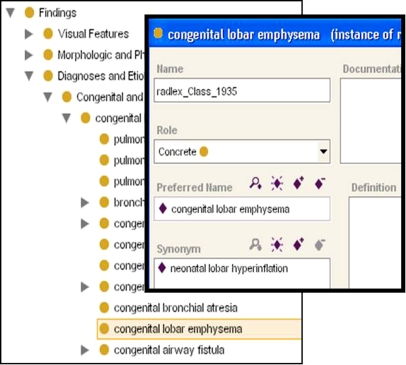
RadLex in Protégé. RadLex ontology imported into Protégé, showing a hierarchy of classes, representing RadLex preferred terms (left). Each RadLex class contains slots that contain information about the term, such as the preferred name and synonyms. For example, we see that the RadLex term selected in the ontology (left) has a preferred name “congenital lobar emphysema” and a synonym “neonatal lobar hyperinflation” (detail of selected term shown on right).
Fig 3.
Fig 3.
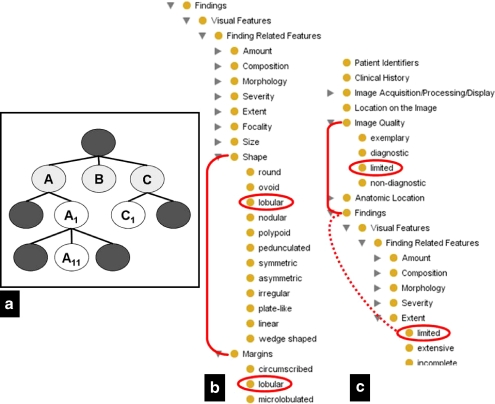
Analyzing RadLex ontology structure. The location of duplicate terms in the RadLex ontology structure can suggest whether different branches of the ontology are similar semantically. a In this generic ontology, terms A, B, and C are at the same level of the ontology tree structure and could be similar. If the children of these terms (e.g., A1 and C1) are duplicates, this suggests that the parent terms (A and C) are similar semantically, although not if the duplicate terms lie at different levels below the parents (e.g., A11 and C1). b Fragment of RadLex ontology showing that the duplicate term lobular is a child of terms at the same level of the ontology tree (shape and margins), suggesting that the shape and margins RadLex terms are similar semantically. c In this fragment of the RadLex ontology, the term limited is duplicated but lies at different depths of the tree below the terms Image Quality and Findings, providing no additional information about whether the latter two terms are similar semantically.
Fig 4.
Fig 4.
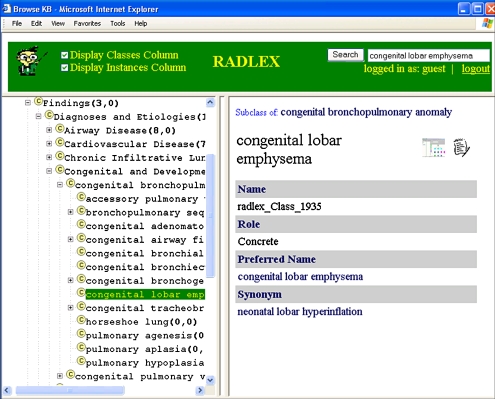
RadLex ontology accessed over the Internet using WebProtege. This application provides Web access to ontologies; a single ontology file can be edited by curators (Fig 2) and immediately deployed on the Web without needing to update any software applications. The ontology is shown on the left and details about selected terms on the right, similar to that provided by the Protégé editing tool (Fig 2).

References

    1. Andriole KP, et al. Addressing the coming radiology crisis-the Society for Computer Applications in Radiology transforming the radiological interpretation process (TRIP) initiative. J Digit Imaging. 2004;17:235–243. doi: 10.1007/s10278-004-1027-1. - DOI - PMC - PubMed
    1. Langlotz CP, Caldwell SA. The completeness of existing lexicons for representing radiology report information. J Digit Imaging. 2002;15(Suppl 1):201–205. doi: 10.1007/s10278-002-5046-5. - DOI - PubMed
    1. Sinha U, et al.: Evaluation of SNOMED3.5 in representing concepts in chest radiology reports: integration of a SNOMED mapper with a radiology reporting workstation. Proc AMIA Symp:799–803, 2000 - PMC - PubMed
    1. Starren J, Johnson SM: Expressiveness of the Breast Imaging Reporting and Database System (BI-RADS). Proc AMIA Annu Fall Symp:655–659, 1997 - PMC - PubMed
    1. Reiner BI, Knight N, Siegel EL. Radiology reporting, past, present, and future: the radiologist’s perspective. J Am Coll Radiol. 2007;4:313–319. doi: 10.1016/j.jacr.2007.01.015. - DOI - PubMed

Publication types

LinkOut - more resources