


Pediatric spinal cord tumors and masses
- PMID: 17874681
- PMCID: PMC2031985
- DOI: 10.1080/10790268.2007.11753963
Pediatric spinal cord tumors and masses
Abstract
Background/objective: Spinal cord tumors are a relatively rare diagnosis, accounting for 1% to 10% of all pediatric central nervous system tumors. Understanding the etiology and clinical outcomes of these tumors is therefore very important. This study presents detailed information regarding clinical presentation, histological findings, outcomes, functional assessment, and management of a series of patients with this diagnosis.
Method: Retrospective, descriptive study.
Subjects: Thirty-five children with a final diagnosis of spinal cord tumor or mass, excluding dysraphism.
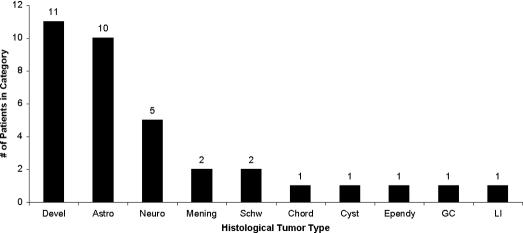
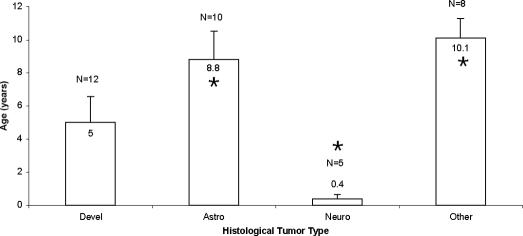
Results: Neurodevelopmental tumors (dermoid tumors, epidermoid tumors, and teratomas) were the most common tumor type (31%), followed by astrocytomas (29%) and neuroblastomas (14%). Other types included schwannomas, meningiomas, giant cell tumors, extradural cystic masses, leukemic-related masses, and masses related to neurofibromatosis. Mean age at diagnosis was 6.6 years (SD = 5.5 y) and did not vary significantly by tumor type except for children with neuroblastoma (mean = 0.4 y, SD = 0.5 y). More boys (57%) were identified in the series than girls (43%); however, there was no association between tumor type and sex. Presenting complaints of pain were noted in 57% and were localized to the back, neck, or extremities. Extremity weakness was reported as an initial presenting symptom in 46%. Three children had scoliosis as a presenting issue and 14 had gait abnormalities. Regardless of treatment modality, mobility was retained in 83% of children with or without gait aids. Neurogenic bowel and/or bladder were present in 23% of the population.
Conclusions: This study corroborates other studies indicating that intramedullary tumors are the predominant form of pediatric spinal cord tumor. This population, however, presented with an unusually large number of developmental tumors, contrary to several published studies. The disparity may be the result of this institution acting as a regional referral center, thus increasing the number of this type of patient. The population is too small to make any other conjecture. The predominance of astrocytomas and neuroblastomas among those patients with poor outcomes and the prevalence of developmental tumors suggest the need for broader investigation. Although, in general, spinal cord tumors are relatively rare, this preliminary study supports the need to further evaluate associations between tumor type, presenting symptoms, treatment, and functional outcome in children with spinal cord tumors.
Figures
References
-
- Hardison HH, Packer RJ, Rorke LB, Schut L, Sutton LN, Bruce DA. Outcome of children with primary intramedullary spinal cord tumors. Childs Nerv Syst. 1987;3:89–92. - PubMed
-
- Stiller CA, Nectoux J. International incidence of childhood brain and spinal tumours. Int J Epidemiol. 1994;23:458–464. - PubMed
-
- Nadkarni TD, Rekate HL. Pediatric intramedullary spinal cord tumors. Critical review of the literature. Childs Nerv Syst. 1999;15:17–28. - PubMed
-
- Constantini S, Epstein F. Pediatric intraspinal tumors. In: Choux M, Di Rocco E, Hockley A, Walker M, editors. Pediatric Neurosurgery. London, UK: Churchill Livingstone; 1999. pp. 601–602.
-
- Schick U, Marquardt G. Pediatric spinal tumors. Pediatr Neurosurg. 2001;35:120–127. - PubMed
MeSH terms
LinkOut - more resources
Full Text Sources
Medical
Research Materials
