Not your parents' test scores: cohort reduces psychometric aging effects
- PMID: 17874953
- PMCID: PMC4169292
- DOI: 10.1037/0882-7974.22.3.546
Not your parents' test scores: cohort reduces psychometric aging effects
Abstract
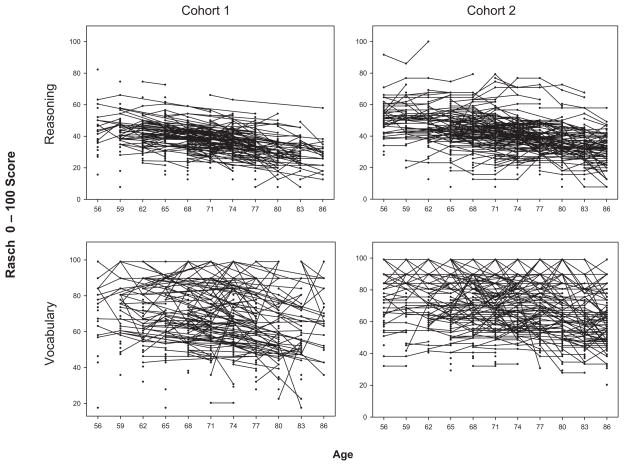
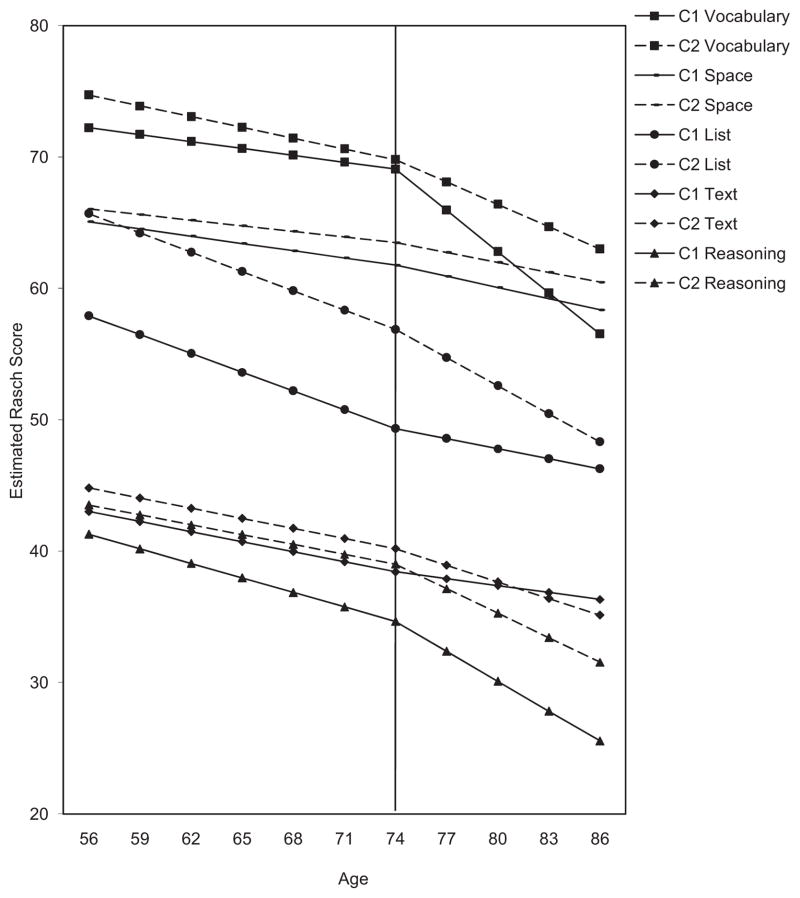
Increases over birth cohorts in psychometric abilities may impact effects of aging. Data from 2 cohorts of the Long Beach Longitudinal Study, matched on age but tested 16 years apart, were modeled over ages 55-87 to test the hypothesis that the more fluid abilities of reasoning, list and text recall, and space would show larger cohort differences than vocabulary. This hypothesis was confirmed. At age 74, average performance estimates for people from the more recently born cohort were equivalent to those of people from the older cohort when they were up to 15 years younger. This finding suggests that older adults may perform like much younger ones from the previous generation on fluid measures, indicating higher levels of abilities than expected. This result could have major implications for the expected productivity of an aging workforce as well as for the quality of life of future generations. However, cohort improvements did not mitigate age declines.
(PsycINFO Database Record (c) 2007 APA, all rights reserved).
Figures
References
-
- Akaike H. Factor analysis and AIC. Psychometrika. 1987;52:317–332.
-
- Alwin DF. Family of origin and cohort differences in verbal ability. American Sociological Review. 1991;56:625–638.
-
- Alwin DF, McCammon RJ. Aging, cohorts, and verbal ability. Journals of Gerontology, Series B: Psychological Sciences and Social Sciences. 2001;56:S151–S161. - PubMed
-
- Barber N. Educational and ecological correlates of IQ: A cross-national investigation. Intelligence. 2005;33:273–284.
-
- Blair C, Gamson D, Thorne S, Baker D. Rising mean IQ: Cognitive demand of mathematics education for young children, population exposure to formal schooling, and the neurobiology of the pre-frontal cortex. Intelligence. 2005;33:93–106.