


Effects of robot-assisted therapy on upper limb recovery after stroke: a systematic review
- PMID: 17876068
- PMCID: PMC2730506
- DOI: 10.1177/1545968307305457
Effects of robot-assisted therapy on upper limb recovery after stroke: a systematic review
Abstract
Objective: The aim of the study was to present a systematic review of studies that investigate the effects of robot-assisted therapy on motor and functional recovery in patients with stroke.
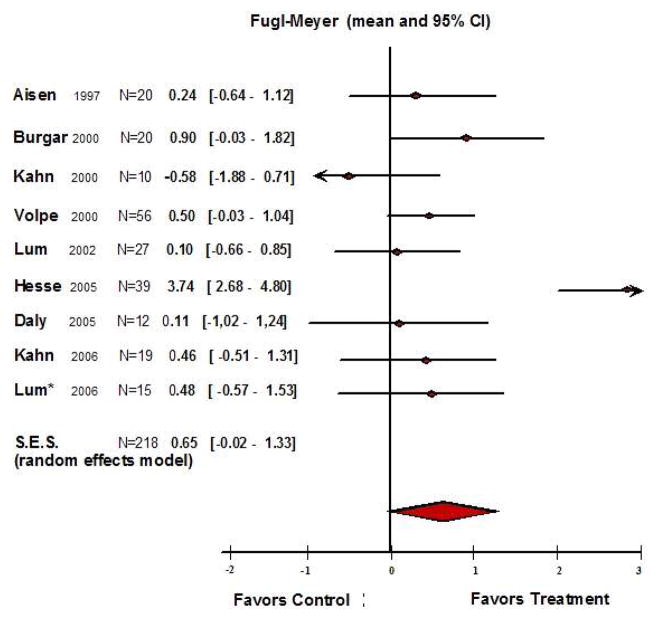
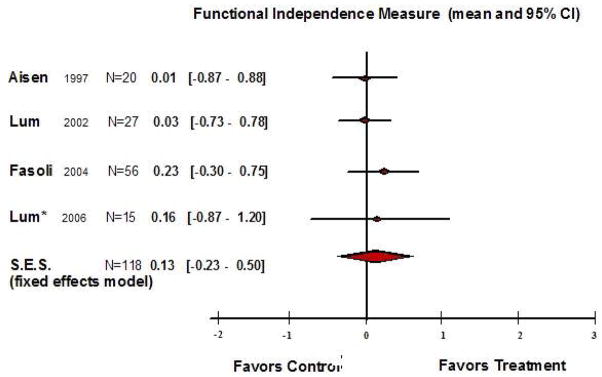
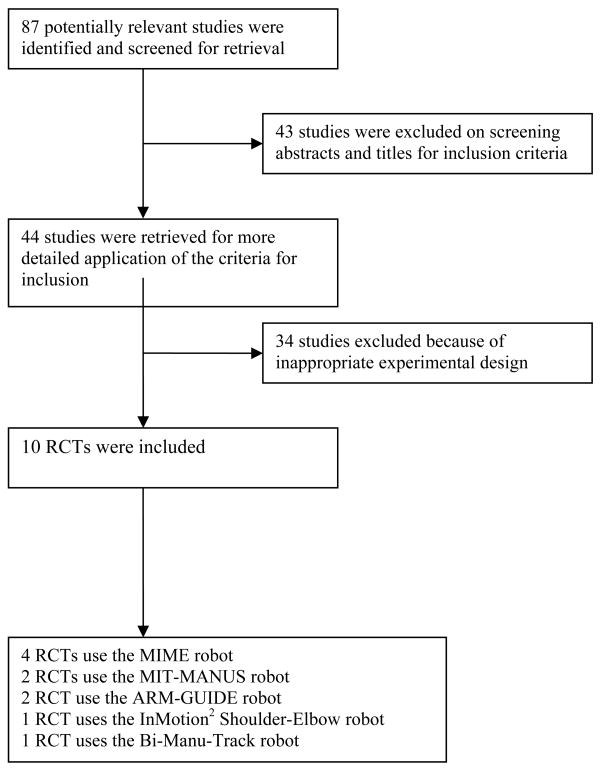
Methods: A database of articles published up to October 2006 was compiled using the following Medline key words: cerebral vascular accident, cerebral vascular disorders, stroke, paresis, hemiplegia, upper extremity, arm, and robot. References listed in relevant publications were also screened. Studies that satisfied the following selection criteria were included: (1) patients were diagnosed with cerebral vascular accident; (2) effects of robot-assisted therapy for the upper limb were investigated; (3) the outcome was measured in terms of motor and/or functional recovery of the upper paretic limb; and (4) the study was a randomized clinical trial (RCT). For each outcome measure, the estimated effect size (ES) and the summary effect size (SES) expressed in standard deviation units (SDU) were calculated for motor recovery and functional ability (activities of daily living [ADLs]) using fixed and random effect models. Ten studies, involving 218 patients, were included in the synthesis. Their methodological quality ranged from 4 to 8 on a (maximum) 10-point scale.
Results: Meta-analysis showed a nonsignificant heterogeneous SES in terms of upper limb motor recovery. Sensitivity analysis of studies involving only shoulder-elbow robotics subsequently demonstrated a significant homogeneous SES for motor recovery of the upper paretic limb. No significant SES was observed for functional ability (ADL).
Conclusion: As a result of marked heterogeneity in studies between distal and proximal arm robotics, no overall significant effect in favor of robot-assisted therapy was found in the present meta-analysis. However, subsequent sensitivity analysis showed a significant improvement in upper limb motor function after stroke for upper arm robotics. No significant improvement was found in ADL function. However, the administered ADL scales in the reviewed studies fail to adequately reflect recovery of the paretic upper limb, whereas valid instruments that measure outcome of dexterity of the paretic arm and hand are mostly absent in selected studies. Future research into the effects of robot-assisted therapy should therefore distinguish between upper and lower robotics arm training and concentrate on kinematical analysis to differentiate between genuine upper limb motor recovery and functional recovery due to compensation strategies by proximal control of the trunk and upper limb.
Figures
References
-
- Muntner P, Garrett E, Klag MJ, Coresh J. Trends in Stroke Prevalence between 1973 and 1991 in the US Population 25 to 74 years of age. Stroke. 2002;33:1209–1213. - PubMed
-
- Kwakkel G, Kollen BJ, van der Grond J, Prevo AJ. Probability of regaining dexterity in the flaccid upper limb: impact of severity of paresis and time since onset in acute stroke. Stroke. 2003;34:2181–6. - PubMed
-
- Van Peppen RP, Kwakkel G, Wood-Dauphinee S, Hendriks HJ, Van der Wees PJ, Dekker J. The impact of physical therapy on functional outcomes after stroke: what’s the evidence? Clin Rehabil. 2004;18:833–62. - PubMed
-
- Kwakkel G, Kollen BJ, Lindeman E. Understanding the pattern of functional recovery after stroke: Facts and theories. Restorative Neurology and Neuroscience. 2004;22:281–299. - PubMed
Publication types
MeSH terms
Grants and funding
LinkOut - more resources
Full Text Sources
Other Literature Sources
Medical
Research Materials
