


Serum transforming growth factor-beta1 level reflects disease status in patients with esophageal carcinoma after radiotherapy
- PMID: 17876899
- PMCID: PMC4171310
- DOI: 10.3748/wjg.v13.i39.5267
Serum transforming growth factor-beta1 level reflects disease status in patients with esophageal carcinoma after radiotherapy
Abstract
Aim: To evaluate the relationship between changes in serum transforming growth factor beta1 (TGFbeta1) level and curative effect of radiotherapy (RT) in patients with esophageal carcinoma.
Methods: Ninety patients with histologically confirmed esophageal carcinoma were enrolled. Serum samples for TGFbeta1 analysis were obtained before and at the end of RT. An enzyme-linked immunosorbent assay was used to measure serum TGFbeta1 level. Multivariate analysis was performed to investigate the relationship between disease status and changes in serum TGFbeta1 level.
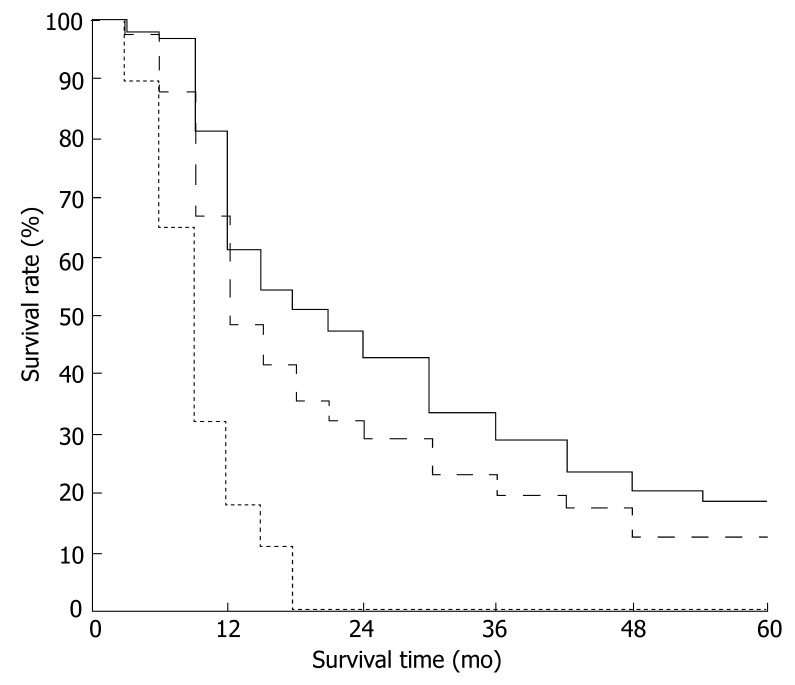
Results: Serum TGFbeta1 level in patients with esophageal carcinoma before RT was significantly higher than that in healthy controls (P < 0.001). At the end of RT, serum TGFbeta1 level was decreased in 67.82% (59/87) of the patients. The overall survival rate at 1, 3 and 5 years was 48.28% (42/87), 19.54% (17/87) and 12.64% (11/87), respectively. Main causes of death were local failure and regional lymph node metastasis. In patients whose serum TGFbeta1 level decreased after RT, the survival rate at 1, 3 and 5 years was 61.02% (36/59), 28.81% (17/59) and 18.64% (11/59), respectively. The survival rate at 1 year was 17.86% (5/28) in patients whose serum TGFbeta1 level increased after RT, and all died within 18 mo (P < 0.01).
Conclusion: Serum TGFbeta1 level may be a useful marker for monitoring disease status after RT in patients with esophageal carcinoma.
Figures
References
-
- Yamada S, Takai Y, Nemoto K, Ogawa Y, Kakuto Y, Hoshi A, Sakamoto K. Low-dose rate telecobalt therapy as a boost against esophageal carcinomas. Cancer. 1992;69:1099–1103. - PubMed
-
- Smalley SR, Gunderson LL, Reddy EK, Williamson S. Radiotherapy alone in esophageal carcinoma: current management and future directions of adjuvant, curative and palliative approaches. Semin Oncol. 1994;21:467–473. - PubMed
-
- Wang Y, Shi XH, He SQ, Yao WQ, Wang Y, Guo XM, Wu GD, Zhu LX, Liu TF. Comparison between continuous accelerated hyperfractionated and late-course accelerated hyperfractionated radiotherapy for esophageal carcinoma. Int J Radiat Oncol Biol Phys. 2002;54:131–136. - PubMed
-
- Gao XS, Qiao XY, Yang XR, Asaumi J, Zhou ZG, Wang YD, Zhou DA, Wan J, Kuroda M, Kishi K, et al. Late course accelerated hyperfractionation radiotherapy concomitant with cisplatin in patients with esophageal carcinoma. Oncol Rep. 2002;9:767–772. - PubMed
MeSH terms
Substances
LinkOut - more resources
Full Text Sources
Other Literature Sources
Medical
