


Behavioral and histopathological consequences of paraquat intoxication in mice: effects of alpha-synuclein over-expression
- PMID: 17879265
- PMCID: PMC3097512
- DOI: 10.1002/syn.20456
Behavioral and histopathological consequences of paraquat intoxication in mice: effects of alpha-synuclein over-expression
Abstract
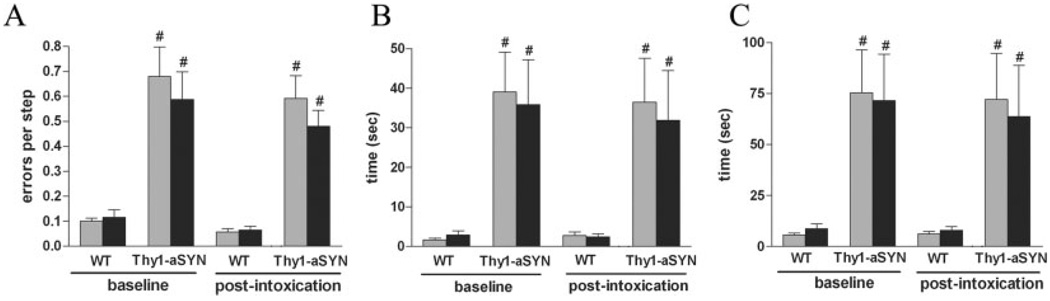
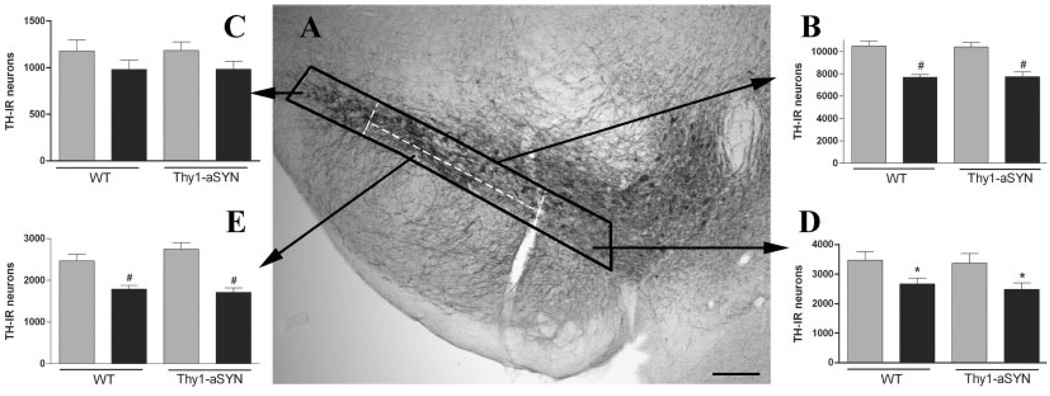
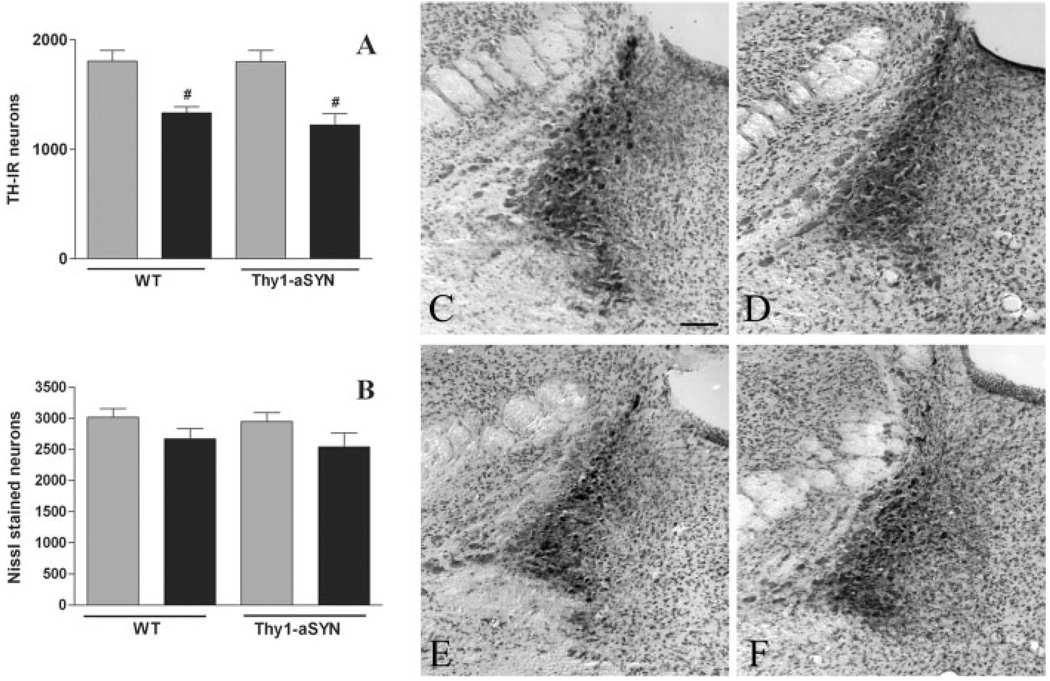
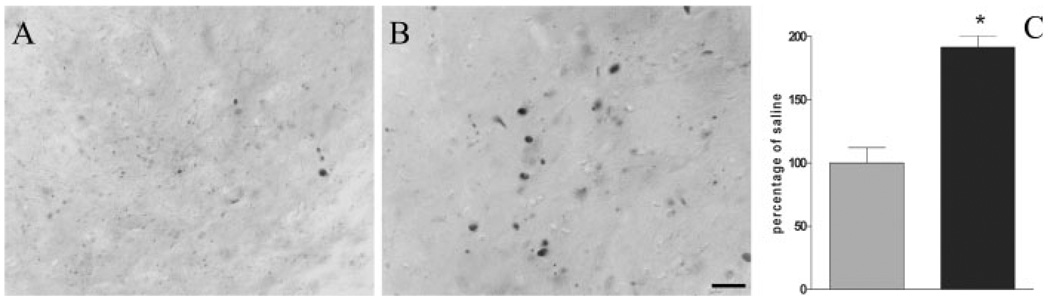
Genetic variability in the alpha-synuclein gene and long-term exposure to the pesticide paraquat constitute possible risk factors for sporadic Parkinson's disease. The goal of the present study was to further characterize the effects of paraquat in mice as a model of Parkinson's disease and to determine whether it acted synergistically with alpha-synuclein over-expression to cause nigrostriatal cell death or dysfunction. Paraquat (10 mg/kg i.p.) was administered once a week for 3 weeks to mice over-expressing human alpha-synuclein under the Thy1 promoter and their wild-type littermates. The effect of paraquat on catecholaminergic neurons was reminiscent of that of Parkinson's disease, with preferential loss of dopaminergic neurons in the ventral tier of the substantia nigra pars compacta and loss of tyrosine hydroxylase staining in the locus coeruleus. alpha-Synuclein over-expression did not increase paraquat-induced cell loss, and paraquat did not worsen the behavioral deficits observed in the transgenic mice. However, paraquat markedly increased proteinase-K-resistant alpha-synuclein aggregates in substantia nigra of the transgenic mice. The data further validate the use of paraquat to model Parkinson's disease in mice and show that although paraquat and alpha-synuclein over-expression act synergistically to increase protein aggregation in vivo, this interaction does not result in short-term neuroprotection or increased vulnerability of nigrostriatal neurons.
(c) 2007 Wiley-Liss, Inc.
Figures
References
-
- Arrasate M, Mitra S, Schweitzer ES, Segal MR, Finkbeiner S. Inclusion body formation reduces levels of mutant Huntingtin and the risk of neuronal death. Nature. 2004;431:805–810. - PubMed
-
- Bonneh-Barkay D, Langston WJ, Di Monte DA. Toxicity of redox cycling pesticides in primary mesencephalic cultures. Antioxid Redox Signal. 2005;7:649–653. - PubMed
-
- Bordelon YM, Chesselet MF. Early effects of intrastriatal injections of quinolinic acid on microtubule-associated protein-2 and neuropeptides in rat basal ganglia. Neuroscience. 1999;93:843–853. - PubMed
-
- Braak H, Del Tredici K, Rub U, de Vos RA, Steur ENJ, Braak E. Staging of brain pathology related to sporadic Parkinson’s disease. Neurobiol Aging. 2003;24:197–211. - PubMed
-
- Braak H, Bohl JR, Muller CM, Rub U, de Vos RA, Del Tredici K. Stanley Fahn Lecture 2005: The staging procedure for the inclusion body pathology associated with sporadic Parkinson’s disease reconsidered. Mov Disord. 2006;21:2042–2051. - PubMed
Publication types
MeSH terms
Substances
Grants and funding
LinkOut - more resources
Full Text Sources
Miscellaneous