. 2007 Oct;5(10):e256.
doi: 10.1371/journal.pbio.0050256.

Interlocking transcriptional feedback loops control white-opaque switching in Candida albicans

Affiliations

Interlocking transcriptional feedback loops control white-opaque switching in Candida albicans

Rebecca E Zordan et al. PLoS Biol. 2007 Oct.

Abstract

The human pathogen Candida albicans can assume either of two distinct cell types, designated "white" and "opaque." Each cell type is maintained for many generations; switching between them is rare and stochastic, and occurs without any known changes in the nucleotide sequence of the genome. The two cell types differ dramatically in cell shape, colony appearance, mating competence, and virulence properties. In this work, we investigate the transcriptional circuitry that specifies the two cell types and controls the switching between them. First, we identify two new transcriptional regulators of white-opaque switching, Czf1 and white-opaque regulator 2 (Wor2). Analysis of a large set of double mutants and ectopic expression strains revealed genetic relationships between CZF1, WOR2, and two previously identified regulators of white-opaque switching, WOR1 and EFG1. Using chromatin immunoprecipitation, we show that Wor1 binds the intergenic regions upstream of the genes encoding three additional transcriptional regulators of white-opaque switching (CZF1, EFG1, and WOR2), and also occupies the promoters of numerous white- and opaque-enriched genes. Based on these interactions, we have placed these four genes in a circuit controlling white-opaque switching whose topology is a network of positive feedback loops, with the master regulator gene WOR1 occupying a central position. Our observations indicate that a key role of the interlocking feedback loop network is to stably maintain each epigenetic state through many cell divisions.


Conflict of interest statement

Competing interests. The authors have declared that no competing interests exist.

Figures

Figure 1
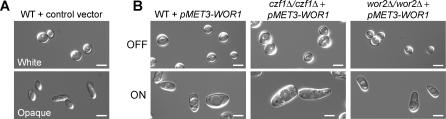
Figure 1. Ectopic Expression of WOR1 Drives Opaque Formation in czf1Δ/czf1Δ or wor2Δ/wor2Δ Strains
Images are differential interference contrast photomicrographs of cells resuspended from colonies. (A) White and opaque isolates of WT strains with an empty control vector, grown on media that induces the MET3 promoter (ON). (B) Ectopic expression of WOR1 in WT, czf1Δ/czf1Δ, or wor2Δ/wor2Δ strains; cells were grown on media to repress (OFF) or induce (ON) the pMET3-WOR1 construct. All strains are a strains. Scale bar = 5 μm.
Figure 2
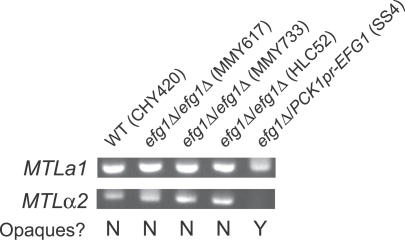
Figure 2. Verification of Mating Type in efg1Δ/efg1Δ Strains
Whole-cell PCR was performed to verify the presence of the MTLa1 and MTLα2 genes in a series of efg1Δ/efg1Δ mutants. As described in Materials and Methods, PCR amplification of the a and α alleles of each of the five genes present at the mating type locus confirm these results. The ability of each mutant to form opaque colonies, as described in the Results, is indicated with Y (yes) or N (no).
Figure 3
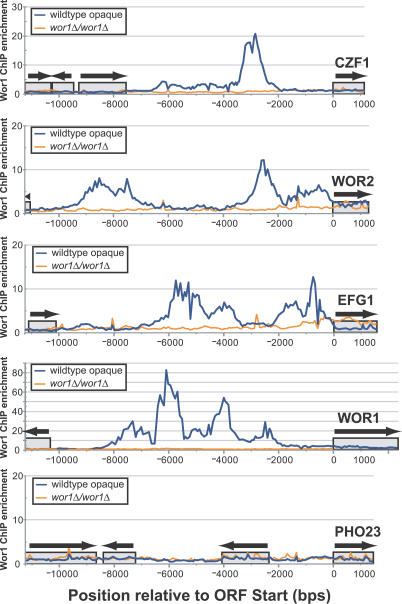
Figure 3. Wor1 Binds Upstream of the CZF1, WOR2, EFG1, and WOR1 Genes
ChIP was performed with α-Wor1Nterm antibodies in a WT opaque a strain or a wor1Δ/wor1Δ (white) a strain. The ChIP enrichment was detected by hybridization to a C. albicans tiling microarray with probes every ∼80 bp across the genome. The top three binding profiles show Wor1 enrichment upstream of the CZF1, WOR2, and EFG1 ORFs. The fourth binding profile serves as a positive control of Wor1 enrichment, seen at the WOR1 promoter [11]. The bottom binding profile, showing the DNA upstream of PHO23, serves as an example of the low levels of Wor1 enrichment seen throughout the majority of the genome. Grey boxes indicate ORFs and arrows indicate the orientation of each coding sequence along the chromosome.
Figure 4
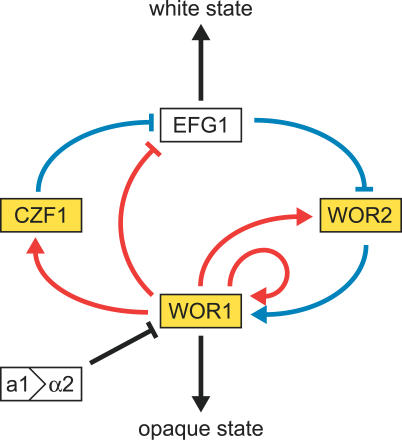
Figure 4. Model of the Genetic Network Regulating the White-Opaque Switch
White and gold boxes represent genes enriched in the white and opaque states, respectively. Blue lines represent relationships based on genetic epistasis. Red lines represent Wor1 control of each gene, based on Wor1 enrichment in chromatin immunoprecipitation experiments. Activation (arrowhead) and repression (bar) are inferred based on white- and opaque-state expression of each gene.
Figure 5
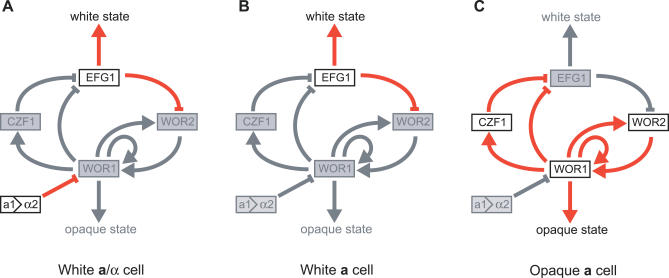
Figure 5. Activity of the White-Opaque Genetic Regulatory Network in Different Cell Types
In each scenario, genes indicated by white boxes are up-regulated and genes in gray boxes are down-regulated. Red lines represent active regulatory relationships; gray lines represent relationships that are inactive, due to the down-regulation of the effector gene. (A) In white a/α cells, the a1-α2 heterodimer represses WOR1, keeping the Wor1-mediated feedback loops inactive. This allows EFG1 expression and formation of white cells. (B) In white a cells, EFG1 expression contributes to the formation of white cells and down-regulates WOR2. This helps keep Wor1 expression low in white cells, even though the a1-α2 repression of WOR1 has been lifted. (C) In opaque a cells, WOR1 expression levels are up-regulated, which in turn activates the represented positive feedback loops, the net effect being increased CZF1, WOR2, and WOR1 expression, and decreased EFG1 expression.

Comment in

  • Completing the Candida loop.
    O'Day K. O'Day K. PLoS Biol. 2007 Oct;5(10):e270. doi: 10.1371/journal.pbio.0050270. Epub 2007 Sep 18. PLoS Biol. 2007. PMID: 20076647 Free PMC article. No abstract available.

References

    1. Slutsky B, Staebell M, Anderson J, Risen L, Pfaller M, et al. “White-opaque transition”: A second high-frequency switching system in Candida albicans . J Bacteriol. 1987;169:189–197. - PMC - PubMed
    1. Rikkerink EH, Magee BB, Magee PT. Opaque-white phenotype transition: A programmed morphological transition in Candida albicans . J Bacteriol. 1988;170:895–899. - PMC - PubMed
    1. Tsong AE, Miller MG, Raisner RM, Johnson AD. Evolution of a combinatorial transcriptional circuit: A case study in yeasts. Cell. 2003;115:389–399. - PubMed
    1. Lan CY, Newport G, Murillo LA, Jones T, Scherer S, et al. Metabolic specialization associated with phenotypic switching in Candida albicans . Proc Natl Acad Sci U S A. 2002;99:14907–14912. - PMC - PubMed
    1. Miller MG, Johnson AD. White-opaque switching in Candida albicans is controlled by mating-type locus homeodomain proteins and allows efficient mating. Cell. 2002;110:293–302. - PubMed

Publication types

MeSH terms

Substances