. 2007 Sep 19:8:327.
doi: 10.1186/1471-2164-8-327.

The cys-loop ligand-gated ion channel gene superfamily of the red flour beetle, Tribolium castaneum

Affiliations

The cys-loop ligand-gated ion channel gene superfamily of the red flour beetle, Tribolium castaneum

Andrew K Jones et al. BMC Genomics. .

Abstract

Background: Members of the cys-loop ligand-gated ion channel (cys-loop LGIC) superfamily mediate chemical neurotransmission and are studied extensively as potential targets of drugs used to treat neurological disorders such as Alzheimer's disease. Insect cys-loop LGICs are also of interest as they are targets of highly successful insecticides. The red flour beetle, Tribolium castaneum, is a major pest of stored agricultural products and is also an important model organism for studying development.

Results: As part of the T. castaneum genome sequencing effort, we have characterized the beetle cys-loop LGIC superfamily which is the third insect superfamily to be described after those of Drosophila melanogaster and Apis mellifera, and also the largest consisting of 24 genes. As with Drosophila and Apis, Tribolium possesses ion channels gated by acetylcholine, gamma-amino butyric acid (GABA), glutamate and histamine as well as orthologs of the Drosophila pH-sensitive chloride channel subunit (pHCl), CG8916 and CG12344. Similar to Drosophila and Apis, Tribolium cys-loop LGIC diversity is broadened by alternative splicing although the beetle orthologs of RDL and GluCl possess more variants of exon 3. Also, RNA A-to-I editing was observed in two Tribolium nicotinic acetylcholine receptor subunits, Tcasalpha6 and Tcasbeta1. Editing in Tcasalpha6 is evolutionarily conserved with D. melanogaster, A. mellifera and Heliothis virescens, whereas Tcasbeta1 is edited at a site so far only observed in the beetle.

Conclusion: Our findings reveal that in diverse insect species the cys-loop LGIC superfamily has remained compact with only minor changes in gene numbers. However, alternative splicing, RNA editing and the presence of divergent subunits broadens the cys-loop LGIC proteome and generates species-specific receptor isoforms. These findings on Tribolium castaneum enhance our understanding of cys-loop LGIC functional genomics and provide a useful basis for the development of improved insecticides that target an important agricultural pest.


Figures
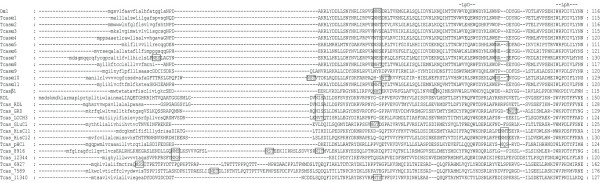
Figure 1
Figure 1
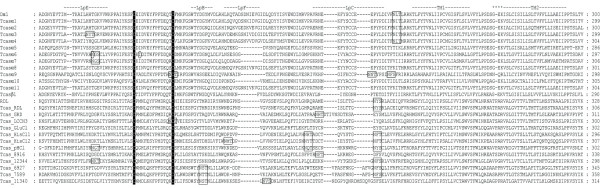
This figure shows the upper quartile of a protein sequence alignment of T. castaneum cys-loop LGIC subunits, for the full image please see Additional file 2. Drosophila Dα1 and RDL are included for comparison. N-terminal signal leader peptides are shown in lower case and loops implicated in ligand binding (LpA-F) are indicated. Putative N-glycosylation sites are boxed and amino acid residues altered by RNA editing are circled.
Figure 2
Figure 2
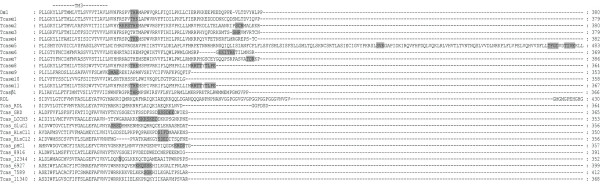
This figure shows the second quartile of a protein sequence alignment of T. castaneum cys-loop LGIC subunits, for the full image please see Additional file 2. Drosophila Dα1 and RDL are included for comparison. Loops implicated in ligand binding (LpA-F) as well as transmembrane regions (TM) are indicated. The two cysteines forming the cys-loop are highlighted in black shading. Putative N-glycosylation sites are boxed and amino acid residues altered by RNA editing are circled.
Figure 3
Figure 3
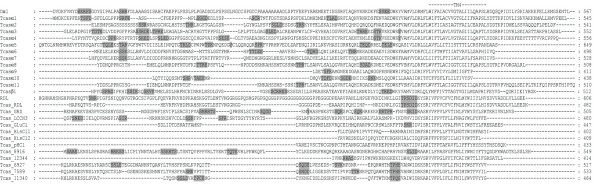
This figure shows the third quartile of a protein sequence alignment of T. castaneum cys-loop LGIC subunits, for the full image please see Additional file 2. Drosophila Dα1 and RDL are included for comparison. Transmembrane regions (TM) are indicated and potential cAMP, PKC and CK2 phosphorylation sites are boxed with gray shading while potential tyrosine kinase phosphorylation sites are enclosed in gray shaded ovals.
Figure 4
Figure 4
This figure shows the lower quartile of a protein sequence alignment of T. castaneum cys-loop LGIC subunits, for the full image please see Additional file 2. Drosophila Dα1 and RDL are included for comparison. Transmembrane regions (TM) are indicated and potential cAMP, PKC and CK2 phosphorylation sites are boxed with gray shading while potential tyrosine kinase phosphorylation sites are enclosed in gray shaded ovals.
Figure 5
Figure 5
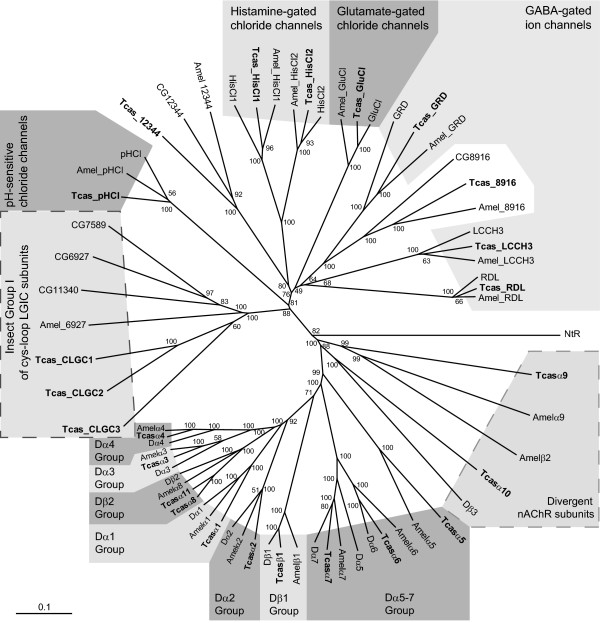
Tree showing relationships of T. castaneum, A. mellifera and D. melanogaster cys-loop LGIC subunit protein sequences. Numbers at each node signify bootstrap values with 100 replicates and the scale bar represents substitutions per site. The subunits shown in the tree are as follows: A. mellifera Amelα1 (DQ026031), Amelα2 (AY540846), Amelα3 (DQ026032), Amelα4 (DQ026033), Amelα5 (AY569781), Amelα6 (DQ026035), Amelα7 (AY500239), Amelα8 (AF514804), Amelα9 (DQ026037), Amelβ1 (DQ026038), Amelβ2 (DQ026039), Amel_GluCl (DQ667185), Amel_GRD (DQ667183), Amel_HisCl1 (DQ667187), Amel_HisCl2 (DQ667188), Amel_LCCH3 (DQ667184), Amel_pHCl (DQ667189), Amel_RDL (DQ667182), Amel_6927 (DQ667195), Amel_8916 (DQ667193), Amel_12344 (DQ667194); D. melanogaster Dα1 (CAA30172), Dα2 (CAA36517), Dα3 (CAA75688), Dα4 (CAB77445), Dα5 (AAM13390), Dα6 (AAM13392), Dα7 (AAK67257), Dβ1 (CAA27641), Dβ2 (CAA39211), Dβ3 (CAC48166), GluCl (AAG40735), GRD (Q24352), HisCl1 (AAL74413), HisCl2 (AAL74414), LCCH3 (AAB27090), Ntr (AF045471), pHCl (NP_001034025), RDL (AAA28556), CG6927 (AAF45992), CG7589 (AAF49337), CG8916 (BT022901), CG11340 (AAF57144), CG12344 (AAF58743); T. castaneum subunits, which are shown in boldface type, Tcasα1 (EF526080), Tcasα2 (EF526081), Tcasα3 (EF526082), Tcasα4 (EF526083), Tcasα5 (EF526085), Tcasα6 (EF526086), Tcasα7 (EF526089), Tcasα8 (EF526090), Tcasα9 (EF526091), Tcasα10 (EF526092), Tcasα11 (EF526093), Tcasβ1 (EF526094), Tcas_CLGC1 (EF545129), Tcas_CLGC2 (EF545130), Tcas_CLGC3 (EF545131), Tcas_GluCl (EF545121), Tcas_GRD (EF545119), Tcas_HisCl1 (EF545124), Tcas_HisCl2 (EF545125), Tcas_LCCH3 (EF545120), Tcas_pHCl (EF545126), Tcas_RDL (EF545117), Tcas_8916 (EF545127), Tcas_12344 (EF545128).
Figure 6
Figure 6
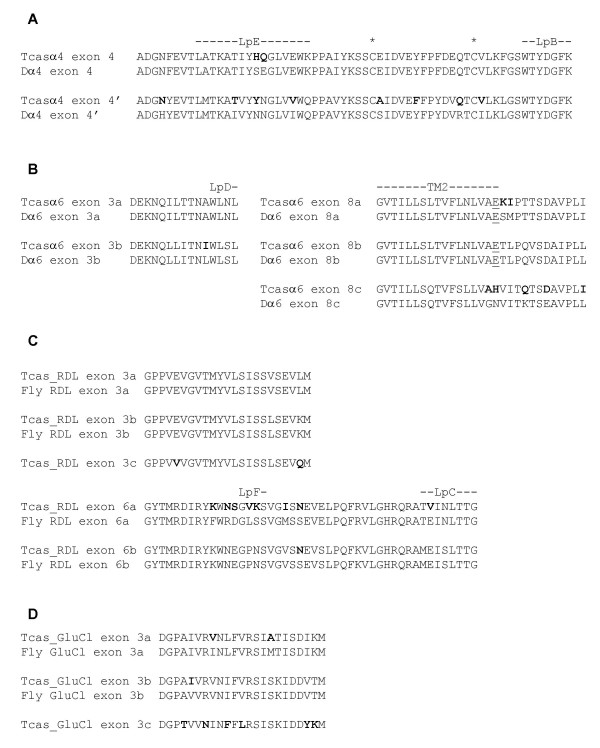
Alternative splicing of exons in T. castaneum cys-loop LGIC subunits. Equivalent alternate exons of T. castaneum and D. melanogaster cys-loop LGIC subunits are aligned. (A) Exon 4 splice variants in Tcasα4 and Dα4. The cysteine residues forming the cys-loop are marked by asterisks. (B) Splice variants of exons 3 and 8 in both Tcasα6 and Dα6. The glutamic acid residue located in the second transmembrane region (indicated as TM2) and involved in ion conductance [48] is underlined. (C) Splice variants of exons 3 and 6 in both Tcas_RDL and Drosophila RDL. Tribolium has an additional alternative for exon 3 (denoted Tcas_RDL exon 3c). (D) Exon 3 splice variants in Tcas_GluCl and Drosophila GluCl. Tribolium has an additional alternative exon (denoted Tcas_GluCl exon 3c). Throughout the figure, Tribolium residues that differ from those of the orthologous Drosophila exon are highlighted in bold and loops B to F, which contribute to ligand binding, are indicated.
Figure 7
Figure 7
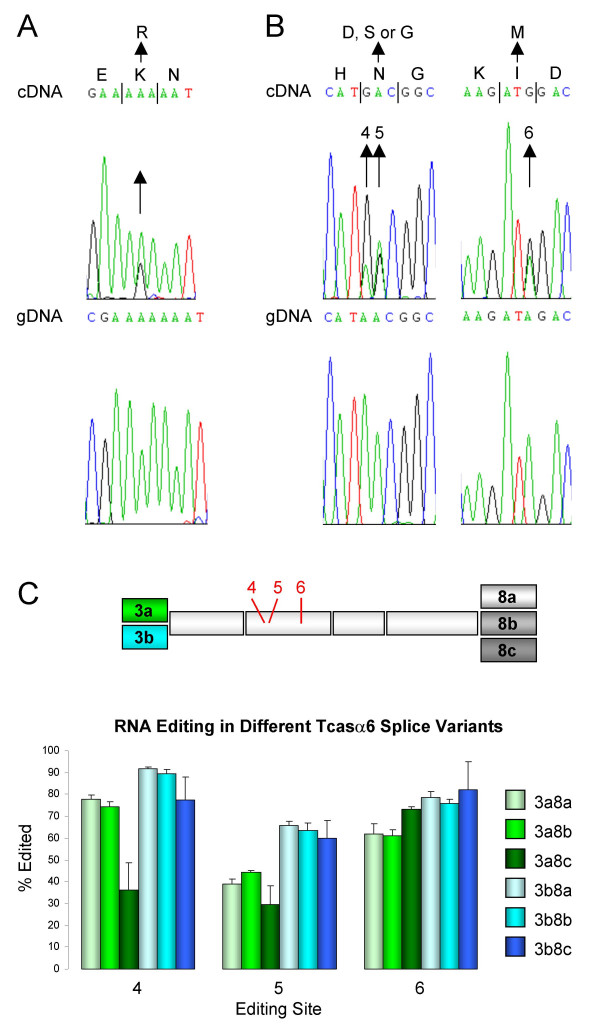
RNA A-to-I editing in T. castaneum cys-loop LGIC subunits. Arrows highlight the mixed adenosine/guanosine peak in the cDNA sequence indicating RNA editing as well as the resulting amino acid change. The corresponding genomic DNA (gDNA) sequence, which lacks this mixed A/G signal, is also shown. (A) RNA editing of Tcasβ1. (B) RNA editing of Tcasα6. Editing sites 4, 5 and 6 [37] are indicated. (C) A schematic of exons 3–8 of Tcasα6 with editing sites 4–6 (indicated in red) is shown. The graph shows mean RNA editing levels (n = 4) at sites 4–6 in different splice variants. Error bars indicate standard deviation.
Figure 8
Figure 8
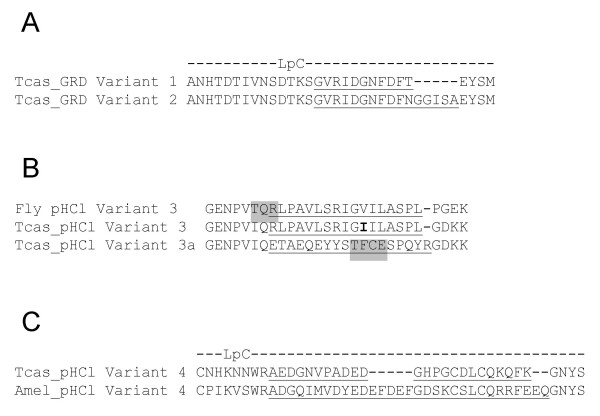
Differential splicing in T. castaneum cys-loop LGIC subunits. (A) Alignment of loop C (LpC) sequences of Tcas_GRD variants 1 and 2. Insertions arising from differential use of splice sites are underlined. (B) Alignment of variant 3 of Drosophila pHCl with the equivalent Tribolium variant (Tcas_pHCl Variant 3). The variants are caused by the differential use of splice sites which inserts stretches of amino acids (underlined). The Tribolium residue in Tcas_pHCl Variant 3 that differs from that of the equivalent Drosophila splice variant is highlighted in bold. Tribolium has an additional variant, Tcas_pHCl Variant 3a, resulting from an insertion of a different peptide sequence at the same site. Potential phosphorylation sites are highlighted in gray shading. (C) Alignment of loop C (LpC) sequences of Tcas_pHCl Variant 4 and a similar variant in Apis (Amel_pHCl Variant 4) where use of differential splice sites introduces an insertion (underlined).

References

    1. Sattelle DB, Jones AK, Sattelle BM, Matsuda K, Reenan R, Biggin PC. Edit, cut and paste in the nicotinic acetylcholine receptor gene family of Drosophila melanogaster. Bioessays. 2005;27:366–376. doi: 10.1002/bies.20207. - DOI - PubMed
    1. Tomizawa M, Casida JE. Structure and diversity of insect nicotinic acetylcholine receptors. Pest Manag Sci. 2001;57:914–922. doi: 10.1002/ps.349. - DOI - PubMed
    1. Buckingham SD, Biggin PC, Sattelle BM, Brown LA, Sattelle DB. Insect GABA receptors: splicing, editing, and targeting by antiparasitics and insecticides. Mol Pharmacol. 2005;68:942–951. doi: 10.1124/mol.105.015313. - DOI - PubMed
    1. Vassilatis DK, Elliston KO, Paress PS, Hamelin M, Arena JP, Schaeffer JM, Van der Ploeg LH, Cully DF. Evolutionary relationship of the ligand-gated ion channels and the avermectin-sensitive, glutamate-gated chloride channels. J Mol Evol. 1997;44:501–508. doi: 10.1007/PL00006174. - DOI - PubMed
    1. Gisselmann G, Pusch H, Hovemann BT, Hatt H. Two cDNAs coding for histamine-gated ion channels in D. melanogaster. Nat Neurosci. 2002;5:11–12. doi: 10.1038/nn787. - DOI - PubMed

Publication types