. 2007 Sep 20;55(6):942-57.
doi: 10.1016/j.neuron.2007.07.039.

The IkappaB kinase regulates chromatin structure during reconsolidation of conditioned fear memories

Affiliations

The IkappaB kinase regulates chromatin structure during reconsolidation of conditioned fear memories

Farah D Lubin et al. Neuron. .

Abstract

Previously formed memories are susceptible to disruption immediately after recall due to a necessity to be reconsolidated after retrieval. Protein translation mechanisms have been widely implicated as being necessary for memory reconsolidation, but gene transcription mechanisms have been much less extensively studied in this context. We found that retrieval of contextual conditioned fear memories activates the NF-kappaB pathway to regulate histone H3 phosphorylation and acetylation at specific gene promoters in hippocampus, specifically via IKKalpha and not the NF-kappaB DNA-binding complex. Behaviorally, we found that inhibition of IKKalpha regulation of either chromatin structure or NF-kappaB DNA-binding complex activity leads to impairments in fear memory reconsolidation, and that elevating histone acetylation rescues this memory deficit in the face of IKK blockade. These data provide insights into IKK-regulated transcriptional mechanisms in hippocampus that are necessary for memory reconsolidation.


Figures
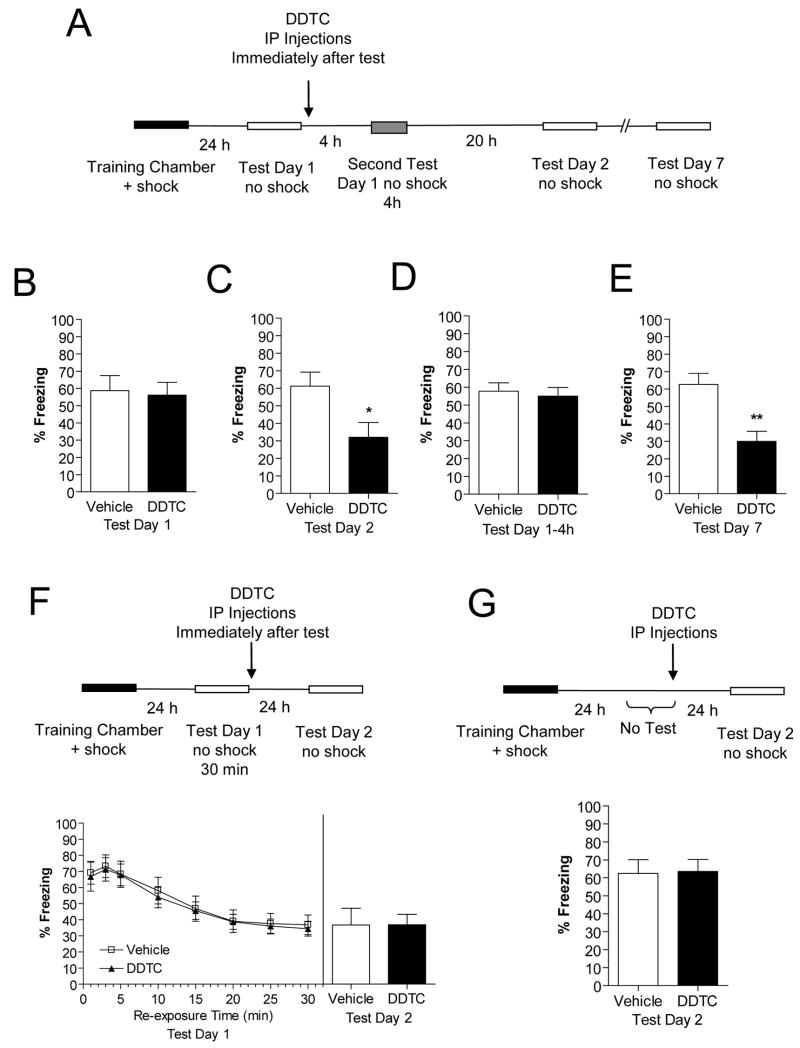
Figure 1
Figure 1
Effect of inhibition of the NF-κB signaling pathway on contextual fear conditioning after context re-exposure. (A) Diagram outlines the experimental design used with data presented below in panels B–E (vehicle, n=10; DDTC, n=9). (B) Freezing behavior on Test Day 1. (C) Freezing behavior during re-exposure on Test Day 2. (D) Short-term memory test, assessed 4 h after re-exposure to chamber. (E) Freezing behavior on Test Day 7. (F) Effect of context re-exposure for 30 min (Test Day 1) on freezing behavior assessed on Test Day 2. (G) Injection of DDTC at the same time interval as the test animals in Panel B but with the first test given 48 h later. Student’s t-test; *p<0.05, **p<0.01 compared to vehicle. Error bars are SEM.
Figure 2
Figure 2
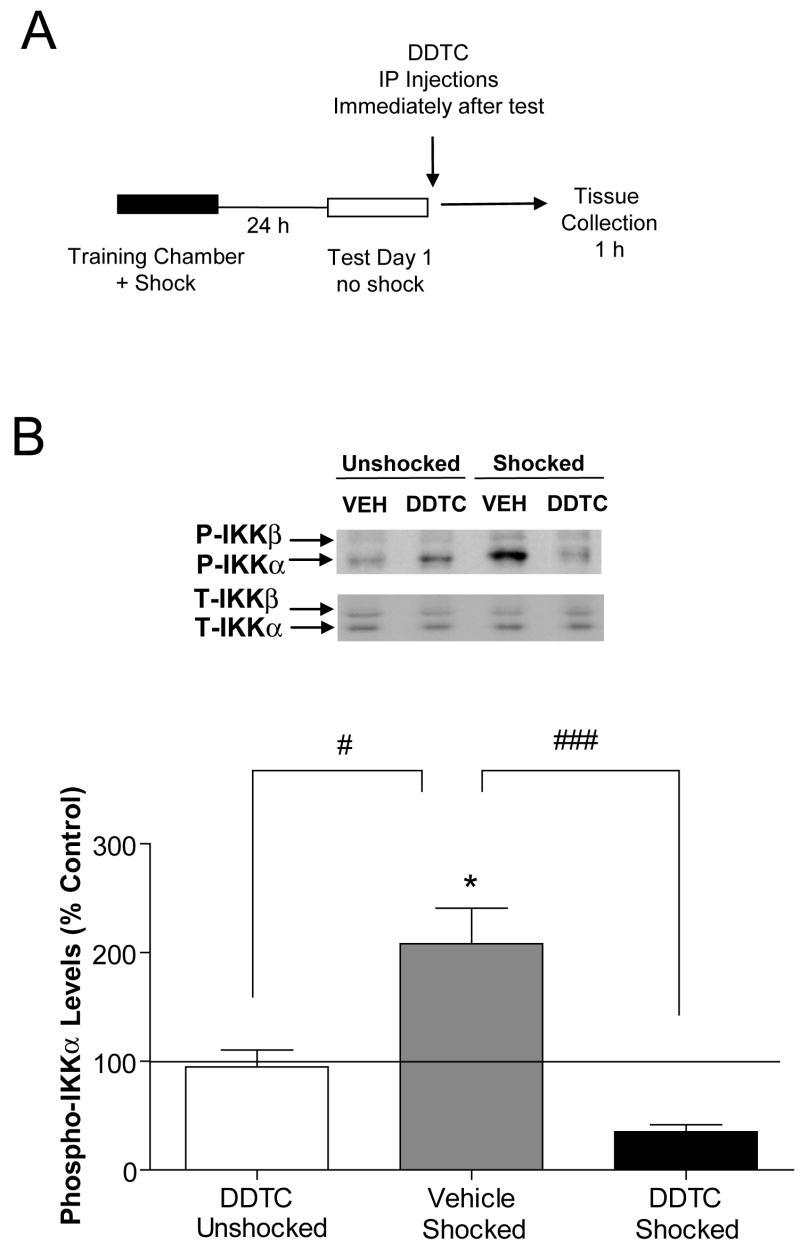
Activation of IKKα in hippocampus after context re-exposure. (A) Experimental design used with data presented below. (B) Western blot densities for phosphorylated IKKα (P-IKKα)normalized to total IKKα (T-IKKα) levels from area CA1 (vehicle-unshocked, n=3; DDTC-unshocked, n=3; vehicle-shocked, n=6; DDTC-shocked, n=6). At the 1 h time point assessed, there were no changes in P-IKKα levels in area CA3 or dentate gyrus after context re-exposure (Data not shown). Two-way ANOVA with post-hoc test; *p<0.05, **p<0.01 compared with unshocked-DDTC, #p<0.05, ##p<0.01 compared with vehicle-shocked group. Error bars are SEM; Solid lines represent normalized vehicle control levels.
Figure 3
Figure 3
Activation of the NF-κB signaling pathway is regulated after re-exposure to the context. (A) Outline of the experimental procedure performed. (B) Representative Western blots and densitometry analysis for phosphorylated IKKα (P-IKKα) normalized to total IKKα (T-IKKα) levels are shown (Group A, n=9; Group B, n=9; Group C, n=6; Group D, n=8). Student’s t-test; *p<0.05 compared with naive group. (C) Nuclear extracts were prepared from area CA1 from all groups in parallel. NF-κB DNA binding activity was measured using EMSA (Group A, n=5; Group B, n=10; Group C, n=8, Group D, n=5). Student’s t-test; *p<0.05 compared with naive group. (D) Nuclear extracts were prepared from area CA1 1 h after re-exposure (vehicle-shocked, n=6; DDTC-shocked, n=6). The specific band is indicated with an arrow. The relative optical density (R.O.D) values of the specific NF-κB shifted-band normalized to vehicle group (VEH) are shown. Student’s t-test; *p<0.05 compared with vehicle-shocked group. Error bars are SEM; Solid lines represent normalized naïve control levels.
Figure 4
Figure 4
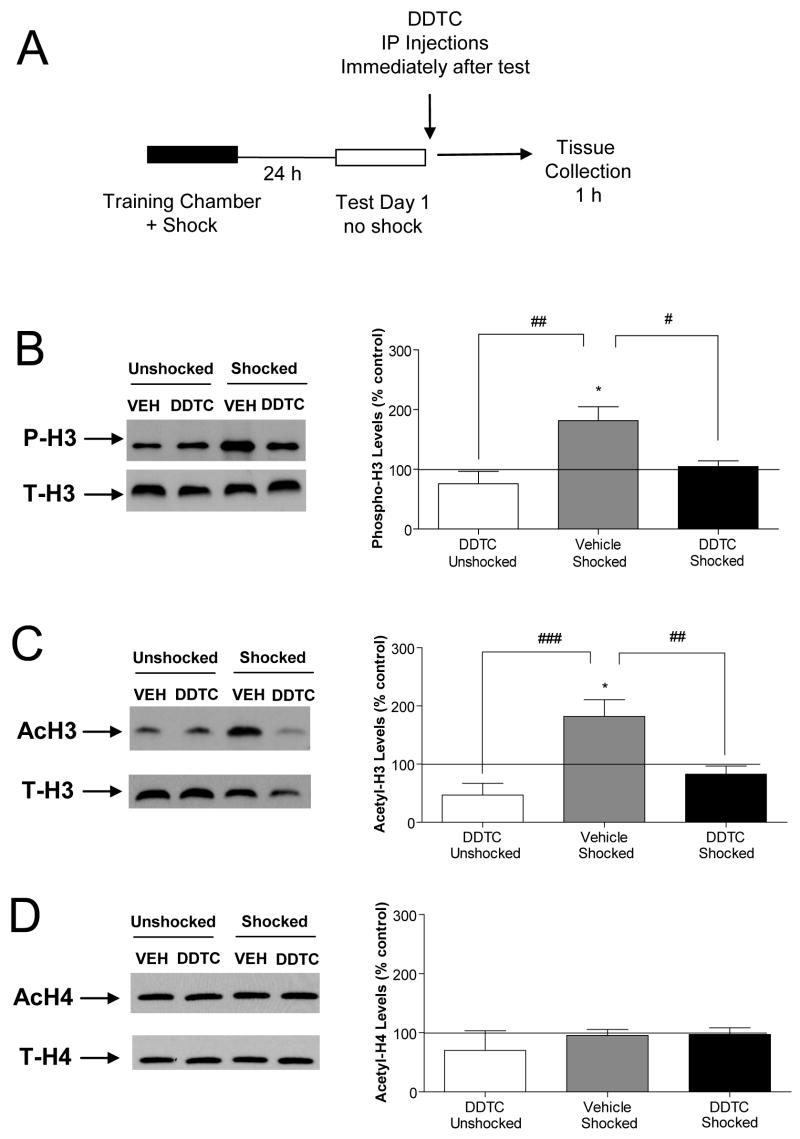
Regulation of histone H3 phosphorylation and acetylation is associated with activation of the NF-κB signaling pathway after context re-exposure. (A) Histone extracts from area CA1 were prepared from animals 1 h after DDTC or saline (vehicle) treatment. (B) Phosphorylated histone H3 (P-H3) levels were normalized to total histone H3 (T-H3) protein levels from area CA1. There were no changes in histone H3 modifications in area CA3 or dentate gyrus at 1 h after recall (Data not shown) (vehicle-unshocked, n=5; DDTC-unshocked, n=6; vehicle-shocked, n=9; DDTC-shocked, n=9). (C) Acetylated histone H3 levels (AcH3) levels were normalized to total histone H3 (T-H3) protein levels (vehicle-unshocked, n=6; DDTC-unshocked, n=6; vehicle-shocked, n=6; DDTC-shocked, n=9). (D) Acetylated H4 (AcH4) normalized to total histone H4 (T-H4) levels (vehicle-unshocked, n=4; DDTC-unshocked, n=4; vehicle-shocked, n=6; DDTC-shocked, n=6). Two-way ANOVA with post-hoc test; **p<0.01, ***p<0.001 compared with unshocked-DDTC, #p<0.05, ##p<0.01 compared with vehicle-shocked group. Error bars are SEM; Solid lines represent normalized vehicle-unshocked control levels.
Figure 5
Figure 5
Inhibition of IKKα effects contextual fear conditioned memories after re-exposure. (A) The experimental design used is shown with data presented below in panels B–E. (B) Freezing behavior of animals infused with either vehicle or SSZ immediately following re-exposure on Test Day 1 (Vehicle, n=6; SSZ, n=10). (C) Freezing behavior of animals during re-exposure on Test Day 2 (Vehicle, n=6; 5 mM SSZ n=5, 10 mM SSZ, n=5). (D) Assessment of freezing behavior 4 h after re-exposure (10 mM SSZ, n=6). (E) Western blots and graph summary of data for phosphorylated IKKα (P-IKKα) normalized to total IKKα (T-IKKα) levels are shown (Vehicle, n=5; 10 mM SSZ, n=5). (F) The binding activity for NF-κB measured 1 h after 10 mM SSZ treatment is shown. The specific band is indicated by an arrow. The specific NF-κB retarded band from the 10 mM SSZ treated group (n=4) was normalized to the Vehicle treated group (n=4). Two-way ANOVA with post-hoc test; *p<0.05, compared with Shocked-vehicle. Error bars are SEM; Solid lines represent normalized vehicle control levels. R.O.D. = relative optical density.
Figure 6
Figure 6
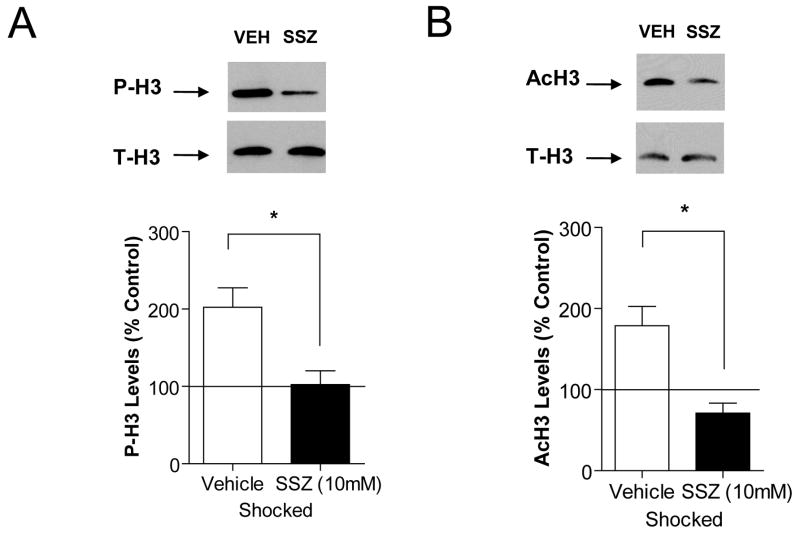
IKKα contributes to increases in histone H3 phosphorylation and acetylation during reconsolidation. (A) Quantitative analysis of phosphorylated histone H3 (P-H3) levels after re-exposure to the training chamber are shown. (unshocked, n=4; shocked-vehicle, n=4; shocked-SSZ, n=4). (B) Western blot analysis of acetylated histone H3 (AcH3) levels from area CA1 after 10 mM SSZ treatment. (naïve, n=4; shocked-vehicle, n=4; shocked-SSZ, n=4). One-way ANOVA; *p<0.05, compared with unshocked-vehicle. Error bars are SEM; Solid lines represent normalized unshocked-vehicle control levels.
Figure 7
Figure 7
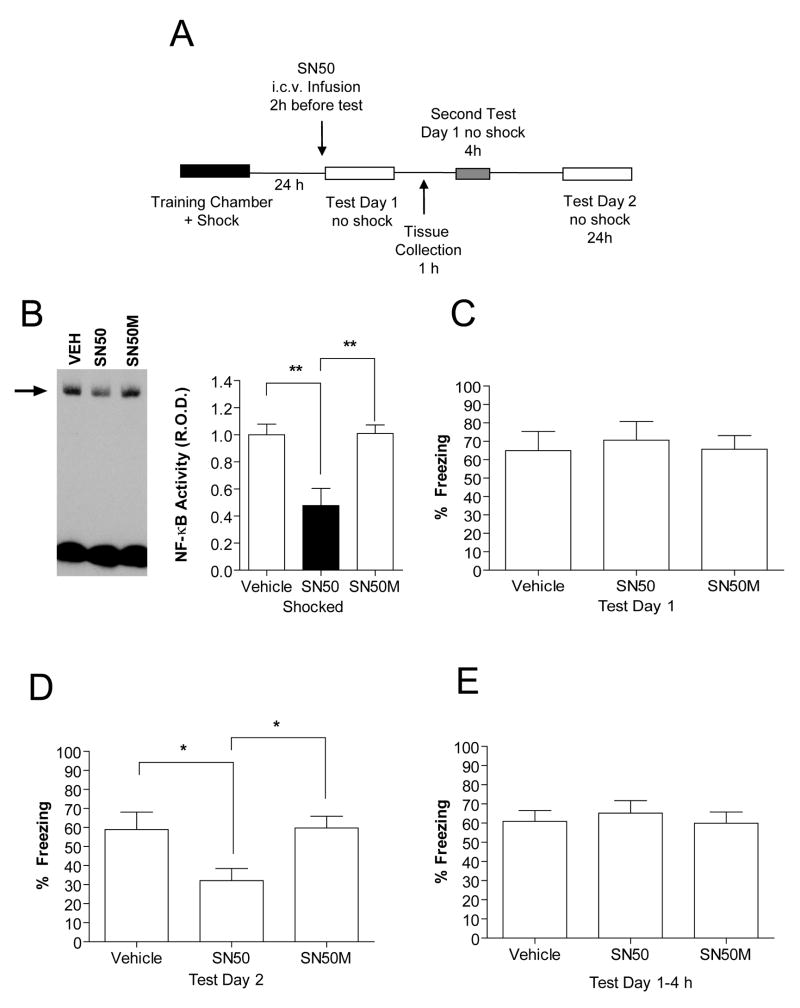
Effect of direct inhibition of the NF-κB transcriptional complex during reconsolidation. (A) Outline of the experimental procedure used. (B) Representative EMSA showing NF-κB binding activity [Relative optical density (R.O.D.)] in hippocampal nuclear extracts from animals injected with vehicle (VEH), SN50 or SN50M. Student’s t-test; **p<0.01. (C) On Test Day 1 performance of animals infused with either vehicle (n=8), the active peptide, SN50 (n=8) or the inactive peptide, SN50M (n=7). (D) Freezing behavior of SN50 treated animals (n=8) compared to vehicle (n=8) or SN50M (n=7) treated animals on Test Day 2. (E) Freezing behavior of vehicle, SN50M, or SN50-treated animals (n=5) 4 h after re-exposure. One-way ANOVA; **p<0.01, compared with Shocked-vehicle. Error bars are SEM.
Figure 8
Figure 8
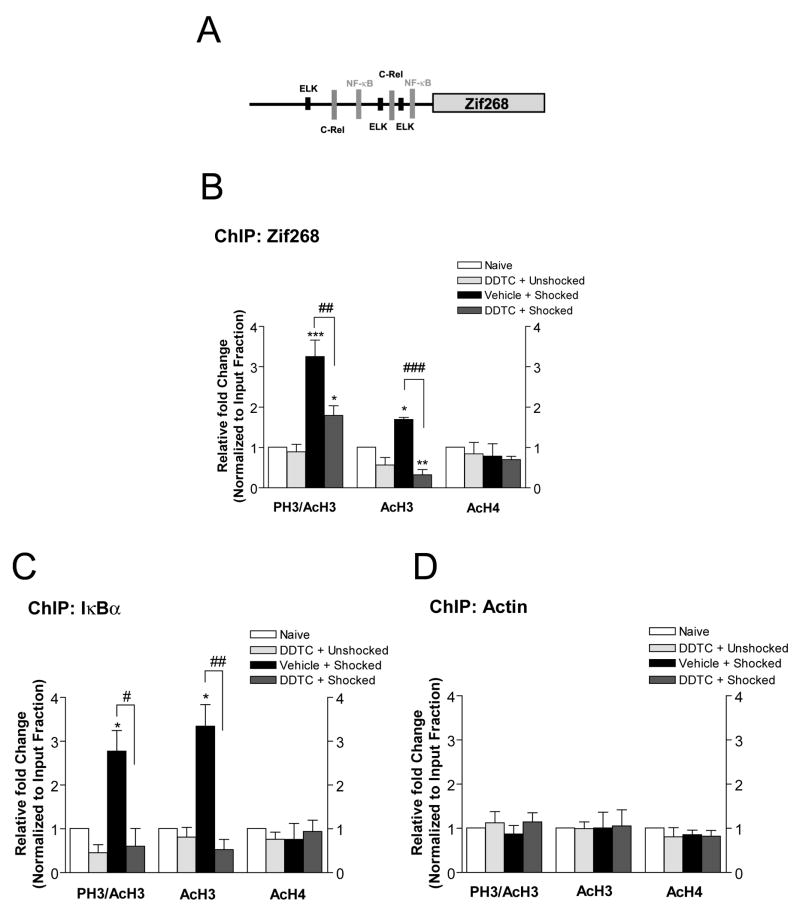
Inhibition of IKKα effects histone modifications around specific gene promoters. (A) NF-κB binding sites, including sites for the c-Rel NF-κB subunit and ELK, identified within 1 kbp promoter upstream sequences of the Zif268 gene (GenBank accession number M18416). (B) Histone modifications [H3 phosphoacetylation (PH3/AcH3), acetylation (AcH3), and histone H4 acetylation (AcH4)] at the Zif268 promoter. (C) Histone modifications at the IκBα promoter. (D) Histone modifications around the β-Actin promoter. One-way ANOVA; *p<0.05, ** p<0.01 compared with Naïve controls, #p<0.05, ##p<0.01, ###p<0.001 compared to shocked-DDTC, n=4. Error bars are SEM.
Figure 9
Figure 9
Effects of inhibition of the NF-κB signaling pathway on enhanced acetylation activity during memory reconsolidation. (A) Experimental design is outlined. (B) Freezing behavior following vehicle or sodium butyrate (NaB) treatment on Test Day 1 (vehicle, n=16; NaB, n=17). (C) Freezing behavior on Test Day 2 during 1 min re-exposure (vehicle, n=7; NaB, n=7; DDTC, n=8; NaB+DDTC, n=6). One-way ANOVA; *p<0.05, compared with shocked-vehicle, **p<0.05, compared with shocked-NaB, #p<0.05 compared to shocked-DDTC. Error bars are SEM.
Figure 10
Figure 10
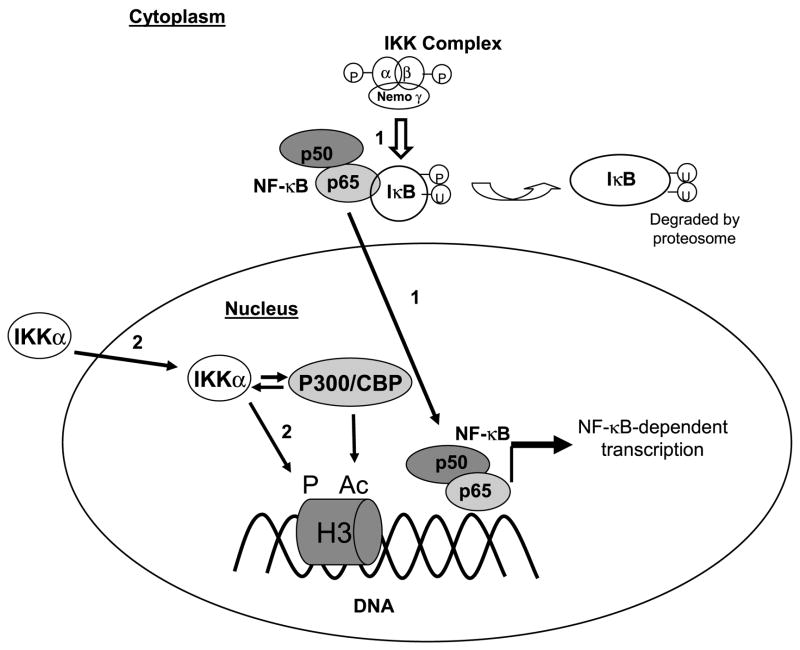
Model for the role of the IKKα kinase protein in the regulation of chromatin structure during long-term memory reconsolidation. Upon activation after memory recall, the IKKα kinase protein initiates two pathways for transcriptional regulation of genes: (1) The IKKα kinase protein at the IKK complex level functions to increase the DNA binding activity of the NF-κB complex for modulation of gene transcripts; (2) Additionally, the IKKα kinase protein acts independently from the IKK complex to mediate changes in chromatin structure that are apparent as an increase in phosphorylation of histone H3 and subsequent acetylation of histone H3 through its interaction with CBP. The changes in chromatin structure ultimately lead to changes in transcriptional regulation of genes relevant for re-stabilization of memory after retrieval.

References

    1. Alarcon JM, Malleret G, Touzani K, Vronskaya S, Ishii S, Kandel ER, Barco A. Chromatin acetylation, memory, and LTP are impaired in CBP+/− mice: a model for the cognitive deficit in Rubinstein-Taybi syndrome and its amelioration. Neuron. 2004;42:947–959. - PubMed
    1. Albensi BC, Mattson MP. Evidence for the involvement of TNF and NF-kappaB in hippocampal synaptic plasticity. Synapse. 2000;35:151–159. - PubMed
    1. Anest V, Cogswell PC, Baldwin AS., Jr IkappaB kinase alpha and p65/RelA contribute to optimal epidermal growth factor-induced c-fos gene expression independent of IkappaBalpha degradation. J Biol Chem. 2004;279:31183–31189. - PubMed
    1. Anest V, Hanson JL, Cogswell PC, Steinbrecher KA, Strahl BD, Baldwin AS. A nucleosomal function for IkappaB kinase-alpha in NF-kappaB-dependent gene expression. Nature. 2003;423:659–663. - PubMed
    1. Ashburner BP, Westerheide SD, Baldwin AS., Jr The p65 (RelA) subunit of NF-kappaB interacts with the histone deacetylase (HDAC) corepressors HDAC1 and HDAC2 to negatively regulate gene expression. Mol Cell Biol. 2001;21:7065–7077. - PMC - PubMed

Publication types

MeSH terms

LinkOut - more resources