Review
. 2007 Nov 15;31(8):1614-24.
doi: 10.1016/j.pnpbp.2007.08.028. Epub 2007 Aug 28.

How to make a rat addicted to cocaine

Affiliations
Review

How to make a rat addicted to cocaine

David C S Roberts et al. Prog Neuropsychopharmacol Biol Psychiatry. .

Abstract

Procedures have been developed which provide extremely stable patterns of cocaine self-administration in rats and these have been useful in lesion and drug pretreatment studies aimed at understanding the neurobiology of cocaine reinforcement. The issue now is whether studying the neurobiology of reinforcement is the same as studying the neurobiology of addiction. If the goal is to understand a progressive and deteriorating disorder, then the self-administration procedures should model specific aspects of the progressive stages of the addiction process. Here we review theoretical strategies for modeling the addiction process and present data from a series of experiments from our laboratory showing conditions which produce a progressive change in the motivation to self-administer cocaine in rats. This phenomenon is revealed by an escalation in breakpoints on a progressive ratio schedule. The effect, which is robust and persistent, depends on dose and speed of injection. Interestingly, high drug intake can retard the development of this effect, which we argue indicates that the addiction process has a developmental sequence. Finally, we suggest that specific parameters (dose, price and availability) can be used to examine the transition from recreational use to binge-like intake.


Figures
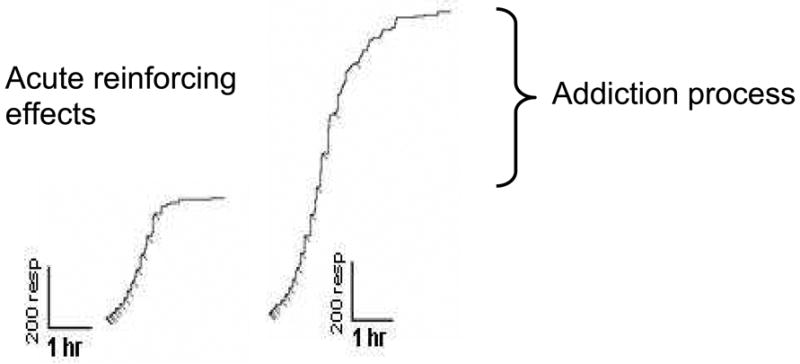
Figure 1
Figure 1
Cumulative records for a representative rat self-administering cocaine (1.5 mg/kg/inj) on a PR schedule of reinforcement. The record on the left represents the acute reinforcing effects of cocaine. Presumably if the breakpoint were to escalate over time this would reflect an addiction process, as represented in the record on the right. Tick marks on the records indicate a drug infusion in this and subsequent figures.
Figure 2
Figure 2
Cocaine self-administration induced increases in cocaine’s reinforcing effects. The left panel represents mean (± SEM) breakpoints maintained by cocaine (1.5 mg/kg/inj) delivered on a PR schedule across sessions. The right panel shows an event record from experimental day 0 (FR schedule; this shows 14 hours of a session) and cumulative records from days 1, 6 and 14 (PR schedule; the scale goes to 5 hours) for a representative rat. Horizontal lines represent breakpoints (± SEM) from the previous published papers from this laboratory. Adapted from Morgan et al. (2006)
Figure 3
Figure 3
The increases in cocaine’s reinforcing effects are dose-dependent. Data are expressed as mean (± SEM) breakpoints. Animals self-administered 20 injections of cocaine (0.75 mg/kg/inj) during the initial exposure. Breakpoints maintained by 0.75 and 1.5 mg/kg/inj significantly increased across days; in contrast, 0.38 or 3.0 mg/kg/inj failed to induce such changes. Adapted from Liu et al. (2005a).
Figure 4
Figure 4
Breakpoints supported by a high dose of cocaine (3.0 mg/kg/inj) depend on drug history. Points represent mean (± SEM) breakpoints maintained by cocaine 1.5 mg/kg/inj (open symbols) or 3.0 mg/kg/inj (closed symbols). The higher dose supported significantly higher breakpoints after a period of escalation on the lower dose.
Figure 5
Figure 5
Injection speed significantly influences escalation of cocaine-reinforced breakpoints. Mean (± SEM) breakpoints maintained by cocaine (1.5 mg/kg/inj) delivered over 5, 25 and 50 seconds. The fastest injection speed (5s) resulted in progressive increases in breakpoints, whereas longer durations of drug delivery (25 and 50s) failed to result in escalation. Adapted from Liu et al. (2005a).
Figure 6
Figure 6
Cocaine intake during initial exposure is critical to the escalation of cocaine-reinforced breakpoints. In the left panel, event records of representative rats having different levels of cocaine intake during FR testing are shown. The right panel represents mean (± SEM) breakpoints maintained by cocaine (1.5 mg/kg/inj) delivered on a PR schedule across sessions. Limited intake during initial access to cocaine resulted in increases in breakpoints over sessions. High levels of cocaine consumption prevented such increases. Adapted from Morgan et al. (2006).
Figure 7
Figure 7
High levels of cocaine intake only transiently alter the escalated breakpoints. The left panel shows the mean (± SEM) breakpoints produced by rats receiving limited (Group D) or extended exposure (Group E) during baseline. The middle panel shows event records for two representative rats with high levels of cocaine intake (60 mg/kg/day) for 5 days. The right panel shows the mean (± SEM) breakpoints produced by Group D or E following high levels of cocaine self-administration. High levels of cocaine consumption only transiently influence the reinforcing effects of cocaine after escalation. Adapted from Morgan et al. (2006).
Figure 8
Figure 8
Circadian pattern of cocaine self-administration (1.5 mg/kg/inj) appears when access is limited to 3 discrete trials per hour. Each row represents one 24 hour period. Injections are denoted by an upward line. A dot denotes a trial in which the rat declined to self-administer. Cocaine was provided for 21 consecutive days. The horizontal line at the top indicates the dark phase of the cycle.
Figure 9
Figure 9
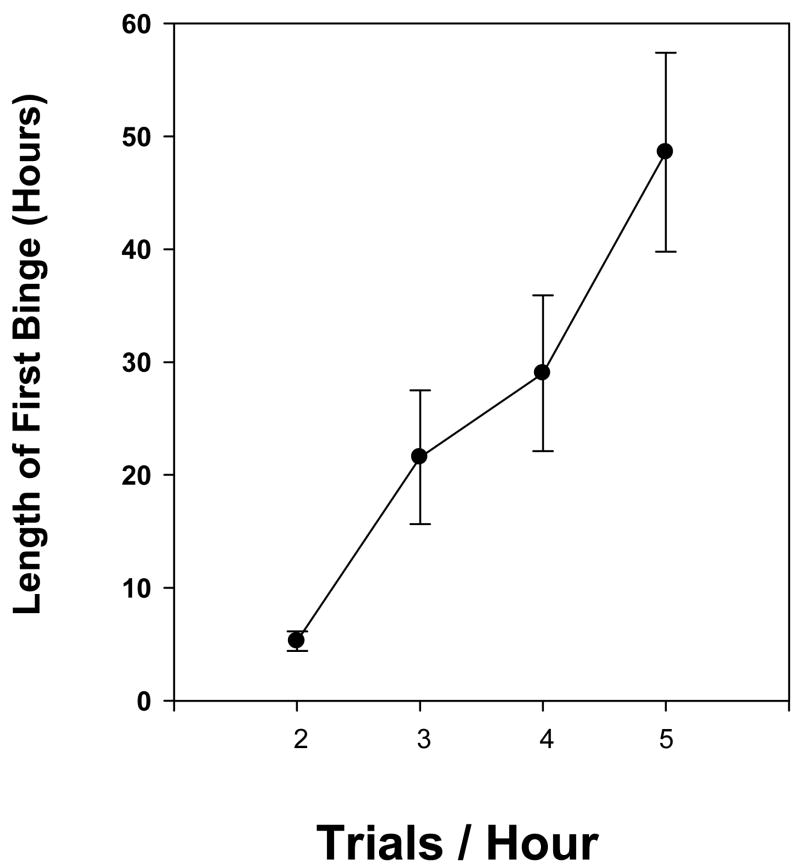
Increasing the number of trials per hour resulted in a significant increase in the duration of the binge. Data represent the mean (± SEM) length in hours of the first cocaine binge (defined as a series of injections with periods of cocaine abstinence no longer than 1 h).

References

    1. Ahmed SH, Kenny PJ, Koob GF, Markou A. Neurobiological evidence for hedonic allostasis associated with escalating cocaine use. Nat Neurosci. 2002;5:625–626. - PubMed
    1. Ahmed SH, Koob GF. Transition from moderate to excessive drug intake: change in hedonic set point. Science. 1998;282:298–300. - PubMed
    1. Ahmed SH, Koob GF. Transition to drug addiction: a negative reinforcement model based on an allostatic decrease in reward function. Psychopharm. 2005;180:473–490. - PubMed
    1. Bannon M, Kapatos G, Albertson D. Gene expression profiling in the brains of human cocaine abusers. Addict Biol. 2005;10:119–126. - PMC - PubMed
    1. Bedford JA, Bailey LP, Wilson MC. Cocaine reinforced progressive ratio performance in the rhesus monkey. Pharmacol Biochem Behav. 1978;9:631–638. - PubMed

Publication types