Review
. 2008 Jan;153(2):216-25.
doi: 10.1038/sj.bjp.0707466. Epub 2007 Sep 24.

CB2 cannabinoid receptors as an emerging target for demyelinating diseases: from neuroimmune interactions to cell replacement strategies

Affiliations
Review

CB2 cannabinoid receptors as an emerging target for demyelinating diseases: from neuroimmune interactions to cell replacement strategies

A Arévalo-Martín et al. Br J Pharmacol. 2008 Jan.

Abstract

Amongst the various demyelinating diseases that affect the central nervous system, those induced by an inflammatory response stand out because of their epidemiological relevance. The best known inflammatory-induced demyelinating disease is multiple sclerosis, but the immune response is a common pathogenic mechanism in many other less common pathologies (e.g., acute disseminated encephalomyelitis and acute necrotizing haemorrhagic encephalomyelitis). In all such cases, modulation of the immune response seems to be a logical therapeutic approach. Cannabinoids are well known immunomodulatory molecules that act through CB1 and CB2 receptors. While activation of CB1 receptors has a psychotropic effect, activation of CB2 receptors alone does not. Therefore, to bypass the ethical problems that could result from the treatment of inflammation with psychotropic molecules, considerable effort is being made to study the potential therapeutic value of activating CB2 receptors. In this review we examine the current knowledge and understanding of the utility of cannabinoids as therapeutic molecules for inflammatory-mediated demyelinating pathologies. Moreover, we discuss how CB2 receptor activation is related to the modulation of immunopathogenic states.


Figures
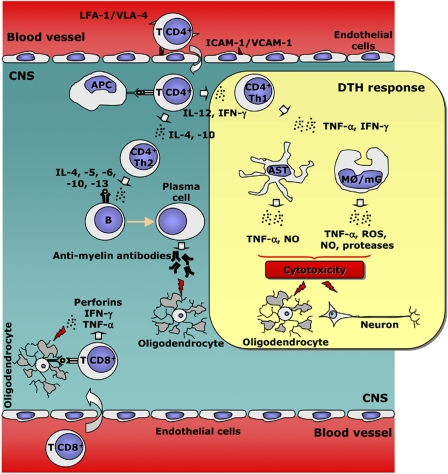
Figure 1
Figure 1
Hypothetic immune-mediated demyelinating disease pathogenesis. Primed CD4+ T lymphocytes migrate to the CNS through blood vessels enriched in adhesion molecules. Once in the CNS, DCs or macrophages/microglia acting as APC present the antigen to antigen-specific CD4+ lymphocytes. Depending on the environmental signals that these cells receive, the CD4+ lymphocytes acquire different T helper (Th) phenotypes. Th1 cells will establish an antigen-specific DTH response that will lead to the liberation of several cytotoxic molecules by the Th1 themselves, astrocytes and microglia/macrophages. In addition, the generation of the Th2 phenotype will result in the activation of infiltrated B cells into plasma cells that will secrete antibodies against myelin antigens. This response has been related both with oligodendroglial damage and recovery. Even though their pathogenic contribution to MS and EAE is not clear, CD8+ T cells recognize specific antigens and they may elaborate a cytotoxic response against the cells that presented the antigen. CNS, central nervous system; DCs, dendritic cells; DTH, delayed-type hypersensitivity; EAE, experimental allergic encephalomyelitis; LFA-1, lymphocyte function-associated antigen-1; MS, multiple sclerosis; VLA-4, very late activation antigen-4.
Figure 2
Figure 2
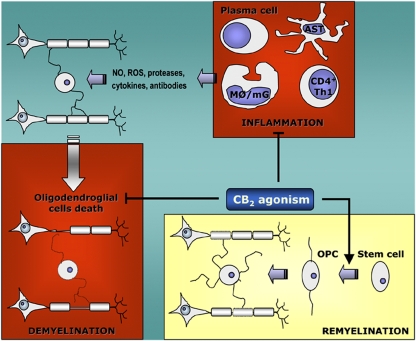
Points of interaction of CB2 receptors with the pathogenesis of demyelinating diseases. The activation of CB2 receptors decreases the deleterious inflammatory response that results in the death of both oligodendrocyte progenitors and mature oligodendrocytes in immune-mediated demyelinating pathologies. Also, CB2 stimulation in oligodendroglial cells promotes their survival and therefore, CB2 agonists may be useful in other non-immune-mediated demyelinating pathologies. In addition, the activation of CB2 receptors may not only have an effect in protecting from demyelination but also, in promoting repair. In this sense, CB2 agonists promote the proliferation of neural stem/precursor cells and increase the expression of migration-related molecules such as PSA-NCAM in the SVZ. Therefore, CB2 receptor agonists could be therapeutic molecules that prevent the loss of myelin and promote the activation of the neural stem/precursor cells involved in the recovery of the myelin sheath. PSA-NCAM, polysialylated neural cell adhesion molecule; SVZ, subventricular zone.

References

    1. Aguado T, Monory K, Palazuelos J, Stella N, Cravatt B, Lutz B, et al. The endocannabinoid system drives neural progenitor proliferation. FASEB J. 2005;19:1704–1706. - PubMed
    1. Alvarez-Buylla A, Lim DA. For the long run: maintaining germinal niches in the adult brain. Neuron. 2004;41:683–686. - PubMed
    1. Arévalo-Martín A, Vela JM, Molina-Holgado E, Borrell J, Guaza C. Therapeutic action of cannabinoids in a murine model of multiple sclerosis. Neuroscience. 2003;23:2511–2516. - PMC - PubMed
    1. Arevalo-Martin A, Garcia-Ovejero D, Rubio-Araiz A, Gomez O, Molina-Holgado F, Molina-Holgado E.Cannabinoids modulate OLIG2 and PSA-NCAM expression in the subventricular zone of postnatal rats through CB1 and CB2 receptors Eur J Neurosci 2007. e-pub ahead of print: doi:10.1111/j.460-9568.2007.05782
    1. Back SA, Han BH, Lou NL, Chricton CA, Xanthoudakis S, Tam J, et al. Selective vulnerability of late oligodendrocyte progenitors to hypoxia–ischemia. J Neurosci. 2002;22:455–463. - PMC - PubMed

Publication types

MeSH terms

Substances