


Meeting the imperative to improve physician well-being: assessment of an innovative program
- PMID: 17891503
- PMCID: PMC2219814
- DOI: 10.1007/s11606-007-0363-5
Meeting the imperative to improve physician well-being: assessment of an innovative program
Abstract
Background: Improving physician health and performance is critical to successfully meet the challenges facing health systems that increasingly emphasize productivity. Assessing long-term efficacy and sustainability of programs aimed at enhancing physician and organizational well-being is imperative.
Objective: To determine whether data-guided interventions and a systematic improvement process to enhance physician work-life balance and organizational efficacy can improve physician and organizational well-being.
Design and participants: From 2000 to 2005, 22-32 physicians regularly completed 3 questionnaires coded for privacy. Results were anonymously reported to physicians and the organization. Data-guided interventions to enhance physician and organizational well-being were built on physician control over the work environment, order in the clinical setting, and clinical meaning.
Measurements: Questionnaires included an ACP/ASIM survey on physician satisfaction, the Maslach Burnout Inventory (MBI), and the Quality Work Competence (QWC) survey.
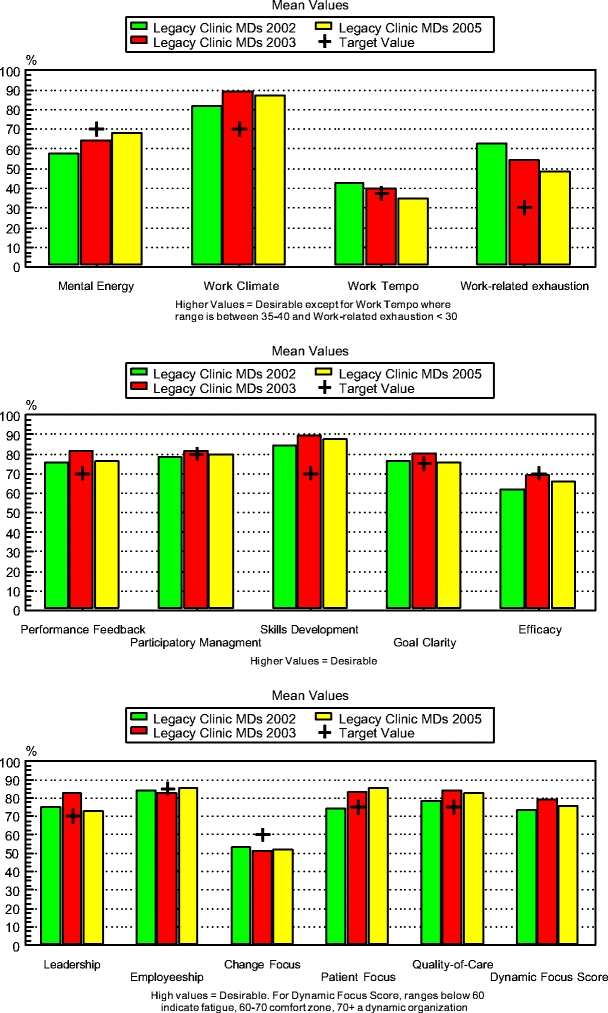
Results: Emotional and work-related exhaustion decreased significantly over the study period (MBI, p = 0.002; QWC, p = 0.035). QWC measures of organizational health significantly improved initially and remained acceptable and stable during the rest of the study.
Conclusions: A data-guided program on physician well-being, using validated instruments and process improvement methods, enhanced physician and organizational well-being. Given the increases in physician burnout, organizations are encouraged to urgently create individual and systems approaches to lessen burnout risk.
Figures
References
-
- Williams ES, Konrad TR, Scheckler WE, et al. Understanding physicians’ intentions to withdraw from practice: the role of job satisfaction, job stress, mental and physical health. Health Care Manage Rev. 2001;26:7–19. - PubMed
-
- Crane M. Why burned-out doctors get sued more often. Med Econ. 1998;75:210–2, 215–8. - PubMed
-
- Myers MF. Doctors’ Marriages. A Look at the Problems and their Solutions. Second Edition. New York: Plenum Medical Book Company; 1994.
MeSH terms
LinkOut - more resources
Full Text Sources
Medical
