. 2007 Oct 2;104(40):15781-6.
doi: 10.1073/pnas.0707763104. Epub 2007 Sep 24.

Aquatic eutrophication promotes pathogenic infection in amphibians

Affiliations

Aquatic eutrophication promotes pathogenic infection in amphibians

Pieter T J Johnson et al. Proc Natl Acad Sci U S A. .

Abstract

The widespread emergence of human and wildlife diseases has challenged ecologists to understand how large-scale agents of environmental change affect host-pathogen interactions. Accelerated eutrophication of aquatic ecosystems owing to nitrogen and phosphorus enrichment is a pervasive form of environmental change that has been implicated in the emergence of diseases through direct and indirect pathways. We provide experimental evidence linking eutrophication and disease in a multihost parasite system. The trematode parasite Ribeiroia ondatrae sequentially infects birds, snails, and amphibian larvae, frequently causing severe limb deformities and mortality. Eutrophication has been implicated in the emergence of this parasite, but definitive evidence, as well as a mechanistic understanding, have been lacking until now. We show that the effects of eutrophication cascade through the parasite life cycle to promote algal production, the density of snail hosts, and, ultimately, the intensity of infection in amphibians. Infection also negatively affected the survival of developing amphibians. Mechanistically, eutrophication promoted amphibian disease through two distinctive pathways: by increasing the density of infected snail hosts and by enhancing per-snail production of infectious parasites. Given forecasted increases in global eutrophication, amphibian extinctions, and similarities between Ribeiroia and important human and wildlife pathogens, our results have broad epidemiological and ecological significance.


Conflict of interest statement

The authors declare no conflict of interest.

Figures
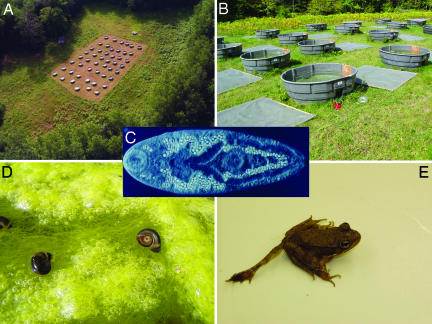
Fig. 1.
Fig. 1.
Experimental setup. Bird's eye (A) and local (B) views of outdoor mesocosms used to investigate effects of nutrient enrichment on host–parasite interactions. Nutrients (N and P) and trematode eggs were added to mesocosms in a factorial experiment to understand how anthropogenic eutrophication influenced transmission of a multihost pathogen. The pathogenic trematode R. ondatrae (C, excysted metacercariae) uses pulmonate snails (D) as first intermediate hosts and amphibians as second intermediate hosts. Nutrient enrichment was hypothesized to promote algal growth, leading to an increase in the density and biomass of herbivorous snail hosts, thereby enhancing parasite transmission into snails. Infected snails with high resource availability were also expected to produce more parasite cercariae, increasing the risk of amphibian infection and pathology. In amphibians, Ribeiroia infection induces severe limb malformations (E) by disturbing the developing limb field.
Fig. 2.
Fig. 2.
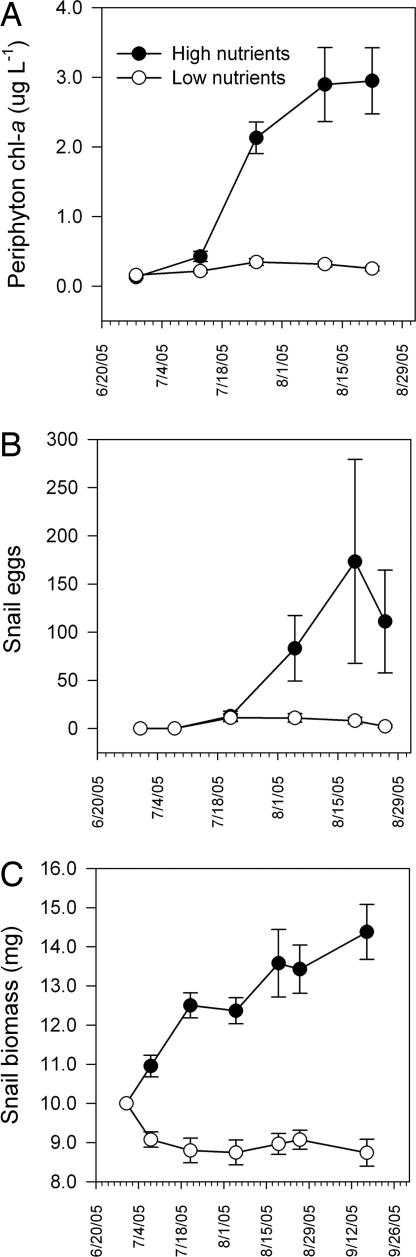
Effects of nutrient enrichment on algal and snail growth. Nutrient enrichment significantly enhanced periphyton chl a (A) (RM-ANOVA, nutrients: F[1,30] = 75.93, P < 0.0001; time × nutrients: Greenhouse–Geisser corrected F[2.061,120] = 23.747, P < 0.0001), snail egg production (B) (RM-ANOVA, nutrient status: F[1,30] = 9.803, P = 0.004; time × nutrients: Greenhouse–Geisser adjusted F[2.58,77.39] = 6.92, P = 0.001), and dry mass of the snail host population (P. trivolvis) (C) (RM-ANOVA, nutrients: F[1,30] = 68.46, P < 0.0001; time × nutrients: Greenhouse–Geisser corrected F[2.96, 88.88] = 21.802, P < 0.0001). Snail density was converted to total dry mass by using the following equation (mass in grams = 0.0002 × [length in mm]2.7232; R2 = 0.96). Values are mean ± 1 SE and are pooled among parasite egg treatments, because parasite level did not significantly affect measured response variables.
Fig. 3.
Fig. 3.
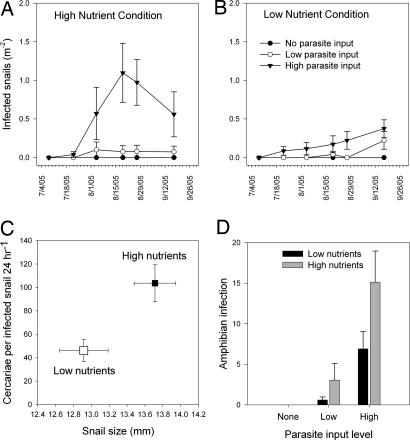
Influence of eutrophication on Ribeiroia infection in snails and amphibians. Effects of Ribeiroia egg input level on the density of infected snail hosts (P. trivolvis) under high-nutrient conditions (A) and under low-nutrient conditions (B) (parasite input: F[2,30] = 18.917, P < 0.0001; nutrients: F[1,30] = 11.079, P = 0.001; parasite × nutrients: F[2,30] = 8.368, P = 0.001). (C) Influence of nutrient condition and snail size (log10-transformed) on the per capita production of cercariae by infected snails (with snails nested within mesocosm and date sampled; mixed-model analysis, nutrients: F[1,31.477] = 5.20, P = 0.03; snail size: F[1,87.09] = 28.604, P < 0.0001). (D) Mean abundance of Ribeiroia metacercariae within larval green frogs as a function of Ribeiroia egg input level and nutrient condition (ANOVA, parasite input: F[2,28] = 19.27, P < 0.0001; nutrient input: F[1,28] = 5.289, P = 0.02). No metacercariae were recovered from amphibians in the “no-parasite” treatment. Values are mean ± 1 SE.

References

    1. Harvell CD, Mitchell CE, Ward JR, Altizer S, Dobson AP, Ostfeld RS, Samuel MD. Science. 2002;296:2160–2162. - PubMed
    1. Kiesecker JM. Proc Natl Acad Sci USA. 2002;99:9900–9904. - PMC - PubMed
    1. Pope K, Masuoka P, Rejmánková E, Grieco J, Johnson S, Roberts D. Ecol Appl. 2005;15:1223–1232.
    1. Patz JS, Campbell-Lendrum D, Holloway T, Foley JA. Nature. 2005;438:310–317. - PubMed
    1. Daszak P, Cunningham AA, Hyatt AD. Science. 2000;287:443–449. - PubMed

Publication types